What is the schedule for the UNGA for today? Who is speaking and when?
Asked 29 times
Today, September 25, is Day 4 of the 81st UN General Debate, running two sessions at UN Headquarters in New York, and it also hosts a dedicated High-level Meeting on Pandemic Prevention, Preparedness and Response.

Here is the full list of speakers for Day 4 of the general debate at the 81st UN General Assembly, Friday, September 25, in speaking order. Speakers are asked to keep to about 15 minutes, so exact times drift through the day.
Morning session (9:00 AM to 2:45 PM EDT)
- 1. Kiribati: President Taneti Maamau
- 2. Maldives: Vice President Hussain Mohamed Latheef
- 3. Iraq: Prime Minister Ali Falih Al-Zaidi
- 4. Lebanon: President of the Council of Ministers Nawaf Salam
- 5. Monaco: Minister of State Christophe Mirmand
- 6. Marshall Islands: President Hilda Heine
- 7. Malta: Prime Minister Robert Abela
- 8. Lesotho: Prime Minister Samuel Ntsokoane Matekane
- 9. Tuvalu: Prime Minister Feleti Teo
- 10. North Macedonia: President of the Government Hristijan Mickoski
- 11. Solomon Islands: Prime Minister Mathew Cooper Wale
- 12. Saint Lucia: Prime Minister Philip Pierre
- 13. Albania: Prime Minister Edi Rama
- 14. Pakistan: Prime Minister Muhammad Shehbaz Sharif
- 15. Papua New Guinea: Prime Minister James Marape
- 16. Niger: Prime Minister of the Transition Government Lamine Zeine Ali Mahaman
- 17. Bahamas: Prime Minister Philip Edward Davis
- 18. Haiti: Prime Minister Alix Didier Fils-Aimé
Afternoon session (3:00 PM to 9:00 PM EDT)
- 19. Guinea-Bissau: Prime Minister Ilídio Vieira Té
- 20. Egypt: Prime Minister Moustafa Kamal Madbouly
- 21. Saint Vincent and the Grenadines: Prime Minister Godwin Friday
- 22. Tonga: Prime Minister Lord Fakafanua
- 23. Samoa: Deputy Prime Minister Mulipola Anarosa Ale Molioo
- 24. Saint Kitts and Nevis: Deputy Prime Minister Geoffrey Hanley
- 25. Bahrain: Minister for Foreign Affairs Abdullatif bin Rashid Al Zayani
- 26. Azerbaijan: Minister for Foreign Affairs Jeyhun Aziz oglu Bayramov
- 27. Kazakhstan: Minister for Foreign Affairs Mukhtar Tileuberdi
- 28. Mauritania: Minister for Foreign Affairs, African Cooperation and Mauritanians Abroad Mohamed Salem Merzoug
- 29. Mexico: Minister for Foreign Affairs Roberto Velasco Álvarez
- 30. Mauritius: Minister for Foreign Affairs Dhananjay Ramful
- 31. Chad: Minister of Public Health and Prevention Abdelmadjid Abdelrahim Mahamat
- 32. Norway: Minister for Foreign Affairs Espen Barth Eide
- 33. Guatemala: Minister for Foreign Affairs Carlos Ramiro Martínez Alvarado
- 34. Sweden: Minister for Foreign Affairs Maria Malmer Stenergard
- 35. Togo: Minister for Foreign Affairs, Regional Integration, and Togolese Abroad Robert Komlan Edo Dussey
The General Debate, the annual gathering where all 193 UN member states take the podium, runs two blocks every day: morning from 9:00 am to 2:45 pm New York time (1:00 pm to 6:45 pm GMT) and afternoon from 3:00 pm to 9:00 pm New York time (7:00 pm to 1:00 am GMT). Each speaker is asked to keep to a voluntary 15-minute limit, though sessions run until everyone scheduled for the day has spoken.
The precise order for today isn't fixed in advance beyond the provisional list. Speakers frequently shift as delegations adjust travel and other commitments, and the actual running order is confirmed each morning.
Also happening today
Alongside the General Debate, the UN is holding a High-level Meeting on Pandemic Prevention, Preparedness and Response, a standalone event at UN Headquarters tied to the 81st session's broader agenda. This is separate from the General Debate floor speeches and focuses specifically on global health security.
Where to follow it live
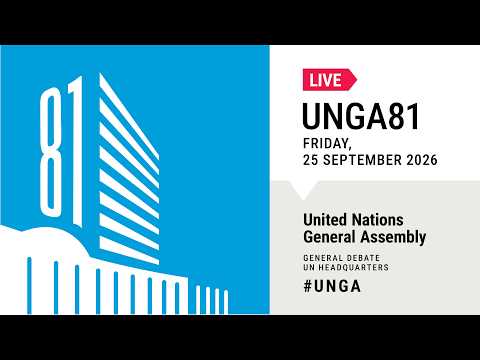 Watch Day 4 live on the UN's YouTube channel
UN Web TVWatch live on UN Web TV
- The daily speakers list: gadebate.un.org
- The Journal of the United Nations: journal.un.org
Follow-ups
What is the Loss and Damage Fund? The Loss and Damage Fund, now officially called the Fund for Responding to Loss and Damage (FRLD), is the first global financial mechanism designed to help developing countries cope with the climate impacts they can no longer avoid, impacts they did almost nothing to cause.
 spio.com
It is the mechanism President Hilda Heine of the Marshall Islands was pressing for when she told the 81st UN General Assembly that the world needs to wake up and act. For low-lying Pacific and African nations like hers and Niger, this is not an abstract policy debate: it is about who pays when your coast disappears.
What "loss and damage" actually means
Loss and damage refers to the negative consequences that arise from the unavoidable risks of climate change: rising sea levels, prolonged heatwaves, desertification, acidification of the sea, and extreme events such as bushfires, species extinction and crop failures. The key word is "unavoidable." These are harms that mitigation, cutting emissions, and adaptation, building seawalls or drought-resistant crops, can no longer prevent. They are already happening.
The fund's aim is to provide financial support to the world's most vulnerable countries as they deal with devastating climate impacts they did little to cause. Since the concept was first proposed in 1991, progress had been painfully slow, blocked repeatedly by wealthy nations wary of financial liability.
How it came to exist
The formal concept of loss and damage originated in 2013 at COP19 in Warsaw, Poland, with the establishment of the Warsaw International Mechanism for Loss and Damage. Progress crawled for a decade. At COP27 in Sharm El-Sheikh, Egypt, parties agreed to establish a loss and damage fund and a Transitional Committee to make recommendations for operationalization at COP28. At COP28 in Dubai, countries formally agreed on how the fund would be structured and governed, solidifying its role as the first truly global fund for responding to climate-induced loss and damage.
The deal created a fund in which countries responsible for high carbon emissions would compensate vulnerable countries suffering from climate impacts. The fund would initially draw on contributions from developed countries and other private and public sources. While major emerging economies such as China would not initially be required to contribute, that option remains on the table.
Where it stands now
As of early 2025, a total of $768.4 million had been pledged to the fund by 27 contributors. At an initial pledging session at COP28, wealthy governments offered around $820 million to the fund, of which only 55% has been delivered into its coffers.
The fund launched an early call for proposals under its Barbados Implementation Modalities for 2025 to 2026, financing country-led initiatives to address climate-change-induced loss and damage, with a total envelope of $250 million. Grants range from $5 to $20 million per project, prioritizing national-scale interventions in the most climate-vulnerable countries.
The hard problem: the money is nowhere near enough
Despite not yet paying out any money as of mid-2026, the fund could face liquidity issues by the end of next year. With ten projects already requesting $166 million in total, the fund's Executive Director Ibrahima Cheikh Diong warned a board meeting in Zambia that the fund was likely to be oversubscribed.
Some governments, particularly in small island states and parts of Africa, have raised concerns about slow disbursement timelines, access barriers, and a lack of transparency around how decisions are made. Meanwhile, major contributors like the United States have already pulled out, casting uncertainty over the fund's future.
For countries like Niger and the Marshall Islands, that gap is not a budget line: it is the difference between rebuilding after a flood and not rebuilding at all.
How low-lying is the Marshall Islands and how much of it is at risk from rising seas? At its highest point, the Marshall Islands stands just two meters above sea level — that is the peak, not the average.
 spio.com
With an average elevation of just seven feet above sea level, the Republic of the Marshall Islands is acutely vulnerable to inundation from both episodic events such as storm surge and chronic conditions such as sea-level rise. Seven feet sounds like something you could stand in, until you remember that a storm surge or king tide doesn't need to overtop you permanently to destroy a freshwater lens, flood a hospital or salt a crop field.
The Marshall Islands is a string of atolls in the central Pacific Ocean and consists of 29 atolls, with sea levels rising at twice the global average rate. An atoll is a ring-shaped coral reef that barely clears the surface of the ocean, enclosing a lagoon. It is not a volcanic island with a mountain at its center. It is essentially a thin strip of coral sand sitting in open water.
What is at risk
The atolls of the Marshall Islands are some of the most at-risk areas in the world as sea level continues to rise.
The numbers from the capital tell the story plainly. A World Bank study found that rising sea levels are projected to endanger 40% of existing buildings in the capital, Majuro, with 96% of the city at risk of frequent flooding induced by climate change. That is not some distant scenario: already, residents are facing extreme high tides and 16-foot swells that flood the islands with saltwater, damaging homes and infrastructure and contaminating the freshwater supply.
The risk scales sharply with every centimeter gained. A 1-meter sea level rise will mean 40% of the buildings in Majuro would be permanently inundated, and entire islands will disappear, according to a study by the Marshall Islands government and the World Bank. In Ebeye, the risk is even higher, with 50% of buildings being permanently flooded under the same scenario. With a 2-meter sea level rise, all the buildings of Majuro will be permanently flooded or at high risk of flooding.
Some projections estimate that future sea-level rise could exceed the average elevation of these islands by 2100. When the sea exceeds your highest point, there is no higher ground to retreat to.
The threat that arrives before the flooding
Research suggests the loss of freshwater resources could make the islands uninhabitable long before they might sink below the ocean waves. Saltwater infiltrating the underground freshwater lens, the thin bubble of fresh water beneath each island, is a slower but equally decisive threat. You don't need the island to disappear to make it unlivable. You just need the water to go bad.
This is the existential arithmetic behind President Hilda Heine of the Marshall Islands pressing for the Loss and Damage Fund at the 81st UN General Assembly. The country emits almost nothing, sits on nothing tall enough to save it, and is already paying the price.
What were the highlights, key points, priorities and notable excerpts and quotes in Taneti Maamau's speech at the UN General Assembly? President Taneti Maamau of Kiribati, who also serves as his country's Minister for Foreign Affairs and Immigration, opened Watch Day 4 of the 81st UN General Debate as the first speaker, delivering a speech centred on climate resilience, ocean governance, nuclear-free oceans, and the urgent need for reformed internatio
nal financing for small island states.
 spio.com
Here are the highlights and excerpts from the address by President Taneti Maamau of the Republic of Kiribati at the 81st UN General Assembly.
What follows draws on the official text of Kiribati's national statement delivered to the 80th session, which Maamau personally delivered and which the Pacific Islands Forum Secretariat published in full, combined with his confirmed speaking themes at this session. His framing and priorities have been highly consistent across sessions. The official text for today will appear at gadebate.un.org and forumsec.org when published.
Highlights
- Climate resilience, not retreat. Maamau consistently pushes back on the narrative that Kiribati is simply "sinking." His government's position is that traditional and modern adaptation strategies can allow the I-Kiribati people, the indigenous residents of Kiribati, to remain on their islands, and he calls on the world to limit warming to 1.5°C. He has called the International Court of Justice's landmark ruling giving legal permanence to maritime zones regardless of sea-level rise "firm hope and assurance" for vulnerable countries.
- The Loss and Damage Fund. Kiribati has been a leading voice calling on wealthier nations to operationalize and adequately fund the Loss and Damage Fund, which is the international mechanism agreed at recent climate conferences to compensate the most climate-vulnerable countries for harm they cannot adapt their way out of.
- Ocean governance and illegal fishing. Kiribati's ocean is, as Maamau has put it, "vital for its identity, economy, and food security." He has cited IUU fishing (illegal, unreported and unregulated fishing) as causing over $600 million in annual losses to Pacific economies, calling it "a moral and economic injustice that could fund universal child health care." He supports the BBNJ Agreement, the international treaty on protecting biodiversity in the high seas beyond any country's national jurisdiction.
- A nuclear-free ocean. Kiribati experienced the world's largest thermonuclear test, Operation Grapple, on Kiritimati Island. Maamau has consistently called for an end to the dumping of nuclear waste, radioactive water discharges, and the traversal of nuclear-powered submarines through Pacific waters, and supports the Treaty on the Prohibition of Nuclear Weapons.
- UN reform and the Multidimensional Vulnerability Index. He has called for the UN80 Initiative reforms to protect mandates vital to small island developing states, and pushed for the Multidimensional Vulnerability Index (MVI, a measurement tool that goes beyond income to capture economic, social, and environmental fragility) to be formally adopted in how international aid and concessional finance are allocated, so that countries like Kiribati can access more support.
- Pacific Resilience Facility. Maamau has championed a Pacific-led and Pacific-owned climate finance facility, with $162 million already pledged, as an alternative to navigating complex global financing systems that small island states often cannot access.
Priorities
- Binding global commitment to limit warming to 1.5°C, not just in declaration but in practice.
- Full operationalization of the Loss and Damage Fund with adequate resources for frontline states.
- Adoption of the MVI as the basis for allocating international finance to vulnerable nations.
- Protection of Pacific maritime zones and ratification of the BBNJ Agreement.
- A nuclear-free Pacific ocean, including an end to radioactive water discharges and nuclear waste dumping.
- Reforms to the international financial system so that Least Developed Countries can access concessional finance without prohibitive barriers.
In his own words
These are direct quotes from Maamau's confirmed national statement at the 80th session, which represent his clearest public articulation of Kiribati's positions on these themes:
On climate and resilience:
"While some narratives claim our islands are sinking, we have traditional and modern strategies to adapt and thrive. Our efforts, aligned with international climate goals, focus on building resilience, protecting livelihoods, and preserving our culture."
On the ICJ ruling:
"We welcome and commend the International Court of Justice in its landmark decision giving us firm hope and assurance that Kiribati and other vulnerable countries will continue to exist in light of climate change impacts."
On ocean and fishing: "IUU fishing causes over $600 million annual loss, a moral and economic injustice that could fund universal child health care."
On nuclear weapons and the ocean: Kiribati "fully support[s] the United Nations' push for a world free of nuclear weapons and are committed to addressing the man-made disasters like dumping of nuclear waste, radio water discharges, traversing of nuclear-powered submarines and testing that pose grave risks to our ocean's fragile health."
On closing: "Allow me to close by bestowing upon the United Nations and all its members and all its staff our traditional blessings of Te Mauri, Te Raoi ao Te Tabomoa meaning Abundant Health, Peace and Prosperity."
Worth knowing
Kiribati is an archipelago of 33 coral atolls scattered across the central Pacific, most sitting only five to six feet above sea level. It is one of the countries most immediately threatened by rising seas. Maamau has led Kiribati since 2016 and has taken a notably different approach from his predecessor, Anote Tong, who argued for planned relocation. Maamau's position is that faith, resilience, and infrastructure investment are the right response, not departure. Kiribati is also one of the world's last countries to have hosted nuclear testing on its own soil, which gives its calls for a nuclear-free ocean particular weight at the UN.
The Pacific Islands Forum, the regional body that includes Kiribati, released a joint statement ahead of this week's debate calling on Forum Leaders to elevate Pacific priorities on the global agenda at UNGA81, signaling that Maamau's speech is coordinated with the broader Pacific bloc strategy.
Watch and read the full speech
President Maamau was the first speaker on Day 4 of the general debate. The UN's own video of the whole Day 4 session:
Watch Day 4 of the UNGA 81 general debate on the UN's YouTube channel
UN Web TVWatch Day 4 of the general debate on UN Web TV
The UN posts each country's statement on the general debate website.
Why is the Maldives sending its Vice President rather than its President to speak? President Mohamed Muizzu of the Maldives sent Vice President Hussain Mohamed Latheef to New York because Muizzu himself was in China on a state visit this week, with the Maldivian presidency's own press releases confirming he was there while Latheef was simultaneously making statements at the UN in New York.
 spio.com
The Maldives' official schedule makes the picture clear. On, the Maldivian presidency published both a statement by Muizzu titled "Maldives-China friendship continues to build bridges towards the future" and a separate statement by Hussain Mohamed Latheef at the High-Level Plenary Meeting on Addressing the Existential Threats Posed by Sea Level Rise at the 81st UN General Assembly. Two simultaneous engagements in two different countries meant one of them needed a deputy.
Sending the Vice President to the General Debate is not unusual or a sign of disinterest. Many countries do it, and Latheef is the right person for the job. He met UN Secretary-General António Guterres on the sidelines of the 81st UNGA, where he highlighted the impact of climate change on the Maldives, describing it as a reality the country faces every day. He also outlined the Maldives' priorities at the Assembly, including strengthening climate resilience, ensuring debt sustainability, and implementing the Antigua and Barbuda Agenda for SIDS (ABAS), the framework for small island developing states adopted in 2024.
Who Hussain Mohamed Latheef is
He is an Al-Azhar University alumnus who obtained his undergraduate degree in Social Service and Community Development, and later received his MBA from Anglia Ruskin University in the UK. He is not a placeholder figure; he has been the Maldives' primary voice at several UN engagements already this week, speaking specifically on sea level rise, the issue that sits at the center of everything the Maldives argues for at the UN.
The Maldives is a chain of low-lying coral atolls in the Indian Ocean, and its entire existence is bound up in the question of whether global warming can be held below the level that would flood its land. That makes the General Assembly one of the most consequential stages the country has, and Muizzu clearly judged that the relationship with China, which is the Maldives' largest bilateral partner and development financier, required his personal presence. Both trips matter to the country's survival, just in different ways.
What were the highlights, key points, priorities and notable excerpts and quotes in Ali Falih Al-Zaidi's speech at the UN General Assembly? Iraqi Prime Minister Ali Falih Al-Zaidi used his first speech at the UN General Assembly to deliver a single governing message: Iraq is done being a battlefield, and the state alone will decide war and peace.
 spio.com
Al-Zaidi, 41, has been Iraq's prime minister since May and this was his first appearance at the General Assembly in that role. He is a banker and businessman by background, the youngest person ever to hold the office. Reporting on the speech comes from Asharq Al Awsat, Al Jazeera, Shafaqna English and The Pen PK.
Highlights
- State monopoly on weapons and war. The headline demand of the speech. Al-Zaidi said one of his government's top priorities was to ensure the state alone decides matters of war and peace, stressing weapons must remain in the hands of constitutional institutions. "The practical measures to bring weapons and decisions on war and peace under state control are moving in the right direction," he told the assembly, calling them essential to building state institutions, protecting sovereignty and securing stability.
- Iraq rising from conflict. He opened by saying Iraq will rise from years of conflict, during which "our people have paid a hefty price and lost the lives of their children, their resources, and their development opportunities."
- Economic ambition and regional bridge. He said Iraq aspires "to exercise its influence and have an impact as an effective economic power in the region, and as a bridge for dialogue and cooperation among the peoples of the region." The Development Road project, a planned infrastructure corridor linking Iraq's Grand Faw Port to Turkey and then into Europe, was cited as a "strategic corridor for trade, investment and energy."
- Coalition withdrawal and a new chapter. He said the end of the international coalition's mission in Iraq would mark a new phase in relations with strategic partners, shifting from military cooperation to economic and development cooperation. He vowed institutional reform while pointing to the withdrawal of US-led forces, meant to be completed by the end of September.
- Palestinian statehood. Al-Zaidi told the UN General Assembly there can be no stability in the Middle East without a just solution to the Palestinian issue, urging the international community to move beyond rhetoric and take decisive diplomatic action.
- Border security and counter-extremism. He called for tighter border controls, the closing of security gaps and continued vigilance against conditions that could fuel extremism.
- Diplomacy over conflict. He reiterated Iraq's support for dialogue, respect for sovereignty and non-interference, and urged countries to resolve conflicts through negotiations.
Priorities
- Complete the transfer of weapons to constitutional state control, with his proposed plan setting a deadline of June 30, 2027 for armed factions to hand over weapons after a 90-day ceasefire period.
- Move the relationship with the United States and other coalition partners from a military footing to an economic and development one.
- Build Iraq out as a regional trade hub through the Development Road corridor.
- Advance Palestinian statehood as the precondition for Middle East stability.
- Strengthen border security and prevent the return of extremist conditions.
In his own words
On Iraq's past and future:
"Our people have paid a hefty price and lost the lives of their children, their resources, and their development opportunities." (Shafaqna English)
On regional ambition:
"Iraq aspires to exercise its influence and have an impact as an effective economic power in the region, and as a bridge for dialogue and cooperation among the peoples of the region." (Shafaqna English)
On weapons and state sovereignty:
"The practical measures to bring weapons and decisions on war and peace under state control are moving in the right direction." (Asharq Al Awsat)
On Iraq's place in the world:
"Iraq has never been on the margins. It is at the heart of history and the pulse of the present, and it deserves a partnership for the future." (Asharq Al Awsat)
Worth knowing
The speech lands at a pointed moment. US Secretary of State Marco Rubio had expressed support for Al-Zaidi's efforts to strengthen state authority and called for armed factions to be dismantled, warning that competing centers of power could fragment Iraq and weaken its institutions. Al-Zaidi had proposed a plan beginning with a 90-day period during which armed factions would cease attacks, with the transfer of weapons to the state to be completed by June 30, 2027. The armed factions in question are the Iran-backed militias that operate outside the formal Iraqi military, a power dynamic Iraq has been trying to rebalance for years. Al-Zaidi's language at the UN was notably firm on this, signaling to both Washington and Tehran that Baghdad intends to be the only authority on its own territory.
Watch Day and read the full speech
Watch Iraq's Prime Minister address the 81st UN General Assembly on Al Jazeera
Read Kiribati full coverage at Asharq Al Awsat
What is Prime Minister Lamine Zeine Ali Mahaman's background? Where did he study. Ali Mahamane Lamine Zeine, the Prime Minister of Niger, is an economist by training who built his career in government finance and international development banking before being appointed to lead the junta-backed government.
 spio.com
Zeine was born in 1965 in Zinder, Niger's second most populous city. An ethnic Tubu, he followed a path rooted in economics and public administration from the start.
Where he studied
He joined the Ministry of Economy and Finance in 1991 after completing his studies at the École nationale d'administration (ENA) in Niamey, Niger's capital. The ENA is the country's premier school for training civil servants and public administrators, the route into senior government for most of Niger's technocratic class. He also holds a degree from the Centre d'études financières, économiques et bancaires in Marseille and Paris-I, one of the Sorbonne's successor universities.
What he did before becoming Prime Minister
When former president Mamadou Tandja came to power, he appointed Zeine cabinet director in 2001, then finance minister in 2002, tasked with turning around a chaotic economic and financial situation. He served as finance minister until Tandja was overthrown in a coup in 2010.
Between his two stints in government, he worked as a resident representative of the African Development Bank in Chad, Ivory Coast and Gabon. The African Development Bank is the continent's main multilateral lender, headquartered in Abidjan, and its resident representatives oversee lending programs and economic dialogue in specific countries.
He has served as Prime Minister of Niger since August 2023, appointed by the military council led by General Abdourahamane Tchiani after the coup that removed President Mohamed Bazoum. He also holds the Finance Minister portfolio simultaneously.
Why was Mohamed Bazoum removed from power in the 2023 coup?President Mohamed Bazoum of Niger, the country's democratically elected head of state, was removed in a coup driven at its core by a single act of self-preservation: the general he was about to fire struck first.
President Mohamed Bazoum of Niger, the country's democratically elected head of state, was removed in a coup driven at its core by a single act of self-preservation: the general he was about to fire struck first.
spio.comMohamed Bazoum had won Niger's presidency with 56% of the vote and was widely regarded as a reformist leader committed to keeping his country aligned with the West. He won presidential elections with 56% of the vote, in elections widely seen as free and fair.
The immediate trigger: a general about to be fired
On July 26, 2023, General Abdourahamane Tchiani ordered presidential guards to detain Bazoum at his residential palace in Niamey. Bazoum had been planning to relieve Tchiani from his position, and sources close to Bazoum said he had decided on Tchiani's dismissal at a cabinet meeting just two days earlier, as their relations had become strained. For the first two years of Bazoum's presidency, Tchiani had actually been a loyal supporter, even thwarting a prior coup attempt and being decorated by Bazoum for his loyalty. The coup was most likely a reaction to the threat of his own dismissal.
Bazoum had been trying to diminish the Tchiani threat by preparing to fire him and by cutting the budget of the presidential guard, while simultaneously increasing the overall military budget to counter jihadist threats and to cultivate support elsewhere in the armed forces.
The official justification versus the real picture
The junta called itself the National Council for the Safeguard of the Homeland (CNSP) and gave a different public explanation. The coup was officially justified by claims of deteriorating security and economic mismanagement. But independent analysts found the economic argument hard to accept: Niger's economy had rebounded strongly after the pandemic, with growth estimated at 11.5%, and further growth of nearly 7% in 2023 and 12.5% in 2024 had been projected before the coup.
Deeper currents in the military
The personal power struggle sat inside a broader pattern. Anti-French resentment had been growing in the ranks of the Nigerien military, which hampered the military cooperation with France that Bazoum had expanded and contributed to his growing unpopularity in military circles, with France accused of conducting operations in Niger in an uncoordinated and autonomous manner. The West's response to the coup hardened around demanding Bazoum's restoration, which drove the junta's anti-Western orientation further, producing anti-France and anti-ECOWAS protests, an attack on the French embassy, and the public display of pro-Russia symbols.
ECOWAS, the Economic Community of West African States, threatened military intervention and imposed severe sanctions. It was Niger's fifth military coup since independence from France in 1960, and the first since 2010. Bazoum refused to resign and insisted on his legitimacy, but the junta held its grip. Tchiani, the man who launched the coup, was later inaugurated as president of Niger.
What natural resources does Niger have? Niger, the landlocked West African country whose junta-backed government is led by Prime Minister Ali Mahamane Lamine Zeine, sits on a remarkable trove of natural resources, with uranium above all else, alongside oil, gold, coal, iron ore, phosphates, tin, salt, and gypsum.
 spio.com
What Niger sits on, in dollars
- Uranium: Niger holds about 6% of the world's uranium in the ground, about 351,000 tonnes worth about $82 billion, and supplies about 1.6% of the world's uranium today.
- Oil: Niger has 150 million barrels of proven oil reserves, about 0.01% of the world's, with older estimates of about 1 billion barrels. Output was about 102,000 barrels a day in 2025, around $3.9 billion a year and about 0.1% of world supply.
| Resource | In the ground (share of world) | Value in the ground | Output today (share of world supply) |
|---|---|---|---|
| Uranium | about 351,000 tonnes (about 6%) | about $82 billion | 962 tonnes in 2024, about $225 million (about 1.6%) |
| Oil | 150 million barrels proven, about 1 billion estimated (about 0.01%) | about $16 billion proven, about $105 billion estimated | about 102,000 barrels a day in 2025, about $3.9 billion a year (about 0.1%) |
| Coal | about 85 million tonnes | not estimated | used at home for power |
Who buys it, and how much is processed at home
- Uranium. All of Niger's uranium ore is milled at the mines into yellowcake, a uranium concentrate. None of it is converted or enriched into reactor fuel in Niger; that happens abroad. For decades almost all of it went to France's Orano, and Niger supplied about a quarter of the European Union's uranium. Since the state took over the Arlit mine in 2025, sales have stalled: more than 1,000 tonnes of yellowcake are waiting at Niamey airport, with Russia the likely buyer and Romania also in talks.
- Oil. About 20,000 barrels a day, roughly a fifth of production, is refined at home at the Soraz refinery near Zinder, which supplies Niger's own fuel. The rest, about four fifths, is exported as crude through the Niger-Benin pipeline and sold by China's CNPC, through its trading arm Chinaoil, and by global trading houses to buyers in Europe and Asia.
- Coal. All of it is used at home, to generate electricity.
- Gold. Gold exports were about $2.7 billion in 2025, and Niger plans a gold refinery with Dubai-based Sovereign Royal Gold Trading so that more of it is refined at home.
Each resource in brief
- Uranium. Niger's uranium is mined around Arlit and Akokan in the Saharan north. Its uranium resources are the fifth or sixth largest in the world, according to the World Nuclear Association. The largest single deposit, Imouraren, holds about 171,000 tonnes, around $40 billion at today's price; the government withdrew its license from Orano in 2024. The Dasa project (Global Atomic) holds another 42,000 tonnes and aims to start producing in 2028. Output has fallen from more than 2,000 tonnes a year to 962 tonnes in 2024, after the Akouta mine closed and the state took over the Arlit operation, SOMAÏR.
- Oil. Niger's first oil find was the Tintouma field in 1975; today almost all output comes from the Agadem basin in the east. Output more than tripled in 2025 once the pipeline to Benin, Africa's longest, opened.
- Coal. About 70 million tonnes at Salkadamna and 15 million tonnes at Anou Araren, where mining began after the deposit was found in the late 1960s.
- Niger also has gold, phosphates, iron ore, tin, molybdenum, salt and gypsum.
Worth knowing
- Minerals make up about 40% of Niger's exports.
- Niger remains one of the world's poorest countries.
How the values are worked out: reserves or output multiplied by today's market price (uranium about $89.75 a pound of uranium oxide, Brent crude about $105 a barrel). They are estimates.
Why is it waiting at Niamey airport?The cargo stuck at Niamey's airport is a large shipment of concentrated uranium, blocked there since late 2025 and waiting, with no confirmed movement since.
The cargo stuck at Niamey's airport is a large shipment of concentrated uranium, blocked there since late 2025 and waiting, with no confirmed movement since.
Diori Hamani International Airport in Niger's capital, Niamey, doubles as a civilian and military facility, and it sits at the center of a geopolitical standoff over who controls Niger's most valuable export. Between December and January, a large cargo of concentrated uranium from the country's key uranium producer was blocked at the airport while waiting for export. No movement of that cargo has since been identified.
Concentrated uranium, often called "yellowcake," is uranium ore that has been processed into a powder form ready for shipping to enrichment facilities overseas. It is the raw material that nuclear power plants and weapons programs run on, and Niger sits on roughly six percent of the world's reserves.
Why it is stuck
The blockage is a product of the same political ruptures that have defined Niger since the 2023 coup. The coup triggered a series of crises: under General Abdourahamane Tchiani's junta, Niger broke ties with France, moved closer to Russia, and closed its borders with Benin after accusing it of harboring French troops, and Benin retaliated by blocking oil exports from its port. The same friction that strangled the oil pipeline has reached the uranium trade.
The airport itself has also become a target and a command post. Russian military forces entered Niamey's Airbase 101, establishing a logistics and command hub linked to Africa Corps operations across uranium-rich West Africa, meaning any export now moves through a Russian-secured environment. Islamic State militants launched a predawn assault on Air Base 101 and Niamey International Airport, damaging several aircraft before being repelled with assistance from Russia's Africa Corps.
Who the uranium belongs to
The junta has been systematically stripping Western mining companies of their licenses. The junta canceled gold mining concessions held by several firms, and rejected a request by British energy firm Savannah Energy to extend its exploration and drilling license, citing breaches of contract. France's Orano, which historically dominated Niger's uranium sector, lost its permit for the Imouraren mine. The stranded cargo at the airport fits this pattern: uranium that was processed and ready to ship under the old arrangements, now caught in limbo because the political and commercial terms underneath it collapsed.
Following the completed US military withdrawal and the addition of uranium to the US critical minerals list, Washington re-engaged Niamey through commercial finance rather than defense ties, with the vehicle being the US International Development Finance Corporation (DFC) and the target being Global Atomic's Dasa uranium project. The cargo sitting on the tarmac is a reminder of how completely the old order has broken down, and how contested the new one still is.
What were the highlights, key points, priorities and notable excerpts and quotes in Lamine Zeine Ali Mahaman's speech at the UN General Assembly?Prime Minister Ali Mahamane Lamine Zeine of Niger's junta-backed transition government delivered a defiant, sweeping address at the 81st UN General Assembly, framing his country's break from France and Western institutions not as a coup's aftermath but as the latest chapter in Africa's centuries-long struggle for sover
Prime Minister Ali Mahamane Lamine Zeine of Niger's junta-backed transition government delivered a defiant, sweeping address at the 81st UN General Assembly, framing his country's break from France and Western institutions not as a coup's aftermath but as the latest chapter in Africa's centuries-long struggle for sovereignty.
Zeine spoke on behalf of General Abdourahamane Tiani, Niger's head of state, and opened in the name of "the sovereign people of Niger, a people that is committed to its dignity and to cooperation among nations."
Highlights
- Trust cannot be built on broken promises. Zeine opened with a direct challenge to the session's theme of "restoring trust," arguing that trust is not built through "more and more promises but rather through their effective implementation for the benefit of the peoples." He argued that propaganda has kept Africa falsely dependent, while its resources are "stolen and locked away for the benefit of other agendas." (02:47)
- Palestine, Libya, Iraq: a pattern of unpunished crimes. He listed crimes committed "in Libya, in Iraq, in Palestine, in Lebanon, in Cuba, in Venezuela, and in our Sahel" in the name of universal values, calling them unpunished while sovereign nations face sanctions "for simply having wanted to decide on their own fate." Niger called for a two-state solution, the protection of civilians in Gaza, and unhindered humanitarian access. (03:44)
- Africa's permanent seat on the Security Council. He called Africa's exclusion from a permanent Security Council seat "a historic anomaly" and reaffirmed Niger's support for the Ezulwini Consensus, the African Union position that the continent deserves at least two permanent seats, demanding it become "subject to a full and concrete decision" rather than "sterile debates repeated day after day." (04:57)
- The Sahel is in a war of liberation, not a war of religion. The most politically charged section. Zeine argued that what outsiders call terrorism in the Sahel is "the cynical machinery of recolonization dressed in the trappings of extremism," driven by desire for Niger's uranium, Mali and Burkina Faso's gold, lithium, gas and oil. He named Emmanuel Macron's France by name, accusing it of using "local proxies, networks, and complicity" and of conducting destabilization with "the active complicity of Ukraine." He also said that as he spoke, proxies on Niger's northeastern border were "about to attack our military positions and our oil installations." (06:06)
- The AES: an irreversible confederation. Zeine gave a detailed institutional account of the Alliance of Sahel States (AES), the confederation grouping Niger, Mali and Burkina Faso, formed after all three countries expelled French forces and left the West African regional bloc ECOWAS. He described it as "an irreversible process towards our countries' sovereignty" and catalogued its structures: a unified force of 5,000 troops (scalable to 15,000), a confederation investment and development bank, a biometric passport, shared media, and, most recently, the first meetings of a Confederation Parliament held in Niamey. (10:02)
- Niger foiled a coup attempt, and is investigating outside links. Zeine disclosed that on the night of August 28 to 29, a third attempt at destabilization targeted Niger's institutions, after two previous attacks on Diori Hamani International Airport in Niamey. He said it failed "thanks to the loyalty of our defense and security forces" and that Niger reserves the right under the UN Gourma Charter to pursue "competent mechanisms to defend its sovereignty" once investigations into internal and external support are complete. (17:39)
- Uranium now belongs to Niger. He announced that Niger has recovered control of Somaïr, the uranium mine formerly operated for decades by French nuclear company Orano, nationalized in June 2025. He declared: "For more than half a century, Niger's uranium has lit the cities of Europe while our cities have remained in darkness. That injustice is now over." He said Niger invested 30 billion CFA francs to maintain production using entirely Nigerien workers and experts, and that the uranium will now be sold on the international market "in full transparency." (19:48)
- Economic Community results: 7% growth, deflation, food self-sufficiency. Zeine cited concrete numbers: 7% economic growth driven by oil and agriculture, inflation falling from 9.1% to negative 4.7%, a large-scale irrigation program covering 22,000 hectares of new farmland, a 50% reduction in public healthcare costs with free childbirth and pediatric care, and free and mandatory public education. He said Niger had not faced food shortages or called upon foreign assistance "for the first time in decades." (22:56)
- Algeria, China, Russia and others named as true friends. Closing with gratitude, he named Togo, Turkey, the Kingdom of Morocco, the Russian Federation, and the People's Republic of China as partners "based on mutual respect," thanking them on behalf of President Tiani. (26:52)
Priorities
- Sovereignty over Niger's natural resources, particularly uranium and oil, managed by and for Nigerians
- Full institutional consolidation of the AES confederation, including its parliament, joint military force, and development bank
- African permanent membership on the UN Security Council
- A just and lasting peace in Palestine through a two-state solution
- Economic transformation financed by Niger's own resources, not foreign aid
- Reform of the UN to ensure equal treatment of all member states, large and small
In his own words
On trust and Africa's place in the world:
"Trust cannot be decreed. It is built. It is earned. And it requires truth and justice."
"How to restore trust when for decades propaganda has been used to maintain the idea of a poor Africa condemned to do everything it is told to do, to survive thanks to the assistance of supposed international generosity even while its resources, its riches are stolen and locked away for the benefit of other agendas."
"How to restore this trust when the international institutions that are supposed to protect us have become the tools of a world order in which some peoples count and others merely survive and in which international law does not apply equally to all."
On Palestine:
"Niger is following with deep concern the tragic situation in Palestine, particularly in Gaza, where civilians are paying an unbearable human cost. We call for the effective protection of civilian populations, for unhindered humanitarian access, and for the pursuit of just and lasting peace."
"Niger reaffirms its support for a two-state solution, allowing the state of Palestine and the state of Israel to live side by side in peace, security and dignity."
On the Security Council:
"How to restore trust when 81 years after San Francisco, Africa with its more than around one and a half billion inhabitants and its 54 states still does not have a single permanent seat on the Security Council."
"Niger reaffirms its commitment to the Ezulwini Consensus and calls for this historic anomaly to no longer be the subject of sterile debates repeated day after day, to at long last become subject to a full and concrete decision."
On the Sahel conflict and France:
"Our Sahel is at war. It is in a war of liberation against a conspiracy aimed at recolonizing it."
"What some call terrorism in our region is the cynical machinery of recolonization dressed in the trappings of extremism. But the real motivation lies elsewhere, in a covetousness for the significant resources that God has placed in our land."
"They want to make us believe that we are incapable of governing ourselves, incapable of producing, of thinking, and of defending ourselves."
"This perfidious attempt to destabilize the central Sahel, conducted by France with the active complicity of Ukraine, is now documented, widely documented."
"I say solemnly from this rostrum: the Sahel sees, the Sahel hears, the Sahel remembers, and the Sahel understands things very well."
"A people that has decided to be free cannot be recolonized through fear, through deceit, nor even through savage violence."
"As I speak to you, on our northeastern border, there are proxies led by that France, supported by Ukraine and two other countries. And you know which countries I'm alluding to. Those proxies are armed, managed, and led, and they are about to attack our military positions and our oil installations."
On the AES:
"The AES is to Africa, its historic and contemporary diasporas, as light is to darkness."
"It is a profound, lasting, irrepressible and irreversible change. A change which, by trimming the sharp claws of imperialism, abolishing the trade in black persons and slavery, overthrowing colonialism and neocolonialism, is bringing the peoples of Africa towards independence, sovereignty and liberty."
"One space, one people, one destiny."
On Niger's sovereignty and resources:
"Our refoundation in Niger is not targeted against anyone. It is an expression of our will to rely on ourselves, to have total control over our resources, and also responsibility for our choices and our alliances."
"The sovereignty of our states is not negotiable. Our resources belong to our peoples. Our future will no longer be decided elsewhere."
"For more than half a century, Niger's uranium has lit the cities of Europe while our cities have remained in darkness. That injustice is now over. It is at an end."
"Not a single foreigner was involved in that. The current stock belongs to our country. It does not belong to anyone, and we will sell it to all those who wish to buy, in total transparency."
On Niger's economic progress:
"Three years after breaking with the old order, progress on the ground is remarkable. Our economy has seen 7% growth in 2025, driven above all by oil and agriculture."
"These results are very encouraging despite the scale of the challenges, because they are our results that we have achieved through our own means and resources."
On Niger standing tall:
"Three years ago, some people predicted that Niger would collapse under the weight of sanctions and isolation. Today, Niger is standing tall."
"It is standing tall because its people has refused to bow down."
On what trust requires:
"We declare that trust will be reborn when every nation, big or small, is treated with the same consideration, when the right to sovereign equality, to territorial integrity, to freely choose one's partners, and to non-interference, when those rights are respected."
"No country, however powerful it may be, can claim to be the world's policeman. That time is over."
Worth knowing
The AES, or Alliance des États du Sahel, is the confederation grouping Niger, Mali and Burkina Faso, all three governed by military juntas that came to power through coups. It began as a mutual-defense pact signed in September 2023 under the Liptako-Gourma Charter, then upgraded into a full confederation in July 2024. Its stated long-term goal is federalizing into a single sovereign state. The confederation has moved unusually fast by the standards of African regional integration: a joint biometric passport, a unified military command initially set at 5,000 troops, a confederation bank, shared television and radio, and, most recently, a Confederation Parliament installed in Niamey with 45 lawmakers, 15 from each member state.
The Somaïr mine, now renamed and transferred to state company TSUMCO, was for decades operated by French nuclear group Orano (formerly Areva), which held a 63% stake. Niger nationalized it in June 2025 after accusing Orano of extracting more uranium than permitted. Orano has pursued international arbitration. The mine at Arlit in northern Niger is one of the world's significant uranium operations, and its output powered European nuclear plants for generations while, as Zeine put it, Nigerien cities stayed dark.
The coup attempt Zeine referenced took place on the night of August 28 to 29. Mutinous soldiers attacked sensitive sites in Niamey including the airport and the Presidential Palace. It was the third security incident targeting the airport in 2026 alone: the first, in January, was carried out by the Islamic State Sahel Province; the second, in June, was claimed by JNIM (Jama'at Nusrat al-Islam wal-Muslimin), an al-Qaeda affiliate. Niger's government said the August coup attempt was repelled by loyal forces and allies, and investigations into who supported it internally and externally are ongoing. Russia's Africa Corps was reported to have assisted in putting it down.
The Ezulwini Consensus is the African Union's official position on UN Security Council reform, first adopted in 2005. It calls for Africa to receive at least two permanent seats with veto rights and five non-permanent seats, arguing that Africa is the only major world region with no permanent voice in the body that decides matters of war and peace.
Kwame Nkrumah (Ghana's first president and pan-Africanist icon) and Haile Selassie (Emperor of Ethiopia) were both invoked in the speech's broader pan-African framing, as founding figures of the anti-colonial movement whose vision Zeine presented the AES as continuing.
Watch Day and read the full speech
 Watch the full speech on YouTube
What were the highlights, key points, priorities and notable excerpts and quotes in Christophe Mirmand's speech at the UN General Assembly?Christophe Mirmand, Monaco's Minister of State and head of government, delivered a speech at the 81st UN General Assembly built on a single, clear argument: the law is the only thing that stands between small states and those who would devour them, and right now that law is under assault everywhere at once.
Christophe Mirmand, Monaco's Minister of State and head of government, delivered a speech at the 81st UN General Assembly built on a single, clear argument: the law is the only thing that stands between small states and those who would devour them, and right now that law is under assault everywhere at once.
Christophe Mirmand is a senior French civil servant appointed to lead Monaco's government by Prince Albert II, who named him the 26th Minister of State of Monaco. He is a graduate of Sciences Po and holds a specialized postgraduate degree in financial management, a Master's in international and European law, and a Bachelor's in history, and is an alumnus of the École Nationale d'Administration. In Monaco's system, the Minister of State is the head of government, the person who runs the country day to day on behalf of the sovereign. Mirmand spoke on behalf of Prince Albert II, who did not travel to New York himself.
Highlights
- Sovereignty is not a privilege, it is a duty. Mirmand opened by noting Monaco is the smallest member state by land mass, barely two square kilometers, yet at the UN every one of the 193 members carries a voice of equal weight. He stressed that sovereign equality is not a benefit states enjoy but a responsibility they bear: "the equality that our organization bestows upon us is not a privilege that we enjoy. It is a responsibility that we bear." (00:57)
- The law is under assault. He named the central crisis directly: rearmament accelerating worldwide, force being used again as a political tool, trade breaking down, a race to capture critical resources, and disinformation eroding people's trust in their institutions. He said belief in multilateralism "has never been tried to such an extent since 1945." (03:36)
- Ukraine: unambiguous condemnation. Mirmand said a permanent member of the Security Council has been waging a war of aggression against a sovereign state for almost five years, in flagrant violation of the UN Gourma Charter. He confirmed Monaco voted in favor of every General Assembly resolution calling for Russian withdrawal, aligned with all EU restrictive measures, and provided humanitarian support. He stated Monaco "will never recognize any annexation of territory obtained through force." (05:01)
- Gaza ceasefire, two-state solution, West Bank violence. He welcomed the ceasefire in Gaza and the freeing of hostages, condemned the acts of October 7 and the civilian price paid by people in Gaza equally, and called for full humanitarian access. He expressed concern about ongoing violence in the West Bank and reaffirmed that the only viable option is the two-state solution, with Israel and Palestine living side by side in peace and security within safe and recognized borders. (06:20)
- Lebanon and Iran. He called on all parties to fulfill their commitments under Security Council resolution 1701 on Lebanon, and said only negotiations can produce a global agreement on the Iranian nuclear program and prevent further escalation. (07:27)
- Reform the UN from 2030. Monaco supports the UN80 initiative to make the organization more streamlined and closer to people on the ground. Mirmand called on the "real leaders of the United Nations" to rethink the architecture of the system from 2030, bringing in the public and private sector, civil society, and educational and cultural hubs, and guaranteeing small states genuine inclusivity. He also called for Security Council reform and the revitalization of the General Assembly. (08:51)
- A woman should lead the UN next. On the election of the next Secretary-General, he called for a transparent and rigorous process and said that "after 80 years, the principality hopes that women candidates will be seriously considered." (10:23)
- The ocean as a model for multilateral trust. He pointed to the entry into force of the agreement on marine biodiversity beyond national jurisdiction as proof that multilateralism can deliver. Monaco was one of the first to sign and ratify it. He called for protecting 30% of the ocean by 2030, an ambitious binding agreement on plastics pollution, and extreme caution on deep-sea mining. (11:12)
- Climate and science. He cited the Paris Agreement as the common framework, committed Monaco to reducing greenhouse gas emissions by 67.5% by 2030 and achieving carbon neutrality by 2050, and called on all countries to show more ambition. He noted that the Mediterranean experienced its second-highest surface temperature ever recorded in the preceding year. He defended science directly: "science has never been as certain, as accessible, and as clear." (11:48)
- AI and digital governance. He called for AI technologies to remain at the service of humanity, supported the implementation of the global digital compact, and called for a new normative framework on AI based on law and shared ethical principles. He also called for stronger cooperation on cyber threats. (13:43)
Priorities
- Monaco will never recognize territory annexed by force, and its support for Ukraine's sovereignty and territorial integrity is unwavering.
- Full, safe, unhindered humanitarian access to Gaza and strengthening the ceasefire there.
- A two-state solution as the only viable path to peace between Israel and Palestine.
- Security Council resolution 1701 implemented fully in Lebanon; negotiations on Iran's nuclear program.
- UN restructured from 2030, with Security Council reform and genuine inclusivity for small states.
- A woman seriously considered for the next Secretary-General role.
- 30% of the ocean protected by 2030; a binding agreement on plastics; caution on deep-sea mining.
- Monaco's own commitment: 67.5% emissions reduction by 2030 and carbon neutrality by 2050.
- A new AI governance framework anchored in law and human rights.
In his own words
On equal responsibility between states:
"The equality that our organization bestows upon us is not a privilege that we enjoy. It is a responsibility that we bear. This responsibility is our shared unique duty to uphold the law and multilateralism."
On why small states believe in international law:
"When might makes right, it is the smallest states who are the first to be threatened. When force is regulated by the law, all of humanity is protected."
On the scope of today's task:
"In the words of Dag Hammarskjöld, the second Secretary-General of the UN, the UN was not created to take mankind to heaven, but to save humanity from hell. That is the exact scope of our task. And that is why we do not have the right to give up."
On Ukraine:
"For almost five years, a permanent member of the Security Council has been waging a war of aggression against the sovereign state in flagrant violation of the charter. From the very outset, Monaco condemned this aggression unambiguously and unreservedly."
On territorial annexation:
"Monaco will never recognize any annexation of territory obtained through force. Allowing this for one state would be tantamount to allowing it for all."
On Gaza:
"Nothing can ever justify the acts of terror of the 7th of October, but nor can anything justify the price paid by these civilians in Gaza."
On the two-state solution:
"Our Sahel belief remains the same. The only viable option is the two-state solution. Israel and Palestine living side by side in peace and security within safe and recognized borders. Any policy that makes that scenario less likely through settlement building or sowing terror makes peace less likely too."
On Lebanon:
"The people of Lebanon have the right to a fully sovereign state in peace throughout its territory."
On Iran:
"Only negotiations can lead to a global agreement on the Iranian nuclear program and will prevent further escalation."
On the ocean:
"The ocean is nobody's property. It is everyone's responsibility."
On science and climate:
"Science has never been as certain, as accessible, and as clear." And: "The climate crisis is no longer a distant threat. Heat waves, fires, and floods are multiplying."
On UN reform:
"Monaco calls on the real leaders of the United Nations to rethink the architecture of our system from 2030. Bringing on board the public and private sector, civil society and educational and cultural hubs."
On a woman leading the UN:
"After 80 years, the principality hopes that women candidates will be seriously considered. The organization would do well to demonstrate at its helm the equality for which it stands."
On AI:
"Artificial intelligence is creating enormous opportunities for human development, but it also entails genuine risks. These technologies must remain at the service of humanity and the United Nations cannot remain a spectator."
On trust:
"Trust is not decreed. It is won through deeds and through promises kept."
On the generation's task, quoting Albert Camus:
"The great French writer Albert Camus defined the task of his generation thus: not to reform the world but perhaps even greater to prevent the world from destroying itself. Today that is our task: preventing the world from destroying itself. Preventing law being destroyed by force, preventing trust being destroyed by mistrust, and preventing the planet from being destroyed under the weight of our negligence."
Closing commitment:
"On behalf of his serene highness, Prince Albert II, I wish to reiterate the commitment of Monaco to the United Nations, to its charter, and to the ideal that led to its establishment, saving future generations from the scourge of war, and building together a common house where even the smallest states can take their rightful place, because here the law protects them all."
Worth knowing
Monaco's relationship to the UN is unusual. It is a sovereign principality of roughly 2 square kilometers on the French Riviera, ruled by Prince Albert II of the House of Grimaldi, with a population of around 38,000. It is governed day to day by a Minister of State who by long tradition is a French citizen, appointed by the prince from candidates proposed by the French government. Mirmand, born in Constantine in French Algeria, was appointed the 26th Minister of State of Monaco by Prince Albert II.
Prince Albert II is internationally known for his environmental advocacy, particularly on ocean protection, which explains why that section of the speech carries such personal weight. The BBNJ Agreement, the treaty on marine biodiversity in areas beyond national jurisdiction, is a landmark multilateral deal years in the making. Monaco was among its earliest signatories and ratifiers.
The reference to Dag Hammarskjöld is to the Swedish diplomat who served as the UN's second Secretary-General from 1953 until his death in a plane crash in 1961. He remains one of the most revered figures in UN history, awarded the Nobel Peace Prize posthumously. The Camus quote comes from Albert Camus's Nobel Prize acceptance remarks in 1957, when Camus defined his generation's task not as reforming the world but as preventing it from destroying itself. Mirmand used both to frame Monaco's philosophy: the UN exists not to perfect humanity but to keep it from the worst.
Watch Day and read the full speech
 Watch the full speech on YouTube
What were the highlights, key points, priorities and notable excerpts and quotes in Hilda Heine's speech at the UN General Assembly? President Hilda Heine of the Republic of the Marshall Islands brought her country's two defining crises, nuclear injustice and climate collapse, to the 81st UN General Assembly in New York, delivering a call so direct the Associated Press distilled it to five words: "We all need to wake up and act."
 spio.com
Hilda Heine, 74, is the president of the Marshall Islands, the chain of 29 low-lying coral atolls scattered across more than 750,000 square miles of the central Pacific. She is the first woman ever to lead the country and the first Our Marshallese person to earn a doctorate degree. She has served as president twice, first from 2016 to 2020 and again since 2024, and before politics spent decades as a classroom teacher, school counselor, and college president. She studied at the University of Oregon, the University of Hawaii at Manoa, and earned her doctorate from the University of Southern California.
The Associated Press, pulling voices from the fourth day of the general debate, quoted Heine on climate change:
"We all need to wake up and act."
Highlights
- A nation that cannot move to higher ground. The Marshall Islands consists of narrow strips of land on low-lying coral atolls. In a Time essay published during this week's general debate, Heine put it plainly: the world's other vulnerable communities can move people to higher ground when the seas rise. The Marshalls have no higher ground. The question, she wrote, is how Marshallese people continue to live there safely, not if the nation survives legally: the UN General Assembly this week affirmed that statehood endures even the loss of land.
- Climate urgency framed as survival, not statistics. Heine does not speak about climate change in the abstract. At the 80th session a year earlier, she said: "If I could find a louder alarm for the Pacific Islands than my words today, I would sound it." The alarm she brought to the 81st session carried the same force. The AP's note that she called on the world to "wake up and act" on climate signals she kept the pressure on rich nations to move from pledges to action.
- Nuclear accountability: the UN owes the Marshall Islands an apology. Between 1946 and 1958, the United States conducted 67 nuclear weapons tests in the Marshall Islands under the UN flag, during the trusteeship period when the UN was responsible for the islands. At the 80th session Heine demanded the organization formally reckon with that: "The UN should now be capable of delivering a contemporary acknowledgment and apology for what took place in its name and under its flag." That demand carried into her 81st session advocacy.
- Promises don't reclaim land. She has drawn a sharp line between diplomatic language and physical reality. "Promises don't reclaim land in atoll nations like mine," she said at the 80th session. "Those things require money." The argument is the same at the 81st: climate finance that exists only in communiqués does nothing for a country already measuring its future in centimeters of sea-level rise.
- Deep seabed mining moratorium. The Marshall Islands has banned deep seabed mining in its own waters, and Heine has called on the rest of the world to follow. "We cannot afford to destroy what we don't yet understand," she said. The Pacific Ocean floor is the Marshall Islands' most intimate neighbor, and she treats its protection as inseparable from the country's survival.
- Small voices carry lived truth. Her framing of Pacific island states is not one of helplessness but of moral weight. "Small island states may be small in size, but our voices carry the weight of lived truth." At the 81st session, that voice arrived against the backdrop of the UN General Assembly having just affirmed the legal continuity of states whose land is disappearing beneath the sea.
Priorities
- Urgent, funded climate action from the major emitting countries, not new pledges
- A formal UN acknowledgment of nuclear testing harm done in the Marshall Islands under the UN flag
- A global moratorium on deep seabed mining
- The Marshall Islands' right to persist as a sovereign state regardless of sea-level rise, a principle the 81st session has now enshrined
- Multilateral solidarity and accountability applied equally, without exception
In her own words
From this week's debate, as quoted by the Associated Press:
"We all need to wake up and act." — on climate change
From her Time essay published during the 81st session's high-level week:
"My country, the Republic of the Marshall Islands, will persist despite rising seas. The question is how Marshallese people go on living here safely."
"Our nation consists of narrow strips of land on 29 low-lying coral atolls scattered across more than 750,000 square miles of the central Pacific Ocean. For many, adapting to rising seas may mean moving communities to higher ground. In the Marshalls, we have no higher ground to move to."
From the 80th session speech, which establishes her standing position at this rostrum:
"Our Marshallese pleas to the Trusteeship Council to stop nuclear testing were disregarded. We were told we were safe, but we were not."
"The UN should now be capable of delivering a contemporary acknowledgment and apology for what took place in its name and under its flag."
"If I could find a louder alarm for the Pacific Islands than my words today, I would sound it. Only urgent action at scale can protect our people and our future."
"Promises don't reclaim land in atoll nations like mine. Those things require money."
"We cannot afford to destroy what we don't yet understand."
"Small island states may be small in size, but our voices carry the weight of lived truth."
Worth knowing
The Marshall Islands sits at the intersection of two historical grievances that give Heine's voice unusual moral authority at the UN. The United States tested nuclear weapons there for over a decade under a UN trusteeship arrangement, meaning the UN itself was the administering authority when the tests happened. Communities were displaced, land was contaminated, and the health effects have run across generations. At the same time, the country faces erasure not through war but through the slow physics of a warming ocean, and it has among the least responsibility of any nation for causing it. Heine also co-founded Women United Together Marshall Islands in 1987, and her career before and during the presidency has tied women's rights to climate survival as connected rather than separate causes. Her daughter, Kathy Jetn̄il-Kijiner, is one of the Pacific's best-known climate poets, and the two have appeared together on the world stage.
Watch Day and read the full speech
 Watch Marshall Islands at the UN General Assembly 80th Session on YouTube
Read Kiribati her Time essay published during the 81st session's high-level week: What the World Owes the Marshall Islands — Time

Build something while the world's leaders talk.
CEEK is a creator community with daily posts and people who are putting ideas into motion right now.
Join me on CEEK
Comments
Comments are public. Links are removed.