What happened on Day 1 of the UN General Assembly general debate (UNGA 81)?
Day 1 of the UNGA 81 general debate, Tuesday, September 22, 2026, opened with Secretary-General António Guterres warning that “cracks have become canyons”, then heard 31 countries, led by Brazil’s Lula, who called war “the total bankruptcy of politics”, and US President Donald Trump, who told Iran to make a deal or face annihilation.

Answer from Mary's digital twin. Checkmark turns Green once she confirms it.
 spio.com
The general debate of the 81st session of the UN General Assembly opened on Tuesday, September 22, 2026, under the theme “Restoring trust, managing transformation: a United Nations that delivers for all”. After the Secretary-General and the President of the General Assembly, 31 countries spoke, 13 in the morning and 18 in the afternoon, in the order below.
The big picture
Day 1 set the tone for the week. Leaders described a world split by war, rivalry and fading respect for international law, and asked whether the UN still works. Four threads ran through the speeches:
- The war with Iran and the Gulf, from Trump’s ultimatum to Qatar’s call to reopen the Strait of Hormuz and return to talks.
- Gaza, raised by Jordan, Türkiye, Qatar and France as the clearest test of whether international law applies to everyone.
- Security Council reform, with Lula, Erdoğan and the General Assembly President all pressing for change, and a permanent seat for Africa.
- Artificial intelligence, on the agenda as never before, from Guterres’s warning about “technology without accountability” to Trump’s call to rename it “superintelligence”.
The opening
- António Guterres, Secretary-General, introduced his annual report and gave his last opening address of the general debate before his term ends this year. He set out “four great tests of power”: war, inequality, climate and AI. Read more
The fault lines in our world are widening. Cracks have become canyons.
He closed:
“The greatest power is not the power to dominate. It is the power to build a future that works for everyone.”
- Khalilur Rahman of Bangladesh, President of the General Assembly, opened the debate on trust in the UN itself: “Outside these walls, people are not asking whether the United Nations still exists. They are asking whether it works.” He added: “Africa cannot be asked to wait indefinitely for its rightful place on the Council.” Read more
Morning session
President Luiz Inácio Lula da Silva. Opened the debate, as Brazil always does. Called war “the total bankruptcy of politics”, said the UN is failing its mission to free humanity from war, and warned that the Strait of Hormuz has become a “war trench”. Read more
President Donald Trump. Said he will “never allow Iran to have a nuclear weapon” and faces a “big decision”: a deal with Iran, or to “annihilate the Islamic Republic”. Claimed credit for ending eight conflicts, defended the Venezuela operation, called the ICC “full of evil people”, and said AI should be called “superintelligence”. Cuba’s delegation walked out. Read more
King Abdullah II ibn Al Hussein. Said Israel’s government “keeps moving the goalposts” in Gaza while President Trump “has pushed hard for peace”, and that in Gaza and the West Bank “the objective is the same: to make a viable Palestinian state impossible.” Read more
President Recep Tayyip Erdoğan. Said the UN “is no longer able to fulfil” its mission, called Gaza “the most inhumane, most shameful concentration camp of our time”, and repeated that “the world is bigger than five”, against the Security Council veto. Israel’s delegation walked out. Read more
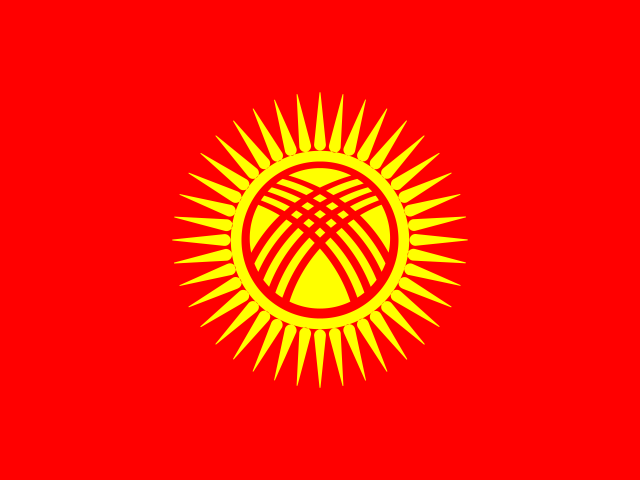
President Sadyr Japarov. Called for UN decisions to be treated as binding, with a public register of who carries them out, and said only the UN should impose sanctions. Read more
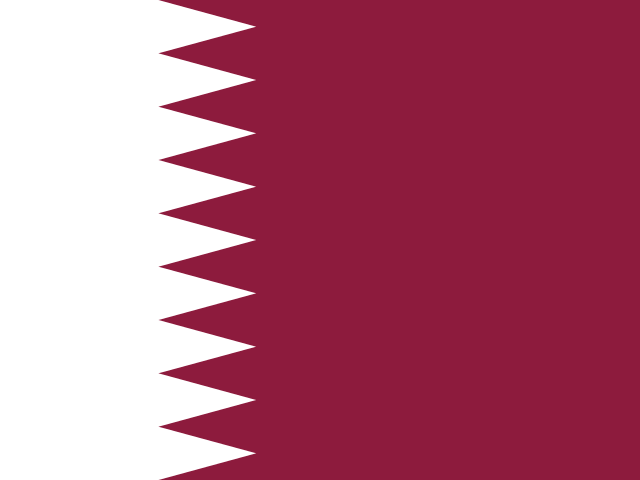
Amir Sheikh Tamim bin Hamad Al Thani. Blamed the Gulf crisis on “the absence of a regional system of collective security”, called for the Strait of Hormuz to reopen and for Iran and the US to return to talks, and called what happened in Gaza “genocide in every sense of the word”. Read more

President Gitanas Nausėda. Said Russia has in practice already lost its war on Ukraine but its leaders will not admit it, and warned about Russian drones in Lithuania’s airspace. Read more
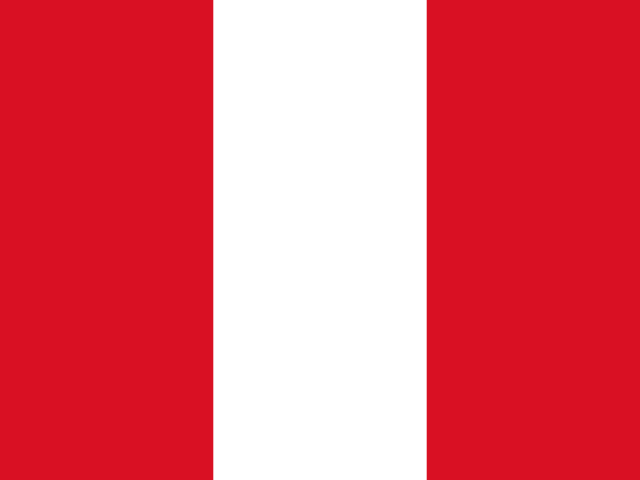
President Keiko Sofía Fujimori Higuchi. In her first UN speech, said gangs and drug traffickers should be treated as terrorist groups, “enemies of the democratic state”. Read more
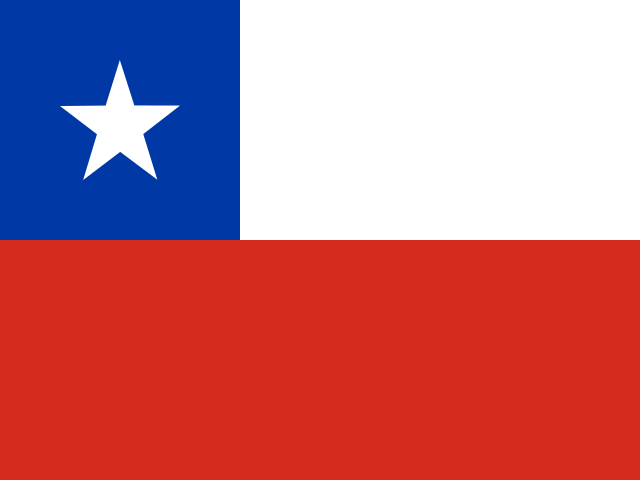
President José Antonio Kast. In his first UN speech, said the UN “has not lived up to the challenges of our times”, proposed three reforms and closed with “Chile is back.” Read more

President Alexander Stubb. Called for an end to the veto, for Charter violators to lose their vote, and for “a new San Francisco moment”, and launched Finland’s Security Council bid. Read more
Grand Duke Guillaume. In his first UN address as head of state, said disappointment with multilateralism should lead to reform, not rejection. Read more
President Emmanuel Macron. Asked whether the world wants “a return to the law of the jungle” or “a civilized international society”, warned against dismantling the Geneva Conventions, said there is no peace without justice, and argued AI rules should not be left to the US, China and private companies. Read more
President João Manuel Gonçalves Lourenço. Said the world lives in “global anarchy” where force beats law, and called for deep Security Council reform with Africa, Latin America and Asia as permanent members. Read more
Afternoon session
President Khurelsukh Ukhnaa. Announced Mongolia’s bid for a Security Council seat in 2048 and 2049, and warned about record military spending. Read more
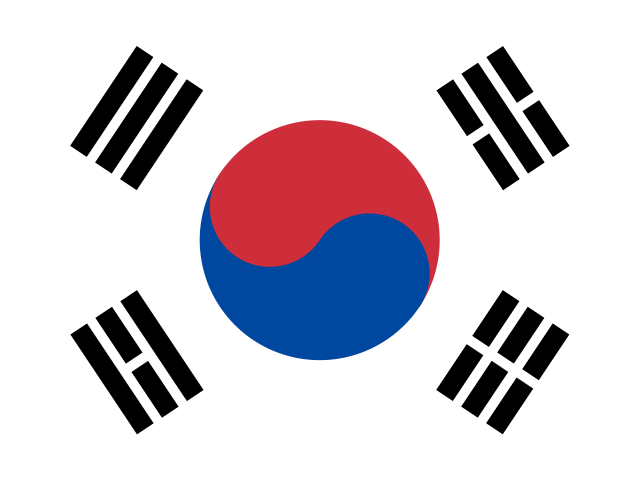
President Lee Jae Myung. Urged North Korea and the US to resume talks, with Seoul as “pacemaker”, and set out a step-by-step path to a nuclear-free peninsula. Read more
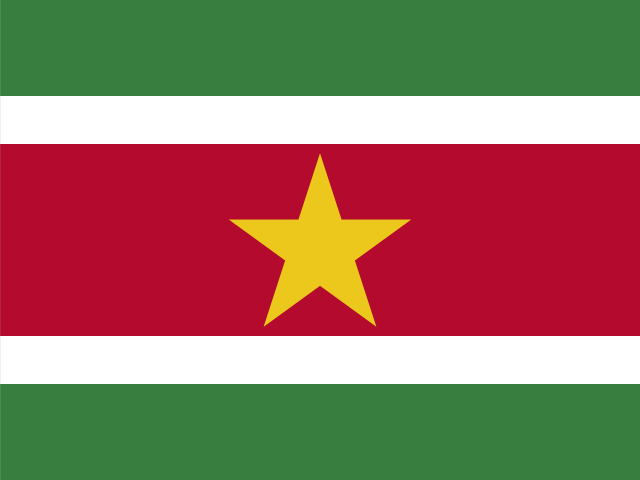
President Jennifer Geerlings-Simons. Said trust in the UN must urgently be restored, and backed Guyana’s Carolyn Rodrigues-Birkett for Secretary-General. Read more

President Julius Maada Bio. Said the world cannot spend trillions on war while millions struggle to develop, and called reparations “not a plea for charity.” Read more
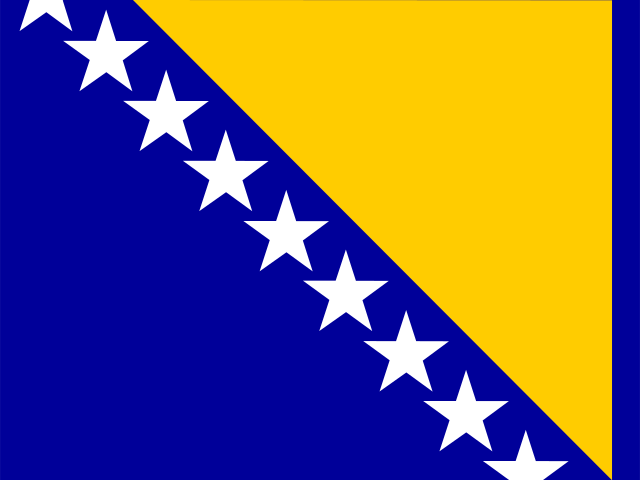
Chairman of the Presidency Denis Bećirović. Warned that Republika Srpska’s leaders threaten the country’s peace, and condemned the honors for Ratko Mladić in Serbia. Read more
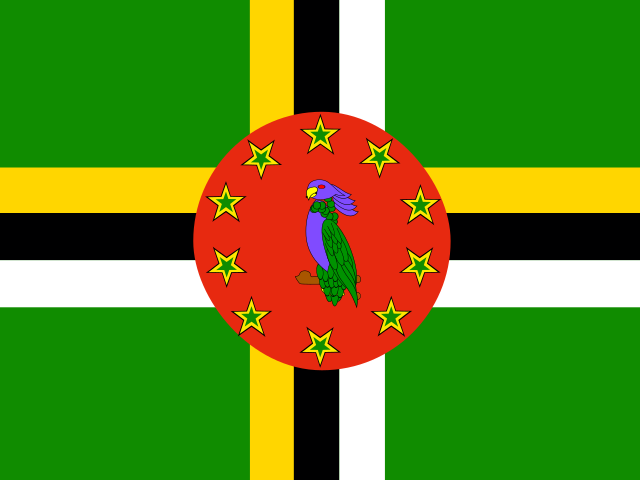
President Sylvanie Burton. Asked for climate money to build resilience before disasters strike, not only after. Read more
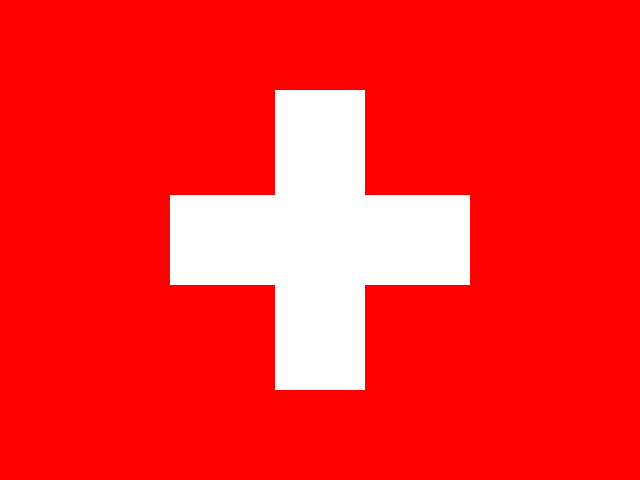
President Guy Parmelin. “Dialogue is not a sign of weakness.” Defended open trade and invited the world to an AI summit in Geneva in June 2027. Read more
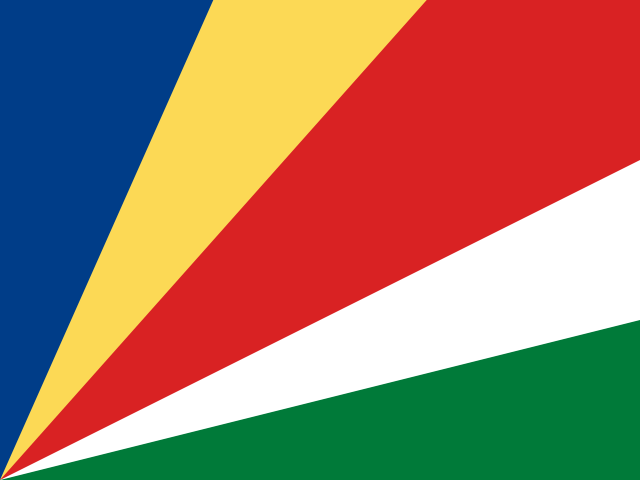
President Patrick Herminie. In his first UN speech, said small states should never pay for wars they have no part in, and that climate finance is a legal duty. Read more
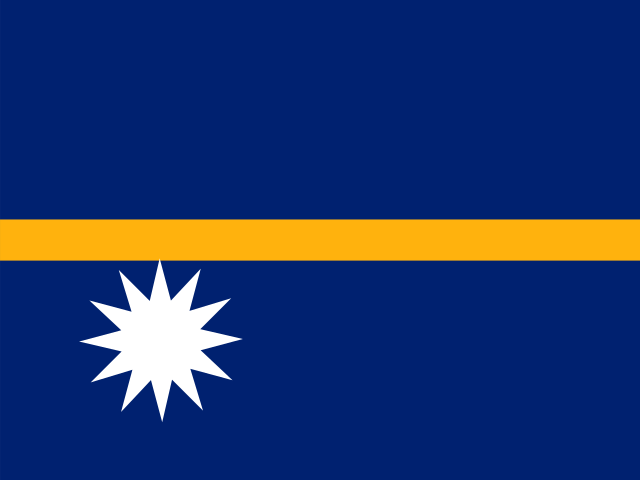
President David Ranibok Adeang. Presented his country to the world by its own name: “Today, we restore Naoero.” Read more
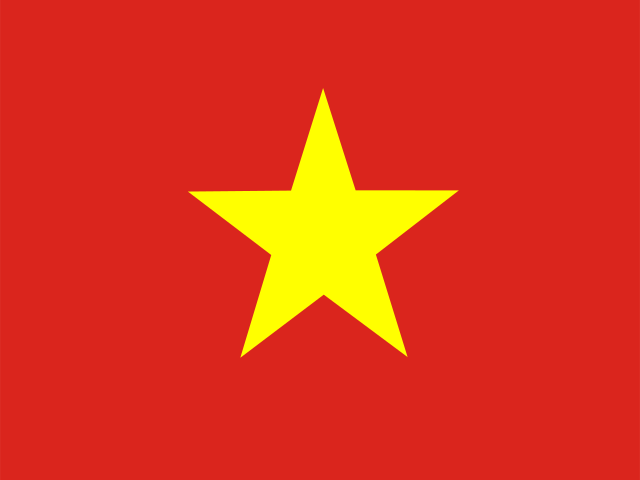
President To Lam. Said change is inevitable but conflict is not, and set out four directions for a UN that rebuilds trust. Read more
Vice President Deogratius Ndejembi. Launched Tanzania’s bid for a Security Council seat in 2029 and 2030, and asked for climate finance as grants. Read more
Prime Minister Tshering Tobgay. Spoke “as a salesman”, pitching Gelephu Mindfulness City to investors: “come and build it with us.” Read more
Prime Minister Kamla Persad-Bissessar. Said criminal networks moving guns and drugs threaten small states, and that stopping illegal guns will be a priority on the Security Council. Read more
Prime Minister Sanae Takaichi. Her first UN speech. Announced a plan for the Gulf states’ economies and energy, called for free passage through Hormuz, proposed an AI summit in Japan, and demanded the Charter’s “enemy States” clauses be deleted. Read more
Prime Minister Andy Burnham. His first UN speech as prime minister. Declared “Britain is back”, announced a center to fight Russian disinformation, and put AI at the heart of the UK’s G20 year. Read more
Prime Minister Andrej Plenković. Said international law is “the boundary between order and tyranny”, and called the honors for Mladić in Serbia an insult to his victims. Read more
Deputy Prime Minister Maxime Prévot. Said the world’s common compass is the UN Charter, defended the international courts, and asked for AI rules that protect children. Read more
Minister of Foreign Affairs Nasser Bourita. Announced Morocco will join the international stabilization force in Gaza, and set out six conditions for Western Sahara. Read more
Moments people talked about
- Walkouts: Cuba’s delegation left the hall during Trump’s remarks on Cuba, and Israel’s left during Erdoğan’s address.
Trump on Iran:
“Do I annihilate the Islamic Republic and do it quickly, never giving them a chance to kill and destroy people and countries again?”
- Lula’s warning: “A ONU está falhando em uma das suas missões mais elevadas: a de livrar a humanidade do flagelo da guerra.” The UN is failing one of its highest missions, to free humanity from the scourge of war.
- Macron’s choice: the law of the jungle, or a civilized international society.
Watch the whole day
UN Web TVWatch Day 1 of the UNGA 81 general debate on UN Web TV UN Web TVWatch Secretary-General António Guterres’s address on UN Web TV UN Web TVWatch President Trump’s address on UN Web TVEach country’s statement is posted on the UN’s general debate website.
A note on the list
The order is the UN’s speakers list for September 22. Kyrgyzstan’s president is listed by the UN as Sadyr Zhaparov; his name is more often written Sadyr Japarov. Nauru appears on the UN list under its own name, Naoero. Tanzania’s full name at the UN is the United Republic of Tanzania, and the United Kingdom’s is the United Kingdom of Great Britain and Northern Ireland. Morocco’s minister’s full title is Minister of Foreign Affairs, African Cooperation and Moroccans Abroad.
Follow-ups
Who is Sanae Takaichi?
Prime Minister Sanae Takaichi of Japan is Japan's first female head of government and the leader of the Liberal Democratic Party, a hard-line conservative who spoke on Day 1 of the UNGA 81 general debate, calling for Security Council reform and the removal of a wartime provision that labels Japan an "enemy state."
Quick facts
- Full name: Takaichi Sanae (高市 早苗), family name first in Japanese convention
- Born: Yamatokōriyama, Nara Prefecture, Japan
- Party: Liberal Democratic Party (LDP)
- Current role: Prime Minister of Japan and LDP President, since October 2025
- Preceded by: Shigeru Ishiba
- Known as: Japan's first female prime minister and LDP president
Their story
Takaichi was born and raised in Tenri, Nara Prefecture, graduated from Kobe University, and worked as an author, legislative aide and broadcaster before entering politics. She moved to the United States and interned for Democratic congresswoman Patricia Schroeder of Colorado. After returning to Japan, she wrote books on American politics and worked as a television presenter.
She was elected as an independent to the House of Representatives in the 1993 general election, then joined the LDP in 1996. She is recognized as a staunch conservative and a security hawk, often referred to as a protégé of the late former Prime Minister Shinzo Abe.
In office
Takaichi became Prime Minister on October 21, 2025, after winning the leadership contest for the Liberal Democratic Party following Shigeru Ishiba's resignation. She won both rounds of the LDP leadership contest, defeating Shinjirō Koizumi with 185 votes to 156 in the runoff, becoming the first woman to hold the post of LDP president.
In 2026, she called a snap general election, which resulted in a historic landslide victory for the LDP, securing a two-thirds supermajority and the largest number of seats ever won in postwar Japanese electoral history.
What she has done
Before reaching the top, Takaichi held a string of senior cabinet posts. After Abe returned to the prime ministership in 2012, she twice served under him as Minister for Internal Affairs and Communications. From 2022 to 2024 she held a number of cabinet positions under Prime Minister Fumio Kishida, most notably Minister of State for Economic Security.
As Prime Minister, her agenda is sweeping. She has prioritized expansionary fiscal policy, strengthening defense capabilities through revisions to the Three Defense Documents, establishing a National Intelligence Bureau, enacting anti-espionage legislation and laying the groundwork for amending the Peace Constitution. On defense spending, she committed to front-loaded measures to reach "2% of GDP" as stipulated in the National Security Strategy.
Article 9 of Japan's 1947 Peace Constitution restricts Japan's military capabilities and limits its ability to respond militarily to crises not directly threatening Japan's survival. Takaichi remarked that a Taiwan crisis could constitute a "survival-threatening situation," sparking fierce debate, since such a determination would permit the mobilization of Japan's Self-Defense Forces.
Many media outlets have referred to her as Japan's "Iron Lady," a reference to former British Prime Minister Margaret Thatcher, for whom Takaichi has publicly expressed admiration.
Her UNGA 81 speech
Takaichi spoke at the UN General Assembly 81st session general debate on September 22, 2026, in New York. Her address covered five main areas:
- The Middle East and the Strait of Hormuz: She called the Strait of Hormuz "an international public good" and said free and safe navigation must be ensured for all vessels, warning that supply disruptions were driving a mounting food crisis in Africa and Asia.
- Nuclear disarmament: She reaffirmed Japan's mission, as the only country to have suffered atomic bombings in war, to lead international efforts toward "a world without nuclear weapons," and called for transparency of nuclear forces.
- Russia and Ukraine: She said plainly that Russia, a permanent Security Council member, "has initiated an act of aggression against another country" and vetoed resolutions concerning its own actions. "It must be said that the Security Council is not functioning for international peace."
- UN Charter reform and the "enemy states" clause: Takaichi called for an overhaul of the UN, including removing a 1940s-era provision that refers to Japan as an "enemy state," a clause that China has used in its disputes with Tokyo. A General Assembly resolution adopted in 2005 had already called for the clause to be deleted; she demanded it be acted upon.
- Security Council reform: She argued that the Council's current structure reflects the world as it stood in 1945 and must be expanded in both permanent and non-permanent members to reflect current realities, adding that a majority of member states already support that expansion.
In her own words
From the full official text of her UNGA 81 address:
On the UN's relevance:
"Despite these concerns, the United Nations has never been more important than it is today in bringing about peace and stability to the world."
On the Security Council:
"A permanent member of the Security Council, with a special responsibility for international peace and security, has initiated an act of aggression against another country, and has vetoed Security Council resolutions concerning its own actions. In this current situation, it must be said that the Security Council is not functioning for international peace."
On the Strait of Hormuz:
"Ensuring free and safe navigation through the Strait of Hormuz for all vessels without additional costs, as has been the case, is extremely important not only for the security of the Middle East, but for the stability of the global economy as a whole."
On UN reform:
"Rather than lamenting the institutional fatigue of the United Nations, it is time for Member States to unite with one heart, vigorously advance a reform of the United Nations and transform the organization into a more resilient and effective United Nations."
On Japan's vision:
"I am convinced that the United Nations is the only organization capable of taking the helm on a global scale."
On her own ambition:
"I want to push Japan to the top of the world once again."
Worth knowing
The "enemy states" clause Takaichi raised is a genuine pressure point in Japan-China relations. Beijing has latched onto the clause in its row with Tokyo, insisting it remains legally binding and serves as a safeguard of the postwar order. Her call to delete it at the UN was a direct challenge to that position.
Takaichi steps into office at a moment of internal party weakness and intense domestic and regional strategic pressures, and her views on empowering women are described as complex, even as she makes history as Japan's first female prime minister.
Watch and read the full speech
UN Web TVWatch the speech on UN Web TVRead the full official speech on the Prime Minister's Office of Japan website

Work it out with people who are also paying attention.
Daily posts and a community reading past the headlines together.
Join me on CEEK
Comments
Comments are public. Links are removed.