What was the name of the king of Ghana known as the wealthiest ruler ever on the face of the earth?
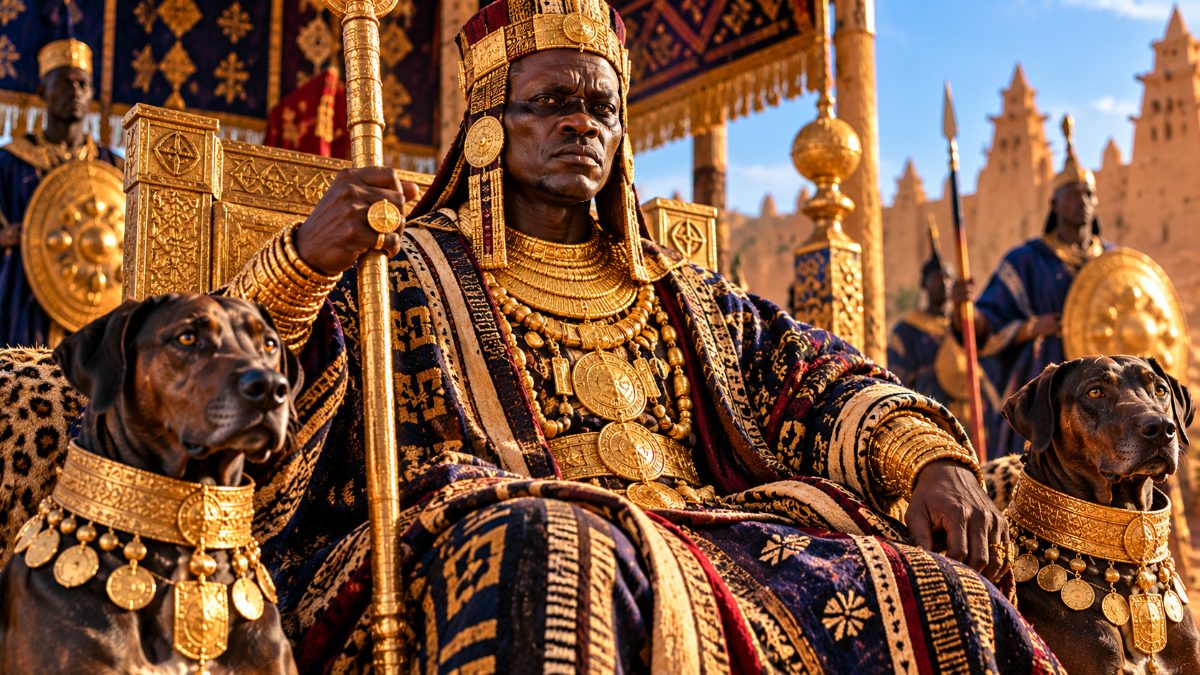
In about 951, the geographer Ibn Hawqal called the king of Ghana “the wealthiest king on the face of the earth,” more than 350 years before Mansa Musa. He did not write down the king's name. The best-known king of Ghana by name is Tunka Manin, who ruled from about 1062 to 1076. Mansa Musa of Mali, who ruled from 1312 to 1337, is the one most often called the richest person in history, and his empire grew on the gold fields Ghana controlled first.

 spio.com
The King of Ghana, Wealthiest on the Face of the Earth
The Ghana Empire, also called Wagadu, was built by the Soninke people in what is now southern Mauritania and western Mali. Its rulers controlled the gold that crossed the Sahara. In about 951, the geographer Ibn Hawqal wrote that the king of Ghana was “the wealthiest king on the face of the earth,” because of his treasures and stores of gold. He did not name the king.
About 100 years later, the geographer al-Bakri described the court of Tunka Manin, who ruled from about 1062 to 1076 from the capital Koumbi Saleh. He is the best-known king of Ghana by name.
| The king of Ghana | Mansa Musa | |
|---|---|---|
| Empire | Ghana (Wagadu), built by the Soninke | Mali, which later took in the lands of Ghana |
| When | Called the wealthiest king on earth in about 951; Tunka Manin ruled about 1062 to 1076 | Ruled 1312 to 1337 |
| Who wrote it | Ibn Hawqal (about 951), al-Bakri (1068), al-Idrisi (1154) | Writers in Cairo, after his pilgrimage to Mecca in 1324 |
| The gold | Every gold nugget in the kingdom belonged to the king. Al-Idrisi wrote of a block of gold weighing over 13.5 kilos (about 30 pounds) | So much gold spent in Cairo that its value fell there for years |
| The power | An army of 200,000, more than 40,000 of them archers | The largest empire in West Africa of its time |
In Their Own Words
“The wealthiest king on the face of the earth.” (Ibn Hawqal, writing about the king of Ghana, about 951)
“The nuggets found in all the mines of his country are reserved for the king.” (al-Bakri, 1068)
“The nuggets may weigh from an ounce to a pound.” (al-Bakri, 1068)
“The king can put 200,000 men into the field, more than 40,000 of them archers.” (al-Bakri, 1068)
“A lover of justice and favorable to Muslims.” (al-Bakri, on Tunka Manin, 1068)
Then Came Mansa Musa of Mali
There is a distinction worth drawing clearly. The Ghana Empire, Wagadu, produced no single king whose wealth became a byword across the world. What it produced was the infrastructure: the gold deposits, the trans-Saharan trade routes and the tax systems that whoever conquered or succeeded it could inherit. When the Mali Empire absorbed what remained of Wagadu, it stepped into that inheritance. The Mali Empire was founded out of the remains of the Ghanaian Empire. So Mansa Musa's wealth is, in a very real sense, the Ghana Empire's final dividend.
Who Mansa Musa was
Mansa Musa, whose full name was Musa Keita I, was the tenth Mansa of the Empire of Mali. Mansa is a title like "sultan" or "emperor." He was born around 1280 and ruled from 1312 to 1337. Among his many titles were the Lion of Mali, Emir of Melle, Lord of The Mines of Wangara and Conqueror of Ghanata.
He is regarded as the wealthiest person of all time, although there are no reliable ways to accurately calculate his wealth. The estimates range widely: some sources have estimated his wealth to be equivalent to $300 billion, though it is impossible to calculate accurately. Other estimates put it higher still, but every historian agrees the number defies modern comparison.
Where the wealth came from
He controlled Mali's vast gold reserves at a time when the region supplied nearly half of the world's gold. The Mali Empire at the time also comprised the conquered Ghana Empire, also known as Wagadu, with its gold deposits. That is the direct line from the warriors of Wagadu to the treasury of Mansa Musa.
By controlling the important trade routes between the Mediterranean and the West African coast, Mansa Musa established his city Timbuktu as the western center for Islamic culture and learning.
The pilgrimage that introduced him to the world
The act that put his wealth on the map, literally, was his hajj pilgrimage to Mecca. He injected an estimated 18 tons of gold into the local market during his pilgrimage, triggering a massive 12-year hyperinflation crisis in Cairo.
The Egyptian historian al-Umari recorded the moment in words that have survived 700 years. "This man flooded Cairo with his benefactions. He left no court emir nor holder of a royal office without the gift of a load of gold."
Gold prices in Cairo fell by 10 to 25% almost overnight, and the market disruption was so severe that the effects were still being felt twelve years later when the historian al-Umari visited Cairo and found residents still discussing Musa's legendary visit.
Mansa Musa's pilgrimage route became so famous that European mapmakers began including detailed depictions of the Mali Empire on their maps, with the 1375 Catalan Atlas showing Musa sitting on a throne holding a golden orb.
What he built with it
Mansa Musa established the University of Timbuktu to attract scholars and artists from throughout the Islamic world. The University of Sankore during his reign housed one of the largest libraries in the world, with the largest collection of books in Africa since the Library of Alexandria in Egypt, holding about a million manuscripts and capable of housing 25,000 students.
The thread running through this whole conversation comes into sharp focus here. The Almoravids broke it open. The Mali Empire inherited it. And Mansa Musa, standing on all of that, became the name history attached to the idea of incomprehensible wealth from West Africa.
More sources: Kingdom of Ghana, Boston University African Studies Center, Tunka Manin, Wikipedia, Ibn Hawqal, Wikipedia, The Gold Trade of Ancient and Medieval West Africa, Brewminate
Follow-ups
What was the origin of Maat? When did it appear in Wolof language? Maat goes back at least to Egypt's Old Kingdom, around 2700 BCE. Some believe the word Maat is Wolof for justice. In Wolof, mat means to be full, complete or right, and àtte is legal and moral judgment. It's not a stretch to see the connection, and I believe Maat is the origin of this system, not the other way around.
 spio.com
Maat and Wolof
Some believe the word Maat is Wolof for justice. In Wolof, mat means to be full, complete or right, and àtte is legal and moral judgment. It's not a stretch to see the connection.
I believe Maat is the origin of this system, not the other way around. The idea of truth, balance and a justice that even kings must answer to was alive in Africa long before anyone wrote it down, and Egypt's Old Kingdom records, from around 2700 BCE, are simply the oldest that survive.
The Senegalese scholar Cheikh Anta Diop, himself a Wolof speaker, spent his life showing the deep ties between ancient Egyptian and the languages of Africa, Wolof above all.
Where Maat came from
The earliest instance of the worship of this deity can be traced back to the Old Kingdom of Egypt, roughly 2686–2181 BCE, a period that marked Maat as the counterforce of chaos and the champion of order and rule of law. That is the oldest formal record, but the concept is likely older still.
The true origin of Maat was from a single philosophy of universal order that quickly developed into concepts complementary of collective moral conviction and models of human behavior, eventually accumulating under the single umbrella of Maat.
There is historical evidence from the time of Pharaoh Menes, just after the unification of upper and lower Egypt into a united Kemet, indicating the administration of the 42 Laws of Maat among the ancient Egyptian people. This knowledge is derived from findings in pyramid texts, coffin texts, and funerary papyrus. The oldest substantial surviving proof is found in the Pyramid Texts of the burial chamber of Unas, dating between 2375 BCE and 2345 BCE.
Etymologically, the name Maat is generally translated as "that which is straight" or "truth," but also implies "order," "balance" and "justice," so Maat personified perfect order and harmony. One scholarly source goes further: both legal terms nt and hp fell under maat, which literally means "the one who steers," the embodiment of order.
The scholar Jan Assmann has suggested that the "generic term for the totality of all social norms" was maat, indicating a kind of "connective justice" that was a touchstone of all of Egyptian civilization, but which came to be explicitly formulated in the Middle Kingdom, circa 2050–1650 BCE.
In the Middle Kingdom, a legal perspective was developed that everyone had equal rights and opportunities, or at least that everyone should have them and that everyone should also have access to social justice, a unique idea in human history existing in ancient Egypt more than a thousand years before evidence of similar thinking by the Greeks and Hebrews.
Maat and Wolof: what the evidence actually shows
Wolof is a Black African language of Senegal, Mauritania and the Gambia, and belongs to the Senegambian branch of the Niger-Congo language family. Its ancestral home and ancient Egypt are separated by thousands of miles and belong to entirely different language families. Ancient Egyptian is an Afroasiatic language; Wolof is Niger-Congo. Those two families diverged in the deep prehistoric past.
What does connect them is not vocabulary but moral architecture. As we covered earlier in this thread, the concept behind Maat, that a ruler's legitimacy rests on justice, that the soul is weighed against a standard of rightness at death, that cosmic order and human conduct are inseparable, runs through West African ethical thought in forms that predate Islam and that Islam itself built upon when it arrived. The Wolof people, like the Mandinka, the Yoruba and others, carried their own versions of this same deep principle without necessarily carrying the Egyptian word for it.
Wolof is a language in layers, resulting from constant interaction between various peoples of the West Sudan world-system.
Who is Mansa Musa?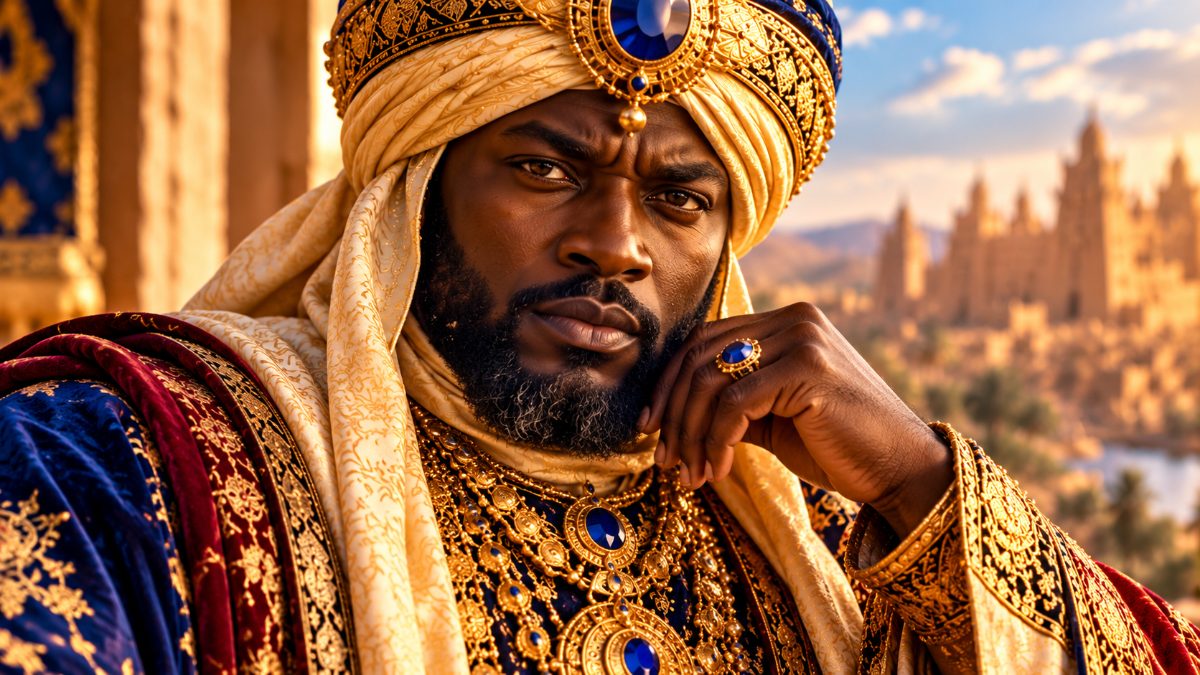 Mansa Musa, the ninth Mansa of the Mali Empire, who ruled from roughly 1312 to 1337, is widely regarded as the wealthiest person in recorded history, a Mandinka ruler who inherited the gold fields that once powered the Ghana Empire we have been tracing and turned them into the most spectacular display of wealth the med
ieval world had ever seen. He came to the throne after the king before him, Muhammad ibn Qu (often called Abu Bakr II), sailed into the Atlantic with 2,000 ships and was never seen again.
spio.comQuick facts
- Born: c. 1280, Mali Empire
- Died: c. 1337, aged about 57
- Full name: Kanku Musa Keita, known to history as Mansa Musa
- Title: Mansa means king or emperor in the Mandé tradition; so his name translates simply as "Emperor Musa"
- Dynasty: The Keita clan, who ruled Mali from around 1250
- Religion: Sunni Islam, Maliki school
- Spouse: Inari Konte
- Successor: Magha (his son, Maghan I)
Their story
Mansa Musa was a member of the powerful Keita clan, whose members ruled the West African empire of Mali from around 1250. According to the Muslim Arab historian Ibn Khaldun, Musa was the ninth ruler of Mali and a grandnephew of its founder, Sundiata Keita. He was not the direct heir to the throne. Mansa Musa gained the throne after his predecessor, Mansa Abu Bakr II, sailed out into the Atlantic with a large fleet of ships and was never seen again.
The connection to this conversation is direct: the gold fields that made the Ghana Empire (Wagadu) legendary were now inside Mali's territory. Sundiata Keita moved to expand the kingdom of Mali by taking control of all the Soninke peoples recently conquered by the Sosso, and their territory comprised much of the former kingdom of Ghana and its nominally independent vassal states. Musa inherited that foundation and built something larger still.
In His Own Words
Mansa Musa left no writings of his own. His words come down to us through al-Umari, a scholar who gathered accounts in Cairo from people who spent time with Musa during his visit. Chief among them was the official Ibn Amir Hajib, who looked after him in Cairo.
“We belong to a house which hands on the kingship by inheritance.” (to Ibn Amir Hajib, Cairo, 1324)
“The king who was my predecessor did not believe that it was impossible to discover the furthest limit of the Atlantic Ocean.” (on the voyage that made him king)
“So he equipped 200 ships filled with men and the same number equipped with gold, water, and provisions.” (on the first fleet)
“Then that sultan got ready 2,000 ships, 1,000 for himself and the men whom he took with him and 1,000 for water and provisions.” (on the second fleet)
“That was the last we saw of him and all those who were with him, and so I became king in my own right.” (on how he came to the throne)
“I came for the Pilgrimage and nothing else. I do not wish to mix anything else with my Pilgrimage.” (when invited to meet the Sultan of Egypt)
“How may this be?” (when told he must kiss the ground before the Sultan)
“I make obeisance to God who created me!” (as he bowed, making clear he bowed to God alone)
“Not even to kings?” (when Ibn Amir Hajib told him Islamic law forbade a custom of his court, which he then gave up)
Did He Disappear at Sea?
No. It was the king before him who sailed west and never came back. In Musa's own account, his predecessor sent 200 ships into the Atlantic, then set out himself with 2,000, leaving Musa to rule as his deputy. When the fleet never returned, Musa became king.
Musa went on to rule for about 25 years. He made his pilgrimage to Mecca in 1324 and 1325, came home and ruled until he died around 1337.
Many popular accounts name that sailing king Abu Bakr II. Historians point out this name comes from a 19th-century mistranslation of Ibn Khaldun. Ibn Khaldun names Musa's predecessor as Muhammad ibn Qu, and several historians credit the voyage to him. Some historians also question the story itself, suggesting it may have explained how Musa, who was not next in line, came to power.
Did He Show Off His Wealth to Prove His Right to Rule?
The sources never say so in his words. He told his hosts in Cairo that he came for the pilgrimage “and nothing else.” But the journey did a great deal for him and for Mali. It made him famous across North Africa, the Middle East and Europe. It built ties with the sultans of Egypt and Morocco. And it brought scholars and the architect Abu Ishaq al-Sahili back to Mali, where they helped make Timbuktu a center of learning.
Was it also about his standing at home? Musa was not the direct heir, and he came to power through his predecessor's disappearance. Whether the display was also meant to secure his place at home is a question the record does not settle.
His Family
Mansa Musa was Mandinka, a member of the Keita dynasty founded by Sundiata Keita, the founder of the Mali Empire.
- Wife: his senior wife was Inari Kunate. She traveled with him on the pilgrimage, with her own attendants.
- Children: his son Maghan, also written Magha, succeeded him as king around 1337. While Musa was on pilgrimage, he left a son named Muhammad to rule in his place.
What the Numbers Really Say
Later writers made his caravan bigger with every telling. Sources from his own time describe thousands of his soldiers and companions, mostly free West African Muslims. The famous 60,000 comes from a chronicle written in 1655, more than 300 years later, and historians call it greatly inflated.
What he built
Mansa Musa was the ruler of the Mali Empire in West Africa from 1312 to 1337. Controlling territories rich in gold and copper, and monopolizing trade between the north and interior of the continent, Mali grew extremely wealthy. With an army numbering around 100,000 men, including an armored cavalry corps of 10,000 horses, and with the talented general Saran Mandian, Mansa Musa was able to extend and maintain Mali's vast empire, doubling its territory and making it second in size only to that of the Mongol Empire at the time.
When he died, the empire included what is now Senegal, southern Mauritania, northern Ghana, Mali, northern Burkina Faso, Guinea, Guinea-Bissau, The Gambia, and Ivory Coast.
The pilgrimage that crashed the gold market
Mansa Musa, like many other devout Mali rulers before and after, set off for a pilgrimage to Mecca, but when he arrived in Cairo en route, he caused an absolute sensation. He was accompanied by 60,000 men, including soldiers, entertainers, his entire royal court, and 12,000 enslaved people, as well as herds of goats and sheep and about a hundred camels carrying some 300 pounds of gold each.
What happened next is one of the most remarkable economic events in recorded history. In Egypt, Mansa Musa and his people gave away or spent so much that they caused the price of gold to plummet, and it would take 12 years for the Egyptian economy to recover. His pilgrimage also led to more than $1 billion in economic losses across the Middle East overall, as his caravan caused the depreciation of gold wherever it went.
Realizing what he had done, on his way back from Mecca, he borrowed all of the gold he could carry from moneylenders in Cairo at high interest, trying to drain back some of the gold he had flooded into the market. It is the only time in recorded history one man directly controlled the price of a global commodity in both directions within a single journey.
His wealth in numbers
The empire controlled the gold mines of Bambuk, Boure, and Galam, which produced more than half of the Old World's gold during Mansa Musa's reign. Modern estimates place his net worth in ranges that strain historical imagination, often expressed in inflation-adjusted terms as hundreds of billions of dollars. The most commonly cited figure is around $400 billion in today's money, though some historians argue the fortune was so structural, tied to Mali's monopoly over both gold and salt, that it simply cannot be calculated by any modern metric.
Timbuktu: the greater legacy
The gold was spectacular. But what Musa did with the scholars he brought back from Mecca may have mattered more. He brought back architects and scholars from his pilgrimage who would build mosques and universities that made cities like Timbuktu internationally famous. Timbuktu became known for its mosques, libraries and centers of learning. Students studied Islamic law, theology, astronomy, mathematics, medicine and literature, while scholars produced and preserved manuscripts covering a wide range of subjects. The city became part of a wider intellectual network stretching across West Africa, North Africa and the Middle East.
He extended the empire to include Gao, commissioned mosques and palaces through the Granada architect Abu Ishaq al-Sahili, and encouraged the scholars of Timbuktu and Sankore. His wealth and generosity were described by the Arabic writers al-Umari, Ibn Battuta and Ibn Khaldun, and his image, enthroned with a gold nugget, was drawn on the Catalan Atlas of 1375.
The Catalan Atlas of 1375, drawn in Majorca half a century after Musa's journey, depicts him seated and crowned, holding a golden orb, identified by name. He is among the first sub-Saharan African rulers to appear on a European world map in this manner. European mapmakers concluded that their picture of the world was simply incomplete without him.
After his death
After his death around 1337, the stability of the Mali Empire was undermined, leading to its eventual decline as the Songhai Empire emerged. But the intellectual tradition he built in Timbuktu outlasted the political empire by centuries. Well after his death, Mansa Musa remained engraved in the imagination of the world as a symbol of fabulous wealth. However, his riches are only one part of his legacy, and he is also remembered for his Islamic faith, promotion of scholarship, and patronage of culture in Mali.
Who is Muhammad ibn Qu?Muhammad ibn Qu was the eighth Mansa of the Mali Empire, the ruler who came just before Mansa Musa, and the man whose obsession with the edge of the Atlantic Ocean handed Musa the throne of the wealthiest empire on earth.
Muhammad ibn Qu was the eighth Mansa of the Mali Empire, the ruler who came just before Mansa Musa, and the man whose obsession with the edge of the Atlantic Ocean handed Musa the throne of the wealthiest empire on earth.
Quick facts
- Full name: Mansa Muhammad ibn Qu (Arabic: محمد بن قو)
- Title: Mansa, meaning king or emperor in the Mandé tradition
- Dynasty: The Keita clan
- Father: Mansa Qu, the seventh Mansa
- Reign: Brief, likely between roughly 1305 and 1312
- Died: c. 1312, whereabouts unknown, the Atlantic Ocean or beyond (disputed)
- Predecessor: Mansa Qu
- Successor: Mansa Musa (the ninth Mansa)
Who he was
He succeeded his father, Mansa Qu, and was the predecessor of Mali's most famous ruler, Mansa Musa. The exact dates of his reign are not known with certainty, though his reign was certainly brief.
His father Mansa Qu had himself only ruled for roughly five years, coming to power after the usurper Mansa Sakura was murdered on his return from the hajj. Oral tradition says that Mansa Qu killed Sakura himself with the help of Sakura's daughter. When Qu died around 1305, Muhammad stepped onto the throne of the richest empire in the medieval world.
The voyage that changed history
Musa said Mansa Muhammad disappeared leading an expedition into the Atlantic Ocean. The story of how Musa told it is one of the most remarkable accounts in medieval history.
Mansa Musa stayed in Cairo for three months while en route to Mecca for the hajj. While Musa there, he befriended an emir named Abu al-Hasan Ali ibn Amir Hajib, who was the governor of the district of Cairo Musa was staying in. Ibn Amir Hajib later relayed to the scholar al-Umari what he had learned of Mali from his conversations with Musa. In one such conversation, Ibn Amir Hajib had asked Musa how he had become king, and Musa responded: "We belong to a house which hands on the kingship by inheritance. The king who was my predecessor did not believe that it was impossible to discover the furthest limit of the Atlantic Ocean and wished vehemently to do so."
Musa then described what happened. Muhammad sent out a first fleet of 200 ships. Only one captain came back, reporting that a powerful current had swallowed the others. But the sultan disbelieved him. Then that sultan got ready 2,000 ships, 1,000 for himself and the men whom he took with him and 1,000 for water and provisions. He left me to deputize for him and embarked on the Atlantic Ocean with his men. That was the last anyone saw of him and all those with him. "And so, I became king in my own right."
The name confusion: Abu Bakr II
You will find this story told almost everywhere under the name "Mansa Abu Bakr II." That name is a historical mistake worth knowing about. The inclusion of Mansa Abu Bakr II in the list of Malian rulers is a misconception that originated in a mistranslation of Ibn Khaldun's text by the 19th-century European historian Baron de Slane. De Slane translated Ibn Khaldun as saying that the kingship passed from Muhammad to Abu Bakr and then to Musa. However, in the original Arabic text, Abu Bakr is only mentioned as the progenitor of Musa's lineage, not as a ruler. No mansa named Abu Bakr II ever reigned. The man on the ships was Muhammad ibn Qu.
Did he reach the Americas?
This account, recorded by the Muslim Arab historian al-Umari, has attracted considerable interest and speculation as a possible instance of pre-Columbian trans-oceanic contact.
What is certain is simpler and more striking than any theory: a man commanded perhaps the greatest naval expedition the medieval world had ever seen, sailed into the unknown. In doing so, he left behind a throne that Mansa Musa would turn into the most spectacular reign in African history.
Who was Sundiata Keita and how did he found the Mali Empire?Sundiata Keita, the Malinke prince whose name means "Lion Prince," was the founder of the Mali Empire, who rose from a childhood disability and years of exile to defeat the Sosso kingdom at the Battle of Kirina around 1235 and build the largest empire West Africa had ever seen, directly absorbing the gold fields that h
Sundiata Keita, the Malinke prince whose name means "Lion Prince," was the founder of the Mali Empire, who rose from a childhood disability and years of exile to defeat the Sosso kingdom at the Battle of Kirina around 1235 and build the largest empire West Africa had ever seen, directly absorbing the gold fields that had powered the Ghana Empire we have been tracing throughout this conversation.
Quick facts
- Born: c. 1217, Dakadjalan, in the kingdom of Kangaba along the upper Niger River
- Died: c. 1255, aged about 37–38 (cause disputed: oral traditions say drowning or an accidental arrow)
- Full name: Mansa Sundiata Keita; also written Sunjata or Sundjata
- Title: First ruler to hold the title Mansa (king of kings) in the Keita dynasty
- Dynasty: The Royal House of Keita
- Religion: Traditional African religion, with some sources indicating a later turn toward Sunni Islam
- Father: Naré Maghann Konaté, ruler of Kangaba
- Mother: Sogolon Kedjou
- Successor: Mansa Wali Keita (also called Mansa Uli I)
- Relation to Mansa Musa: Great-uncle, as the historian Ibn Khaldun and oral tradition confirm
Their story
Sundiata was crippled from childhood, and his mother Sogolon was openly mocked among the king's wives for her son's disability. The ridicule deeply affected him, and he was determined to walk like his peers. Through sheer will, he one day got up and walked. The oral tradition, recorded in the Epic of Sundiata and carried for centuries by griots, the hereditary oral historians and praise-singers of West Africa, adds that deeply hurt by his mother's humiliation, Sundiata resolved to overcome his disability. He asked the blacksmiths to bring him a heavy iron bar, and with encouragement, he rose to his feet before an astonished crowd.
His paternal half-brother Dankaran Touman and Dankaran's mother Sassouma Bereté were cruel and resentful of Sundiata and Sogolon. Their cruelty escalated after the king's death, and to escape threats on her son's life, Sogolon took Sundiata and his sisters into exile. That exile took them through different kingdoms within the Ghana Empire and eventually to Mema, where the king of Mema granted them asylum. Sundiata was admired there for his courage and tenacity, and he was given a senior position within the kingdom.
The enemy he came back to fight
While Sundiata was in exile, the power vacuum left by the Ghana Empire's decline was being filled brutally. Soumaoro Kanté, a 13th-century king of the Sosso people, seized Koumbi Saleh, the capital of the recently collapsed Ghana Empire, and proceeded to conquer several neighboring states, including the Mandinka people. He was a ruthless ruler who demanded heavy taxes and subservience, even killing eleven of the twelve brothers of the Keita clan, fearing they would challenge his rule. The twelfth brother, Sundiata, was spared, reportedly because he was a sickly child who seemed to pose no threat.
When Soumaoro conquered the Mandinka people, messengers were sent to find Sundiata, as he was destined by prophecy to be a great leader. They persuaded him to return and liberate the Mandinka homeland, and he came back accompanied by an army given to him by the king of Mema.
The Battle of Kirina
The exiled Mandinka prince organized a coalition of smaller kingdoms to oppose the growing power of the Sosso. He formed a powerful alliance of other chiefs tired of Soumaoro's harsh rule and defeated the Sosso in a decisive battle at Krina (also called Kirina) around 1235. Sundiata's forces roundly defeated those of Soumaoro Kanté, guaranteeing the pre-eminence of Keita's new Mali Empire over West Africa. Sundiata led a coalition of smaller states to soundly defeat the Sosso and kill Soumaoro. He then marched on Sosso itself and destroyed it, marking the kingdom's end.
How he built the empire
By 1240, Sundiata had seized Kumbi (Koumbi Saleh), the former capital of Ghana, erasing the last symbol of Ghana's imperial past. After 1240, he focused on consolidating control over existing states, while his generals expanded the empire's boundaries to include important trade centers and goldfields.
The empire was organized as a federation. Local chiefs were generally permitted to continue governing their own territories, but each was paired with an appointed governor, or farin, who ensured compliance with imperial policy. The empire was divided into a northern and a southern zone, each overseen by a military governor. Sundiata's central government at Niani included loyal tribal leaders alongside Muslim Arab merchants whose foreign contacts were invaluable for trade and diplomacy.
The new capital at Niani became an important financial and trading center, not least because it was located near the Bure goldfields, the significant resource that led to the incredible wealth of the nascent Mali Empire and would later allow his successors, including Mansa Musa, to project its power and splendour across the globe.
The name Sundiata gave to his empire, Africa's largest up to that point, was Mali, meaning "the place where the king lives."
The oral tradition: griots and the Epic of Sundiata
Much of what we know comes not from written records but from the oral tradition. Although Sundiata Keita is a historical figure, much of what is known about his life and reign has been worked out by historians studying the near-legendary accounts described in the Epic of Sundiata. The Epic of Sundiata is the foundational oral narrative tradition of the Mandinka people in West Africa, chronicling the life, exile, and conquests of Sundiata Keita, the semi-legendary founder of the Mali Empire who ascended to power around 1235. Griots, known in Mandinka as jeliw, are hereditary custodians of oral history, functioning as historians, genealogists, poets and musicians who preserve cultural narratives through memorized recitation, song and performance. They have carried this story for over 700 years.
The link to Mansa Musa
Sundiata was the great-uncle of the most famous ruler of Mali, Mansa Musa, whose lavish pilgrimage to Mecca made Mali the most famous African empire in the medieval world. The gold fields that Ibn Hawqal had called the source of the wealthiest kingdom on earth when he wrote about Ghana were now inside the borders of the empire Sundiata built. Every chapter of this conversation traces back to that one thread: the gold, the land, the title, and the succession of rulers who stood on Sundiata's foundation.
Who is Inari Konte?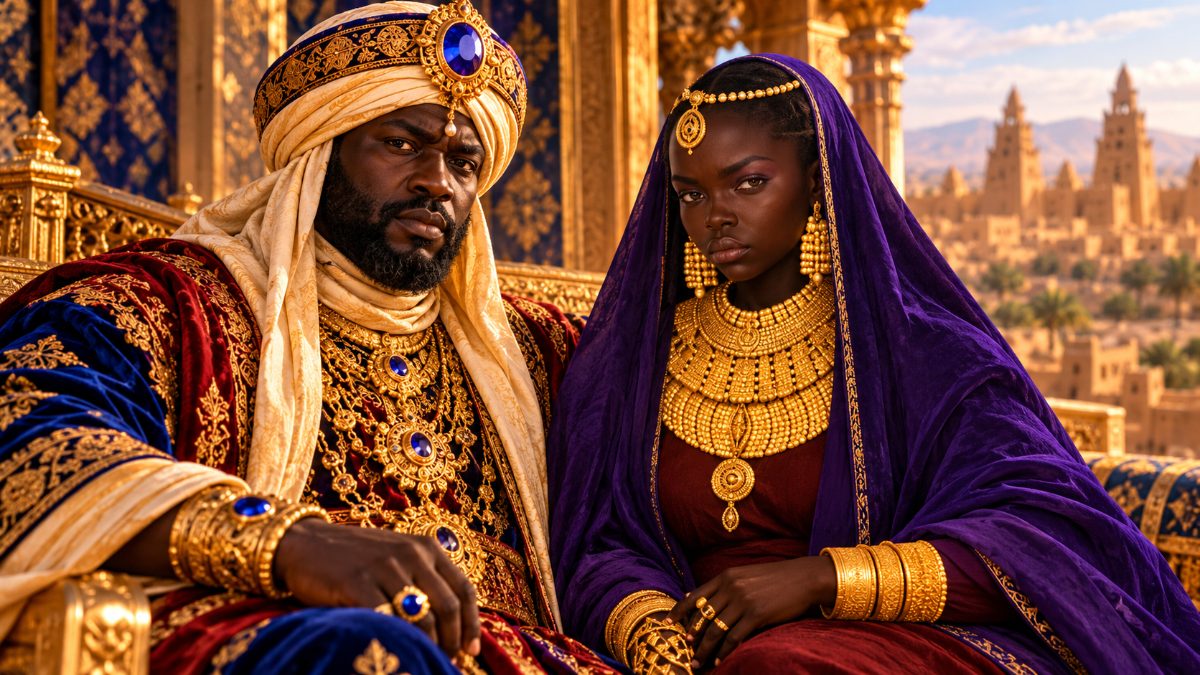 Inari Konte, also written Inari Kunate, was the senior wife and queen consort of Mansa Musa, the wealthiest ruler in recorded history, and one of the most powerful women in the medieval Mali Empire, though the historical record on her own life is frustratingly thin.
spio.comWhat we know
Very little is known about Mansa Musa's private life. It is believed he had a wife, Inari Kunate, with whom he had a son, Maghan. The name appears in different spellings across sources, Inari Konte, Inari Kunate, Inari Kanute, all referring to the same woman. The Konte (or Kunate) clan was a distinguished Malinke family, and marriage into it would have carried political meaning in a court built on alliances between noble lineages.
The first wife was known as the senior wife, and Mansa Musa's senior wife was Inari Kunate, who accompanied him on his pilgrimage to Mecca. That pilgrimage was the event that announced the Mali Empire to the rest of the medieval world. Mansa Musa's wife, Queen Inari Konte, also traveled with the emperor, and she brought with her "five hundred other women and her servants." Traveling with a retinue of that size across the Sahara and through Egypt was itself a statement of imperial power, and her presence signaled that this was not a private act of faith but a display of the full might of Mali.
The queen's role at court
Inari Kunate, described as "the queen of gold," took with her five hundred maids-in-waiting during the famous journey. The queen of Mali wielded so much political power, whose major function was the reception of tributes from various kingdoms. In the Malinke tradition, the senior wife held a recognized institutional position, not just a domestic one. She received tribute, participated in court governance, and carried authority in the emperor's absence.
After Mansa Musa
Following Mansa Musa's death, his son Maghan succeeded him as ruler of the Mali Empire. Musa ruled as mansa for twenty-five years and was succeeded by his son Magha, who reigned for only four years and was then succeeded by Sulayman. Musa's brother Suleiman struck, killing Magan and taking over the throne for himself. The empire that Inari had watched her husband build at its peak began its long unraveling almost immediately after his death.
The limits of the record
This is where the honest answer has to sit with the discomfort of what history did not write down. Medieval Arabic chroniclers documented courts, trade routes, gold weights and theology. The interior lives of queens, their words, their decisions, their grief, rarely made it onto the page. What survives is that Inari Konte held the highest position a woman could hold in the wealthiest empire of the medieval world, that she rode alongside Mansa Musa on the most famous journey of the age, and that she bore the son who would inherit it all. The rest was not recorded, or has not yet been found.
Where did the Soninke people originally come from? The Soninke, the people who built the Ghana Empire we have been tracing, are indigenous to West Africa, with their ancestral roots running deep into the Sahel, the semi-arid belt stretching across what is now southeastern Mauritania, western Mali and eastern Senegal.
 spio.com
No outside arrival is needed to explain them. Archaeological evidence supports an evolution of the Ghana Empire and other Mande states from roots in preceding local ancestral Soninke cultures such as that of Dhar Tichitt, rather than from North Africa or the Middle East.
Where the archaeology points
Archaeological evidence suggests that the regions where the Soninke are found were inhabited in ancient times, with stone settlements built on the rocky promontories of Tichitt-Walata and the Tagant cliffs of southern Mauritania. Ancestral settlements emerged around 1,000 BCE as small communities that evolved into larger villages by 600 BCE, with ironworking artifacts and trade-related structures confirming the Soninke's presence in the region since at least the late first millennium BCE.
The Soninke are a Mande-speaking ethnic group whose language belongs to the northwestern branch of the Mande family, and they originated in the Sahel region of West Africa, with archaeological evidence linking their ancestral cultures to prehistoric settlements in the Dhar Tichitt-Walata cliffs of southeastern Mauritania.
What the oral tradition says
The first ruler of the Ghana Empire was said by Soninke griots to be the semi-divine Dinga Cisse, who was sometimes said to have come with his people "from the East," meaning Aswan, Egypt or Mali. Theories of foreign origin are almost entirely doubted by scholars and are believed to result from later Eurasian cultural influences, namely Muslim Arab and French contact. The "from Egypt" story is almost certainly a later gloss, added after the Soninke converted to Sunni Islam and adopted Abrahamic genealogies as a way of lending prestige to their lineage. Their griots, the hereditary oral historians we already met in Sundiata's story, preserved a separate and older tradition: the epic of Wagadu, which places the founding of the empire firmly in the Sahel.
Their language and family
The Soninke speak a Mande language of the Niger-Congo family. That places them in the same broad linguistic family as the Mandinka people of the Mali Empire, which is why the gold fields passed so relatively smoothly from Soninke hands into the empire Sundiata Keita built: the two peoples shared deep cultural and linguistic roots.
What happened after Wagadu fell
When the Ghana Empire was destroyed, the resulting diaspora brought Soninke people to Mali, Mauritania, Senegal, Gambia, Burkina Faso, Côte d'Ivoire, Guinea-Conakry, the modern-day Republic of Ghana and Guinea-Bissau, where some of this trading diaspora was called Wangara. Those trading groups called Wangara helped spread Soninke people and their culture across much of Mali, Senegal, southern Mauritania and parts of Burkina Faso, The Gambia and Guinea-Bissau. They did not disappear when their empire fell. They dispersed and kept trading, which is how a people can lose a capital and keep a civilization.
What was Ibn Amir Hajib's official role in Cairo when Mansa Musa arrived in 1324? Abu al-Hasan Ali ibn Amir Hajib held the rank of emir and served as the governor of the district of Cairo where Mansa Musa was staying during the hajj stopover in 1324.
 spio.com
Abu al-Hasan Ali ibn Amir Hajib was an emir serving as the governor of the district of Cairo in which Mansa Musa was staying, and that local governorship is what put the two men in the same room, giving us one of the most important firsthand accounts of the Mali Empire ever recorded.
His title, emir, was a rank in the Mamluk Sultanate, the military ruling class that governed Egypt at the time. An emir at the district level was essentially a regional administrator appointed by the sultan, responsible for order, taxation and the reception of important visitors. Mansa Musa, arriving with a retinue said to number tens of thousands of people, would have been very much Ibn Amir Hajib's problem and privilege to host.
Why this matters for the historical record
Ibn Amir Hajib later relayed to the scholar al-Umari what he had learned of Mali from his conversations with Musa. In one such conversation, Ibn Amir Hajib had asked Musa how he had become king. Musa's answer is where we get the account of his predecessor sailing into the Atlantic Ocean and never returning, the story that threads back through this whole conversation.
While in Cairo, Mansa Musa told its governor, the Emir Abu al-Hasan Ali ibn Amir Hajib, how he came to rule. He was the man on the ground, and al-Umari, the Muslim Arab historian who visited Cairo shortly afterward, gathered Ibn Amir Hajib's recollections and committed them to writing. This account, recorded by al-Umari, has attracted considerable interest and speculation as a possible instance of pre-Columbian trans-oceanic contact.
The main point Mansa Musa seems to have been trying to make to Ibn Amir Hajib was that his predecessor's failed voyage paved the way to his becoming king. Without a district governor curious enough to befriend a passing emperor and remember what he said, none of that conversation would have survived.
Where is Granada? Granada is a city in southern Spain, and the one that mattered most to this conversation: it was the last capital of Moorish civilization in Europe, the final stronghold of the same Islamic world that connected Mansa Musa's Mali Empire to the Muslim Arab scholars who recorded it.
 spio.com
Granada is a city in southern Spain, and the thread we've been following makes it one of the most significant cities in Islamic history: it was the last capital of Moorish civilization in Europe, the final thread connecting the Muslim world of West Africa and the Arab scholars who documented the Mali Empire to the world Ibn Amir Hajib and Mansa Musa both lived in.
Where it sits
Granada sits at the foot of the Sierra Nevada Mountains, at the junction of the Darro and Genil rivers, in the south of the Iberian Peninsula, in the region now known as Andalusia, Spain. Its name may have been derived either from the Spanish word granada, meaning "pomegranate," a locally abundant fruit that appears on the city's coat of arms, or from its Moorish name, Karnattah (also written Gharnatah), possibly meaning "hill of strangers."
Why it matters for this conversation
In 711, the North African Muslims known as the Moors crossed the Strait of Gibraltar and quickly conquered the Iberian Peninsula, and throughout the Middle Ages, for over 700 years, Spain was a predominantly Muslim Arab society living under Muslim rule. As the Christian Reconquista pushed south over those centuries, the Moorish world shrank.
Granada reached its peak prosperity, becoming the capital of the Emirate of Granada under the Nasrid dynasty in 1238. Granada flourished culturally and economically for the next 200 years, but in the late 15th century internal feuds and a strengthened Spanish monarchy under Ferdinand and Isabella signaled the end of Moorish civilization in Spain.
That means Granada was thriving at exactly the same moment Mansa Musa was ruling Mali. The Moorish scholars, traders and diplomats who connected West Africa to the Arab world were part of the same Islamic civilization whose last European outpost was Granada.
The fall
On January 2, 1492, King Boabdil surrendered Granada to the Spanish forces, and in 1502 the Spanish crown ordered all Muslims forcibly converted to Christianity. The next century saw a number of persecutions, and later the last Moors still adhering to Sunni Islam were expelled from Spain entirely.
What survived
Granada's dominant sight today is the Alhambra, the last and greatest Moorish palace, and nowhere else does the splendor of that civilization, Al-Andalus, shine so brightly. The Moors made great advances in engineering, medicine, and classical Greek studies. Some of the great thinking of ancient Greece had been forgotten by Europe but was absorbed into Islam and given back to Europe via scholars in Spain. That is the civilization whose last city was Granada, and whose scholars were the very people who documented the Mali Empire, Mansa Musa, and the wealth of West Africa for posterity.
What cities and territories did the Songhai Empire control? The Songhai Empire, the West African state that rose to replace Mansa Musa's Mali Empire as the dominant power in the region, controlled an enormous sweep of territory anchored by three cities you already know from this conversation: Gao, Timbuktu and Djenné, all of them strung along the Niger River.
 spio.com
This is the empire that inherited the world Mansa Musa built and then went further. At its height it was, by most measures, the largest empire in African history.
The three cities at the heart of it
With its capital at Gao and managing to control trans-Saharan trade through centers like Timbuktu and Djenné, the Songhai Empire prospered throughout the 16th century. Each of the three had its own role.
- Gao: the capital and seat of power. The Songhai people established themselves in Gao around 800 CE, which became their capital in the 11th century. When the Mali Empire captured and held it, Gao remained under Malian command until the late 14th century, when, as the Mali Empire started disintegrating, the Songhai reasserted control.
- Timbuktu: the city Mansa Musa famously built up as a center of Islamic scholarship. Songhai seized Timbuktu, the largest city in the region, from the Tuareg who had recently taken it from Mali.
- Djenné: the great market city on the inland Niger Delta. By 1473 the other major trade center of the region, Djenné, also on the Niger, had been conquered.
How far the territory stretched
Centered on the middle reaches of the Niger River in what is now central Mali, the empire eventually expanded west to the Atlantic Ocean coast and east into present-day Niger and Nigeria. Going through it direction by direction:
- North Africa: the empire's territory stretched north through Mali reaching the salt mines at modern-day Taoudenni, the same salt trade that had made the Ghana and Mali empires wealthy.
- Middle East: the Songhai stretched east into Niger, from modern-day Niamey to Agadez, and into parts of Nigeria.
- South: south of the Niger, the Songhai gained control of parts of Burkina Faso and Benin.
- West Africa: toward the West African coastline, the empire stretched west along the Niger River into parts of Mauritania, The Gambia, Senegal and Guinea, though it did not extend fully to the Atlantic coast.
In total, the Songhai spread through portions of present-day Mali, Burkina Faso, Senegal, Guinea, Nigeria, Niger and Mauritania.
The administrative structure
The empire was divided into urban districts containing at least 35 cities, which blended into sub-urban districts and peripheral territories, with the furthest territories containing vassal states and tribes. At the empire's zenith, from 1460 to 1591, the government took the form of an absolute monarchy whose sovereign served as head of state, commander of the armed forces and head of government.
How it ended
The connection to Granada we traced in an earlier answer matters here. Morocco, just across the strait from Granada and part of the same Islamic world, delivered the killing blow. Under Askia Ishaq II, Moroccan forces utilizing firearms invaded the Songhai Empire, routed Songhai forces at Tondibi, Timbuktu and Gao, and though the Songhai launched retaliatory guerrilla actions, they failed to restore the empire, as the economic and administrative centers remained under Moroccan control. The same gunpowder technology that had helped end Moorish Granada gave Morocco the edge over the largest empire Africa had ever seen.
What was Niani like as a city at the height of the Mali Empire? Niani, the capital that Sundiata Keita rebuilt after his victory at the Battle of Kirina, was a large, walled, cosmopolitan city of at least 100,000 people at its peak, straddling the gold trade routes of the upper Niger and drawing Muslim Arab merchants, imperial couriers and scholars from across the medieval world in
to a single, carefully ordered metropolis.
 spio.com
Where it stood and how it began
Sundiata chose to rebuild the then-destroyed city of Niani, near the Sankarani River, as his new capital. It lies on the left bank of the Sankarani River, a tributary of the Niger. A former administrative centre of Kangaba, a small state subservient to the old Ghana Empire, it was named the capital of the new empire of Mali by Sundiata. The geography was deliberate: Sundiata identified Niani as a strategic location due to its proximity to the valuable Bure goldfields, the same fields that had drawn merchants north and south for generations.
What the city looked like at its height
Niani was once a large walled city of tens of thousands of people, the ancient capital of the Mandingo Empire, one of Africa's great pre-colonial powers. The city had at least 100,000 inhabitants in the 14th century. The mansa and his courtiers lived in Niani, which was a centre of trade and commerce.
Niani remained the capital of the Muslim Mandingo empire for 300 years, reaching its zenith as Mali's political, commercial and caravan centre for gold, salt, kola nuts and slaves during the reign of Mansa Musa.
The city was not a single compact block but a dispersed, layered settlement. Many Berber Arabs settled in Niani as a result of trans-Saharan trade. Ibn Battuta's account indicates that the city had a separate quarter for white merchants, meaning the foreign traders from North Africa and the Muslim Arab world who had made Niani their base. The area soon became a hub for African and Arab traders.
The palace and the audience hall
Ibn Battuta describes the king's palace in some detail, in particular the audience hall, which may be the same as that built by Abu Ishaq al-Saheli a decade or two earlier. Al-Saheli was the Andalusian architect Mansa Musa brought home from his famous pilgrimage to Mecca. The hall he left behind became one of the monuments visitors talked about. It was described as "square, surmounted by a cupola, which he covered with plaster and decorated with arabesques in dazzling colours," and the historian Ibn Khaldun called it an "admirable monument."
On certain days the sultan held audiences in the palace yard, where there was a platform under a tree, with three steps, carpeted with silk and fitted with cushions, and over it an umbrella, a sort of pavilion made of silk surmounted by a bird in gold, about the size of a falcon.
The machinery of empire
Couriers left imperial Niani daily on horseback, and those who arrived from the provinces reported to the griot. The griot, the hereditary historian and keeper of oral record, was not merely a performer but a state official: the empire's intelligence and memory ran through him. Every year merchants entered Mali via Oualata with camel loads of salt to sell in Niani, and a camel load of salt could fetch ten dinars worth of gold in the north and 20 to 40 in the south. The price spread tells you how far Niani sat from the source and how much it charged for the privilege.
What the scholars said about the people
Ibn Battuta wrote that the people of the city possessed admirable qualities, were seldom unjust, had a greater abhorrence of injustice than any other people, and that there was complete security in their country: neither traveller nor inhabitant had anything to fear from robbers or men of violence. For a medieval city that size, moving that much gold, that was not a small thing.
What happened to it
Raids by Songhai Empire cavalrymen in the early 15th century marked the beginning of Niani's gradual decline, and after the Mali Empire declined, Niani lost its importance and became a small town again. Today the site sits on the Guinea side of the border with Mali. Archaeological excavations in the 1920s first identified the site, and Guinean-Polish missions in 1965 and 1968 confirmed that the area around Niani was once densely populated. The city that commanded half the world's gold supply is now a quiet village, and the griots are still there.
How far is Aswan from the Sahel region where the Soninke originated? Aswan, the ancient Egyptian city at the southern tip of Egypt on the Nile River, sits roughly 4,300 to 4,500 km east of the Soninke heartland in the western Sahel, separated by the full width of the Sahara Desert.
 spio.com
To put that number in perspective: the entire continental United States, coast to coast, is about 4,500 km wide. The Soninke and ancient Egypt were not neighbors. They were at opposite ends of Africa's great desert.
Where each place actually sits
Aswan lies on the east bank of the Nile River in southern Egypt, at the base of the First Cataract of the Nile, the site traditionally taken as the boundary between Egypt and Nubia. Its coordinates put it at roughly 24°N, 33°E, deep in the northeastern corner of the African continent.
The Soninke ancestral homeland is as far west as you can go and still be in the Sahel. Their ancestral cultures are linked by archaeology to the Dhar Tichitt-Walata cliffs of southeastern Mauritania, and most of the Soninke people are concentrated in the valley of the upper Senegal River and along the Mali-Senegal-Mauritania border between Nara and Nioro du Sahel. That core zone sits at roughly 15°N to 17°N, and around 8°W to 10°W, nearly 41 degrees of longitude west of Aswan.
What lies between them
The Sahara fills the gap almost entirely. The Sahel itself is a belt up to 1,000 km wide that spans 5,400 km from the Atlantic Ocean to the Red Sea, and the western Soninke homeland sits at the Atlantic end of that belt while Aswan sits at the Nile end, closer to the Red Sea than to Mali.
The straight-line distance, calculated from the coordinates, is roughly 4,300 to 4,500 km. An overland journey following the routes available in the medieval period would have been considerably longer, curving north through the Sahara or south around it through Sudan.
Why this matters for the story we have been following
This distance explains something important about how Mansa Musa's pilgrimage reached Cairo. The Mali Empire's heartland was in the western Sahel, far closer to the Atlantic coast than to Egypt. Aswan was the ancient Egyptians' gateway to Africa in the sense of the African interior to its south, meaning Nubia and Sudan, not West Africa. West Africa required crossing the Sahara horizontally, which is exactly what the trans-Saharan trade routes did, and what Mansa Musa's enormous caravan accomplished on its way to Cairo and then to Mecca.
It also explains why, as we covered earlier, the Muslim Arab scholars who recorded the Mali Empire were doing so at a remove: Ibn Amir Hajib and al-Umari were working from accounts gathered in Cairo, itself about 685 km north of Aswan, which placed them even further from the Soninke world. The Soninke built their empire in one corner of the continent; the scholars who documented it were writing from the opposite corner. That the record survived at all is its own kind of marvel.
How did Mansa Musa become Lord of the Mines of Wangara? Mansa Musa, the ninth mansa of the Mali Empire, did not earn the title Lord of the Mines of Wangara through a single conquest or ceremony: he inherited it structurally, because the throne he took in around 1312 already sat directly on top of the most productive gold-producing region in the medieval world.
 spio.com
The title was a plain statement of fact about who controlled what. "Lord of the Mines of Wangara" was one of Mansa Musa's titles because he was in control of all the gold mines there. He also held the titles Emeri of Melle and Conqueror of Ghanata, among others. Together they read less like honorifics and more like a property deed.
What Wangara actually was
Wangara is a name that medieval Muslim Arab geographers used for the gold-bearing territories of the western Sudan, and it covered the two great goldfields the Mali Empire sat on top of. According to the historian Levtzion, there were three principal goldfields in the region: Bambuk, between the Senegal and Faleme rivers; Bure on the Upper Niger; and the Akan goldfields further south, and Bambuk may have been the very "island of gold" the Arab sources called Wangara. The name Wangara itself also referred to closely related groups of northern Mande-speaking traders, Soninke and Malinke, who were identified primarily by their involvement in long-distance trade and Islamic scholarship, and who are associated with the establishment of the medieval empires of Ghana and Mali. The territory and the people who mined and moved the gold shared the same name.
How the mines came to him
The foundation was laid long before Mansa Musa was born. The first emperor, Sundiata Keita, expanded the borders and secured the goldfields of Bambuk and Bure. That conquest, the one Sundiata achieved at the Battle of Kirina, is what made everything else possible. By the time Mansa Musa sat on the throne, the mines were already the empire's beating heart.
It is known from local manuscripts and travellers' accounts that Mansa Musa's wealth came principally from the Mali Empire's control and taxing of the trade in salt from northern regions and especially from gold panned and mined in Bambuk and Bure to the south. The mansa did not go down into the mines. He taxed what came out of them.
The mansa claimed all the gold nuggets, but gold dust was available for trade. That division between nuggets and dust was itself a mechanism of control: every large piece of gold was the king's personal property by law, which kept the wealth concentrated at the top while enough dust circulated to keep the trade routes alive.
Gold was mined first at Bambuk on one of the tributaries of the upper Senegal River, and later at Bure on the headwaters of the Niger River, with the location of the mines shifting as sources in the west became exhausted and new ones were discovered further east. Mansa Musa's reign happened to coincide with peak production at Bure, which is why his particular tenure became legendary.
Why the title carried so much weight
At its height, Mali supplied nearly two-thirds of Europe's gold through the trans-Saharan trade. The trans-Saharan trade network connected the mines to North Africa, and from there to the Mediterranean world. When Mansa Musa arrived in Cairo on his hajj, he was not just a king from a distant empire: he was the man who controlled the tap that fed Europe's gold supply. The title Lord of the Mines of Wangara was the medieval world's way of saying that.
The earliest mention of Wangara trading activity comes from al-Bakri, writing before 1094, who describes the Wangara as conducting the commerce in gold dust from the goldfields of Bure and Bambuk up to the markets of ancient Ghana. That means the system Mansa Musa inherited had been running for at least three centuries before he was born. He did not build it. He presided over it at its absolute peak.
What is the Alhambra? The Alhambra is a palace and fortress complex crowning a hill above Granada, in southern Spain, widely regarded as the supreme masterpiece of Moorish Granada architecture and the physical embodiment of the same Islamic Mediterranean civilization that connected Mansa Musa's Mali Empire to the Muslim Arab scholars who re
corded it.
 spio.com
Background
The Alhambra is a sprawling palace and fortress complex crowning a hill above the city of Granada in southern Spain, built primarily between the 13th and 14th centuries by the Nasrid Palaces dynasty, the last Muslim rulers of the Iberian Peninsula, representing the zenith of Islamic Mediterranean art and architecture in Western Europe. The name itself tells you what it was made of: its name, meaning "the red" in Arabic, likely comes from the reddish tapia (rammed earth) used for its outer walls.
How it was built, and by whom
The Alhambra began as a modest 9th-century fortress before the Nasrid sultan Muhammad I chose it as his royal residence in 1238. Over the next 150 years, his successors transformed it into a palatial city within walls, with mosques, baths, gardens, barracks, and some of the most exquisitely decorated rooms ever created.
Throughout the 13th, 14th and 15th centuries, the fortress became a citadel of high walls and defensive towers, housing two main areas: the military zone or Alcazaba, barracks of the royal guard, and the medina or palatine city, where the famous Nasrid Palaces and the remains of the houses of nobles and commoners who lived there stood. The Nasrid Palaces were used as the residence of the Nasrid monarchs until the Christian Reconquista conquest of Granada in 1492.
What makes it extraordinary
The design principle is unlike anything in European architecture of the same era. The Nasrid palaces are organized not around a facade but around enclosed courts, each built about still water. The Court of the Myrtles centers on a long, mirror-flat pool that doubles the arcades and the Comares Tower in its surface; the Court of the Lions is quartered by four narrow channels that meet at a central fountain.
The Court of the Lions has an ornately decorated gallery with white marble columns and a central fountain with an alabaster basin supported by marble lions. The Hall of the Ambassadors inside the Comares Tower boasts a 75-foot-high dome and served as a grand reception room.
The walls are not simply decorated: they speak. Much of the inscription is poetry written for the building by Ibn Zamrak, the Nasrid court poet, so the architecture literally speaks in the first person: the fountain, the arches and the walls describe themselves and praise their patron. The line you meet most often on the Alhambra's walls is the dynastic slogan wa la ghalib illa Allah: "there is no victor but God," which Nasrid craftsmen repeated through stucco and shield roundels, inside a body of about 10,000 inscriptions.
What happened in 1492 and after
The surrender of Granada to the Catholic Monarchs in 1492, which marked the end of Muslim rule in Spain, took place at the Alhambra. When the Catholic Monarchs conquered Granada, they were so awed by the Alhambra that they preserved much of it, adding a Renaissance palace alongside the Moorish Granada structures. Charles V, who ruled in Spain as Charles I, rebuilt portions in the Renaissance style and destroyed part of the Alhambra in order to build an Italianate palace designed by Pedro Machuca.
Why it connects to this conversation
This is the city and the civilization that Ibn Amir Hajib's world was part of, the same Islamic Mediterranean network that moved scholars, gold, pilgrims and knowledge between Mali, Cairo and the western edges of Europe. The complex represents a unique cultural crossroads: Islamic architecture preserved and augmented by Christian rulers, embodying centuries of convivencia (coexistence) and conflict between the two civilizations on the Iberian Peninsula. The Alhambra is what was lost when Granada fell in 1492, the same year Christopher Columbus sailed west under the Spanish crown, and it is the reason scholars like al-Umari and the world Ibn Amir Hajib moved through still echo across the historical record of West Africa.
Why was Djenné such an important trade center in the Songhai Empire?Djenné, the ancient city on the inland Niger Delta of present-day Mali, was the Songhai Empire's great southern market hub because its geography made it the unavoidable crossroads where gold and kola from the southern forests, salt from the Sahara, and food from the river delta all changed hands before moving on to Tim
Djenné, the ancient city on the inland Niger Delta of present-day Mali, was the Songhai Empire's great southern market hub because its geography made it the unavoidable crossroads where gold and kola from the southern forests, salt from the Sahara, and food from the river delta all changed hands before moving on to Timbuktu Djenn and the wider trans-Saharan trade network.
Where it sat and why that mattered
Djenné sits on the Bani River, in a floodplain between the Bani and Niger rivers, and becomes an island during seasonal flooding. That geography sounds like a liability. It was actually a superpower. Goods were moved overland with pack animals such as the camel or donkey and in the middle Niger Delta by boats, which moved goods to transshipment points such as Djenné for further distribution in the Saharan, Sahelian, and forest zones. Everything that couldn't go by camel came by boat, and everything that couldn't go by boat came by camel, and both routes met at Djenné.
Djenné grew as a trade hub between the central and western Sudan and Guinea's tropical forests. That is the key axis: the Sahara above, the forest belt below, and Djenné sitting exactly in the middle.
What was actually traded there
By the 14th century, gold, kola, and slaves from the southern savanna, salt and manuscripts from the Sahara, and the staple foods of the inland Niger Delta were bartered here in an extensive web of trade reaching as far as northern Africa and Europe. By the time the Songhai Empire absorbed the city, Djenné had become one of the foremost market centers on the African continent.
It was a long-standing point of exchange for caravans carrying salt, gold, and enslaved Africans bound for the Atlantic Ocean or trans-Saharan slave trades.
Why Sonni Ali fought so hard to take it
The Songhai ruler Sonni Ali already controlled Timbuktu, but Timbuktu without Djenné was a trading city without its southern supply line. Securing the vital corridor of trade along the Songhai Empire's western frontier required capturing the southern trading center of Djenné. After a siege lasting 6 months, it was conquered by Sonni Ali and passed definitively under the Songhai Empire, following which it distinguished itself as one of the richest and most important cities in all of Africa.
The partnership with Timbuktu
Djenné and Timbuktu were not rivals. They were a system. Ideas as well as goods were exchanged at Djenné and, with its trading partner Timbuktu 220 miles to the north, the city became an important site of Islamic Mediterranean religion and scholarship. Later sources, including local histories written in Arabic, describe the continued importance of riverine trade between Djenné and Timbuktu and the essential provisioning of Timbuktu Djenn with foodstuffs and other products from Djenné. The two towns were the northern and southern centers for Islamic scholarship and learning on the Middle Niger.
Sonni Ali accommodated the community of Muslim scholars at Djenné, where they remained great preservers of Islamic learning and continued to produce work on Islamic philosophy and the sciences through the 17th century.
A city with roots older than any empire
Djenné's commercial DNA ran deep. Inhabited since 250 BCE, Djenné became a market centre and an important link in the trans-Saharan gold trade. The site it grew up near, Djenné-Jeno, was an important trading center that arose about 250 BCE in the inland delta of the Niger River and flourished until the 11th century CE. Early ceramic and metallurgical findings have been cited as evidence that the inland Niger Delta was integrated into trans-Saharan exchange networks well before the Muslim Arab conquests of North Africa. By the time the Songhai took it, the city had been doing this work for over a thousand years. The empire didn't create Djenné's importance. It inherited it.
Who is Sonni Ali?Sonni Ali, also known as Sonni Ali Ber ("Ali the Great"), was the warrior-king who took a small tributary state on the Niger River and forged it into the Songhai Empire, the largest empire in African history, by seizing the very cities at the center of this conversation: Timbuktu, Djenné and Gao.
Sonni Ali, also known as Sonni Ali Ber ("Ali the Great"), was the warrior-king who took a small tributary state on the Niger River and forged it into the Songhai Empire, the largest empire in African history, by seizing the very cities at the center of this conversation: Timbuktu, Djenné and Gao.
Quick facts
- Full name: Sonni Ali; also written Sunni Ali, Si Ali, Sonni ʿAlī
- Epithet: Ber, meaning "the Great" in the Songhai Empire language
- Born: Around 1430, in the region of Gao, in what is now Mali
- Died: 1492, reportedly drowning while crossing a river on his return from a military campaign against the Gurma
- Reign: 1464 to 1492
- Dynasty: The Sonni dynasty (also written Sunni dynasty), of which he was the 15th ruler
- Father: Sonni Muhammad Daʾo, the 10th Sonni ruler
- Successor: His son, Sonni Baru, who was overthrown within months
- Title: King of Songhai
Their story
When Sonni Ali ascended the Songhai throne around 1464, the kingdom comprised only a small area in the upper Niger valley around its capital, the prosperous trading city of Gao. The Mali Empire, which we have been tracing throughout this conversation, was fracturing. The Songhai people had managed to throw off the domination of the Mali Empire, and hoped to obtain territorial benefits, like other West African peoples, from its disintegration.
Sonni Ali was born the son of Sonni Muhammad Daʾo. His mother was from Fara, an area that was still heavily pagan, and Ali was raised in this milieu. As a Sonni, he also received an Islamic Mediterranean education, but practiced a syncretic, unorthodox faith. That mixed inheritance, warrior tradition on one side and Islamic schooling on the other, defined both his power and the controversy that followed him.
What he achieved
Around 1468, Sonni Ali changed the traditional Songhai tactic of small and sporadic raids on its enemies to a more sustained campaign of permanent territorial expansion. With an army equipped with armored cavalry and the only naval fleet in North Africa, which he deployed on the Niger River, he was able to conquer the rump of the old Mali Empire.
The two conquests that mattered most to this story are Timbuktu and Djenné.
His first major conquest was the ancient city of Timbuktu Djenn. Controlled by the Tuareg since the Malian Empire retreat a few decades earlier, in 1469 the Timbuktu-koi ʿUmar asked for Songhai protection. Sonni Ali answered with an army and took the city.
Djenné, the crossroads market hub we just covered, was harder. Aware of the benefits of controlling Sudanese commerce, Sonni Ali turned to the conquest of the wealthy trading city of Djenné on the Bani River near its confluence with the Niger. His seven-year siege of the city resulted in its conquest in 1473. Seven years to take one city tells you how valuable the prize was.
He effectively mixed leniency, with conquered warriors invited to join his own army, with complete ruthlessness, infamously executing many of the particularly resistant Fulbe tribe. Hence the king earned his epithet, "Sunni the Merciless."
Little is known about the actual administration of Songhai during Sonni Ali's time except that he divided conquered territories into provinces and appointed trusted lieutenants to govern them.
The controversy that defined his legacy
The ulama, Islamic scholars, disapproved of the way that Sonni Ali mixed traditional religious practices with Islam. They eventually declared that Sonni Ali was not a Muslim and could not be the rightful ruler. This was not a minor theological dispute. The scholars of Timbuktu, who ran the intellectual institutions Mansa Musa had built, became his enemies, and their chronicles shape how history remembered him. Their hostility colored almost everything written about him in the primary Arabic sources.
The Timbuktu chronicle, the Tarikh al-Sudan, notes that the Songhai king played on his image as a magician of the indigenous animist religion to strike fear into his enemies. Whether that was genuine belief or calculated theater, it worked.
What came after him
On his return from an expedition against the Gurma in late 1492, Ali died, possibly drowning while crossing a river. He was succeeded by his son, Baru, who tried to reject all Islamic influence, and was therefore felled by a Muslim-sanctioned coup led by Askia Muhammad within 4 months.
Under the rule of Sonni Ali, the Songhai had surpassed the Malian Empire in area, wealth, and power, absorbing vast regions of the Mali Empire. The man who replaced his son, Askia Muhammad I (also called Askia the Great), would consolidate what Sonni Ali had seized by force and turn it into the administrative empire the history books remember. But none of that was possible without Sonni Ali first taking Timbuktu, Djenné and Gao and making them one.
Why were the griots called jeliw? Is that the origin of the word "Jew"?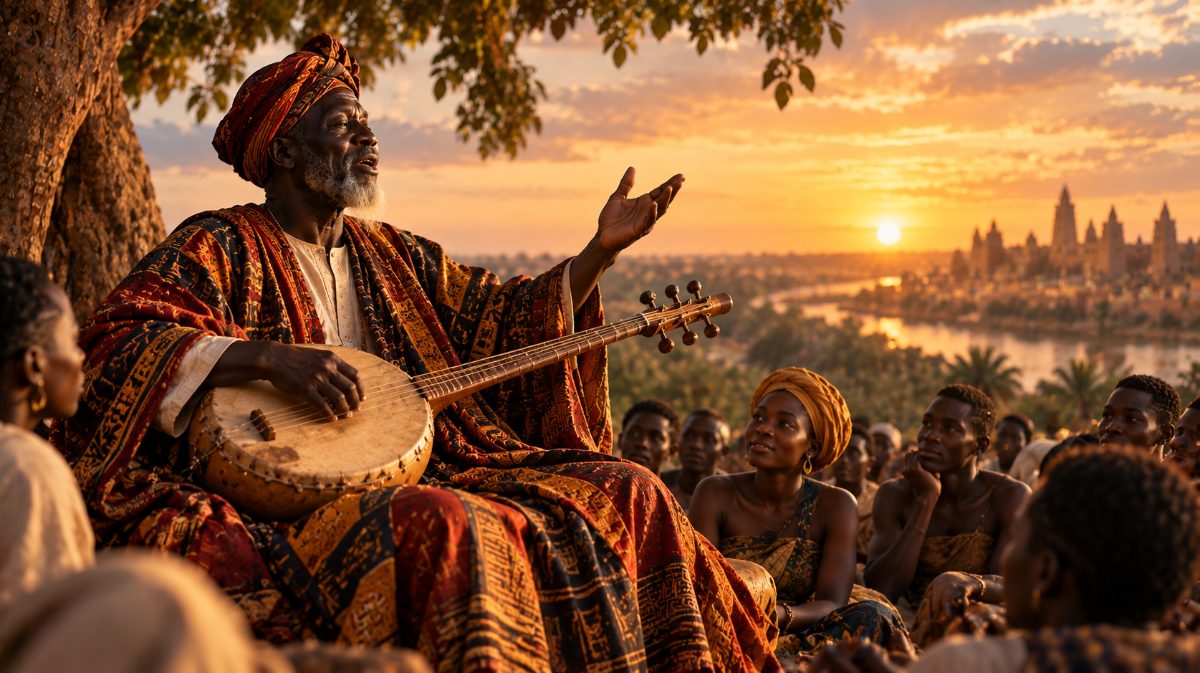 The griots of the Mali Empire were called jeliw because jeli, the Manding word for a single griot, literally means "blood" in the Manika language, and jeliw is simply its plural form; the word has no connection whatsoever to the English word "Jew", which comes from a completely different root in ancient Hebrew and Gree
k.
spio.comWhere jeliw comes from
Jeliw is the Manding plural of jeli, the name used for hereditary specialists who carry genealogies, epics, praise poetry, law and history in Manding societies. The word jeli in the Mandenka language literally means "blood." The logic behind the name is profound: the jeli's knowledge was not learned from a book or acquired at a school. It was passed through bloodlines, generation to generation, parent to child, making the tradition itself something that ran in the blood.
In the West African languages of Bamanakan and Mande Kan, these wordsmiths are known as jali or jeli, depending on the region, with the plural forms jeliw or jalolu. A female griot is referred to as a jelimuso or jalimuso, with muso meaning "woman."
The Manding term jeliya, meaning "musicianhood," is sometimes used for the knowledge of griots, indicating the hereditary nature of the class. Jeliya comes from the root word jeli, which is also the title given to griots in areas corresponding to the former Mali Empire.
Jeliya, the art of the jeli, goes back to the 13th-century origins of the Mali Empire, although the institution of the griot in West Africa probably stems from the even earlier Ghana Empire.
Why "griot" is a different word entirely
The Mande languages spoken in the area don't use the word "griot" or anything like it; the Bambara word, for example, is jeli. "Griot" is the word that French colonizers and later English speakers adopted. The word "griot" may derive from the French transliteration guiriot of the Portuguese word criado, which is the masculine singular term for "servant." The modern term griot stems from a 17th-century French word, guiriot, whose origin is not entirely clear. The people themselves never called their tradition by that name.
Why jeliw and "Jew" are completely unrelated
The word "Jew" traces back through Latin Judaeus and Greek Ioudaios to the Hebrew Yehudi, meaning a person from the tribe or kingdom of Yehuda (Judah), named after the patriarch Judah, son of Jacob. That is a Semitic root on the opposite side of the world from the Niger River. Jeli is a Mande word meaning blood, native to West Africa. The two words sound vaguely alike to an English ear, but they share no ancestry, no linguistic family, no geography and no history. This is what linguists call a false cognate: two words that resemble each other purely by coincidence.
The jeliw were the living libraries of the Mande world. The griots had a much broader, diversified and significant role than that of a mere storyteller: in the traditional, pre-colonial era they were the principal political advisors to kings, chiefs and other high government officials. In addition to being singers and social commentators, griots are often skilled musicians, playing instruments including the kora, the khalam, the balafon and the ngoni. Great kings throughout history had griots: Sundiata Keita, Kankan Musa, and many others. The word for what they were came from inside the culture, rooted in blood and lineage. The word outsiders gave them came from a Portuguese colonial term for servant. Neither path leads anywhere near Hebrew.
You mentioned Mansa Musa was the grandnephew of the kind who was lost at sea. Wasnt the sister’s son next in line according to African tradition? Mansa Musa, the ninth mansa of the Mali Empire, was not the sister's son of his predecessor but rather a grandnephew of the Mali founder Sundiata Keita through the male line, and the succession system of the Mali Empire at the royal court was not straightforwardly matrilineal, making the question more complicated than
 a simple yes or no.
 spio.com
First Cataract, a small correction on the earlier answer: the king who vanished at sea was not Mansa Musa's uncle, he was Mansa Muhammad ibn Qu, the eighth mansa. Musa is believed to be the grandnephew of Sundiata Keita, the empire's founder. His father, Faga Leye, was the son of Mande Bori, Sundiata's brother. So Musa's connection was through the founding generation, two steps back, not through his immediate predecessor.
How Mali succession actually worked
You're right that matrilineal succession, where a king's sister's son inherits rather than his own son, was a real and documented practice in the region. Ibn Battuta, the Moroccan traveler who visited the Mali Empire, recorded that in Walata, none of the inhabitants traced his genealogy through his father, but rather through his maternal uncle, and a man passed on his inheritance only to the sons of his sister, to the exclusion of his own sons.
But Walata was not the capital. The matrilineality practiced in Walata does not appear to have been in effect in the capital, at least with regard to the succession of rulers.
The deeper structure of Mande kinship was neither straightforwardly patrilineal nor matrilineal but combined elements of both. The formal succession of the mansa operated primarily through the male line, moving from father to son or between brothers, while inheritance and clan membership were traced through the mother's line in significant dimensions of Mande social organization.
In practice, the Mali throne passed all over the place. Brothers succeeded brothers. A court official named Mansa Sakura, who was formerly enslaved and not even of the Keita dynasty, usurped the throne following a period of political instability and led Mali to considerable territorial expansion. And scholars who have studied the chronology closely have noted that succession was often an ad hoc affair. Scholars conclude that historians have relied too heavily on Ibn Khaldun's assurances of legitimate succession and that it was really an ad hoc affair without clearly established rules.
The one time the female line did produce a mansa
There is one striking example of female-line succession at the top. Abu Bakr, the fifth mansa of the Mali Empire, was the first mansa to succeed through the female line. He was a son of a daughter of Sunjata, the founder of the Mali Empire. It remains debated whether this marked a return to a traditional pattern of succession that had been ignored by his predecessors, or if it was a break from traditional succession caused by political instability.
So the short answer: the matrilineal principle was alive in Mali society and visible in places like Walata, and it produced at least one mansa. But it was never the locked-in rule at the center of power. The throne at the capital followed whoever could claim Keita blood, hold the court's loyalty, and survive the politics. Mansa Musa fit all three.
Who is Mansa Sakura?Mansa Sakura was a freed slave, or client of the royal court, who seized the throne of the Mali Empire around 1285, held it for roughly 15 years, and is credited by the historian Ibn Khaldun with expanding Mali's borders from the Atlantic Ocean coast to the east of the Niger bend, before being killed on his return from
Mansa Sakura was a freed slave, or client of the royal court, who seized the throne of the Mali Empire around 1285, held it for roughly 15 years, and is credited by the historian Ibn Khaldun with expanding Mali's borders from the Atlantic Ocean coast to the east of the Niger bend, before being killed on his return from the hajj.
Quick facts
- Full name: Sakura; also written Sakoura (French), Sākūra (Arabic)
- Status at birth: Commonly stated to have been a former slave of the royal court, though it is not entirely clear he was literally enslaved. Ibn Khaldun refers to him by the term mawlā, which can be translated as "client," and may imply that he was formerly enslaved but had been freed by the Keitas.
- Dynasty: Not a member of the ruling Keita dynasty.
- Reign: Around 1285 to around 1300
- Predecessor: Mansa Abu Bakr
- Successor: Mansa Qu
- Died: Around 1300, at Tajura, in Ifriqiya (the region covering modern Tunisia and northwest Libya).
- Known from: Primarily from an account given by Ibn Khaldun in his Kitāb al-ʿIbar.
Their story
Sakura came to power at a moment of serious instability. The Mali Empire had just cycled through a series of weak and short-lived rulers from the Keita dynasty, including the sadistic Mansa Khalifa, who was eventually deposed and killed, and the easily controlled Abu Bakr who followed him. On Abu Bakr's death, Sakura seized the throne and managed to restore order to the deteriorating kingdom.
His exact position at court before taking power is debated. In oral tradition he is called jonni, meaning "little slave." It is possible he was a member of the tontajon taniworo, the sixteen clans of freemen who had the right to bear a quiver, who are metaphorically referred to as slaves. Sakura seems to have been the only mansa to take the field himself other than Sundiata Keita, making him and Mansa Mahmud IV the only sitting mansas ever to lead an army in battle.
What he built
He usurped the throne following a period of political instability and led Mali to considerable territorial expansion. During his reign, trade between the Mali Empire and the rest of the Muslim Arab world increased. He expanded the empire's territory significantly, pushing its boundaries eastward toward the great bend of the Niger and incorporating the important trading city of Gao into the empire's commercial network. He extended the empire along the Gambia River to the sea and encouraged trading activities. After a hiatus during the years of instability, merchants from North Africa began traveling to Mali again.
The question of Gao is complicated. Ibn Khaldun credits Sakura with the conquest of Gao, but subsequently gives a conflicting account that Gao was conquered during the reign of Mansa Musa. It is possible that Sakura had indeed conquered Gao, but that the founder of the Sunni Ali dynasty liberated it, only for Musa to reassert control decades later.
The hajj and his death
Sakura is remembered for performing his own pilgrimage to Mecca, establishing the precedent that would be so spectacularly fulfilled by Mansa Musa. His pilgrimage, though less well documented than Musa's, helped to establish Mali's connections to the wider Islamic Mediterranean world and to demonstrate to the Islamic scholarly and commercial communities of North Africa and the Middle East that the rulers of Mali were serious participants in the global community of Islam.
Sakura was killed on his return journey from Mecca, but not before he had brought back scholars, books and other resources that contributed to the cultural development of the empire. The two accounts of his death differ: Ibn Khaldun says he was killed at Tajura, while oral tradition says that Kon Mamadi, a grandson of Sundiata, killed him himself with the help of Sakura's own daughter.
Why he was written out
This is where Sakura connects directly to the question you were asking about succession. Because he was not Keita, the griots largely erased him. The historian Djibril Tamsir Niane suggested that Sakura's absence from oral tradition may be a deliberate exclusion on the part of oral historians, and it is possible that the few accounts of Sakura recorded in oral tradition are later additions based on Ibn Khaldun's written account. Some historians have interpreted Sakura's takeover as an attempt to ensure the survival of the Keita dynasty rather than an attempt to establish his own dynasty, which would explain why power returned to the Keita line the moment he died. Wali's son, Qu, succeeded him, shifting the lineage back to the Keita line. The empire then moved through Qu and his son Muhammad ibn Qu, the king who vanished at sea, before eventually reaching Mansa Musa.
Sakura sounds Japanese, why are there so many similar cognates? Kofi, Sakura etc? What's the relationship?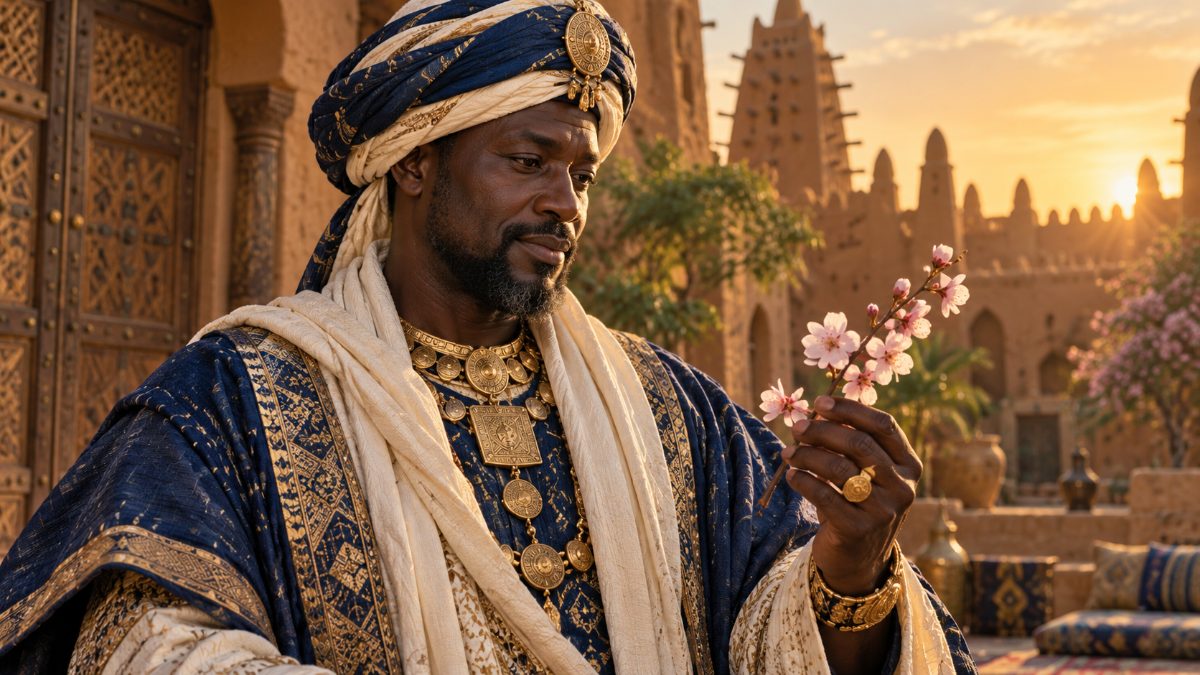 Yes. In Japanese, sakura (桜) means cherry blossom. In Mali, Sakura was the name of Mansa Sakura, who ruled the Mali Empire from about 1285 to 1300. And the similarities between Japanese and African languages are plentiful.
spio.comIn Japanese, sakura (桜) is the cherry blossom. In Mali, Sakura was a king. Mansa Sakura ruled the Mali Empire from about 1285 to 1300, expanding it as far as the ocean in the west. The historian Ibn Khaldun wrote his name Sabkara, and Mali's oral traditions say Sekura.
Japanese and many African languages, especially Niger-Congo languages such as Swahili, Shona, Yoruba and Igbo, are built on a consonant-vowel (CV) structure, and they share an extraordinary number of sound overlaps. Nani means "who" in Swahili, and in Japanese, nani (何) means "what." Both are the question word at the start of a sentence. I believe firmly that the similarities are not coincidental, especially given the same meaning for various words.
Kofi, Kojo and Koji
- Kojo / Koji: Kojo, also written Kwadwo, is the Akan name for a boy born on Monday. Koji is a common Japanese boys' name, often written with 二, "two," for a second son.
- Kofi: the Akan name for a boy born on Friday, from the same family of day names as Kojo.
- Ama: the Akan name for a girl born on Saturday. In Japanese, ama (海女) are the famous women free divers of Japan's coasts.
Exact Shared Names and Meanings
- Obama: a Luo surname in Kenya, from obam, "to lean or bend." In Japanese, Obama (小浜) is a surname and a city, meaning "little beach."
- Tanaka: in Shona (Zimbabwe), a popular given name meaning "we are in a state of goodness" or "our lives have been made beautiful." In Japanese, Tanaka (田中) is one of the most common surnames, meaning "in the rice field."
- Aina: a Yoruba (Nigeria) name for a child born with the umbilical cord around the neck. In Japanese, Aina (愛菜) is a popular girls' name meaning "love" and "greens."
- Chika: a common Igbo (Nigeria) name meaning "God is supreme." In Japanese, Chika (千佳) is a girls' name from "thousand" and "beautiful."
- Fumi / Funmi: Funmi is short for the Yoruba name Olufunmilayo, "God gave me joy." In Japanese, Fumi (文) is a traditional name meaning "writing."
- Edo: the historic name of Tokyo, Japan. It is also the name of a major people, language and state in southern Nigeria.
- Kano: a great ancient city and state in northern Nigeria. In Japan, Kano (狩野) is a well-known surname, carried by the famous Kano school of painters.
Words That Sound the Same
- Moto: in Japanese, moto means "source" or "origin," as in Ajinomoto (味の素, "the essence of taste"). In Swahili and Shona, moto means "fire."
- Haraka: means "quickly" or "hurry" in Swahili. It sounds like the Japanese Haruka (遥か, "distant") and hataraku (働く, "to work").
- Zō / Nzou: zō (象) means "elephant" in Japanese. In Shona, elephant is nzou.
- Oka / Òkè: oka (岡) means "hill" in Japanese. In Yoruba, the word for hill is òkè.
- Suzuki, Yamaha, Kawasaki: brand names with clean, alternating consonant-vowel sounds that flow just like Bantu and West African speech.
The Journey Out of Africa
Early modern humans migrated out of East Africa about 50,000 to 70,000 years ago, crossing the Sinai Peninsula or the Bab-el-Mandeb strait into what is now Yemen and Saudi Arabia. From the Middle East, they pushed east across the Indian subcontinent. On reaching the great barrier of the Himalayas, the migration split into two main paths, one north and one south.

Entering Japan: The Three Gateways
People reached the Japanese islands by three routes:
- West, through Korea: across the strait to Kyushu, about 38,000 years ago.
- South, through Taiwan and the Ryukyu Islands: by sea, by about 37,000 years ago. In 2019, a team paddled a dugout canoe made with stone-age tools from Taiwan to Yonaguni island, about 110 km, in about 45 hours.
- North, through Siberia, Sakhalin and Hokkaido: about 25,000 years ago.

While I haven't seen many people tie this together, I believe firmly that the similarities are not coincidental, especially given the same meaning for various words.
Two names, two completely different origins
The Sakura of the Mali Empire was recorded in Arabic as Sākūra, in French as Sakoura. The Japanese name Sakura means "cherry blossom" and combines the kanji "saku," meaning "to bloom," and "ra," a suffix used in names.
Kofi is equally specific in its roots. It is a traditional Akan day name from the Ashanti people of Ghana, given to boys born on a Friday, and etymologically it comes from the Twi language, where the prefix "Ko-" marks the day of the week. Kofi comes from Kwaofida, a deity associated with Friday.
Why they sound so alike anyway
This is where it gets genuinely interesting. Bantu languages and Japanese share similar sound systems, and Finnish and Hawaiian do too. Swahili and Japanese both allow an optional final "n" sound. Many Niger-Congo languages work the same way.
Many people have noticed that words and names in Black African languages have a phonetic, and sometimes semantic, match in Japanese, and vice versa.
How did Mansa Musa become Muslim? Mansa Musa, the ninth mansa of the Mali Empire, was not converted in any single moment: he was born into a dynasty that had been moving toward Islam for generations, raised in a court steeped in it, and educated in its practice, so that by the time he took the throne he was already a devout Muslim Arab of the Sunni Mal
iki school.
 spio.com
Islam came through the trade routes, long before Musa
The real story begins centuries before Musa was born. Muslim Arab traders from North Africa crossed the Sahara to trade salt for the region's gold, and what they brought with them, alongside their goods, was the Sunni legal tradition known as the Maliki school of Islamic Mediterranean law. The traders who traveled these routes were predominantly Muslim, coming from North Africa and the Middle East, and as they interacted with local populations they introduced Islam to the region, where it gradually gained acceptance.
Malinke chiefs had come under Islamic influence even before the time of Sundiata Keita, the founder of Mali. The oral tradition of the Malinke is clear that Sundiata himself never abandoned the indigenous animist religion, and the Malinke oral tradition maintains that the first ruler of the Mali Empire did not reject the indigenous animist religion and that he was a powerful magician who most certainly did not convert to any foreign faith. But the pressure was building around him. Muslims played a prominent role in the court as counselors and advisors.
The dynasty converges on Islam, generation by generation
Sundiata's son, Mansa Uli (also known as Mansa Wali), went on a pilgrimage to Mecca in the 1260s or 1270s, and this would become a continuing trend among many of Mali's rulers. Mansa Uli's pilgrimage established an important precedent: the rulers of Mali were to be recognized not merely as regional potentates but as participants in the global community of Islam, with all the diplomatic and commercial connections that such participation implied.
As the small Malinke kingdom evolved into a vast multiethnic empire, with influential Muslim elements inside and extensive Islamic relations outside, its kings moved along an imaginary continuum, from attachment to the traditional heritage toward greater commitment to Islam. By the time Musa was born around 1280, that continuum had traveled a long way.
What Islam meant practically, and why rulers embraced it
There was nothing purely spiritual about this. For the merchant princes of the great trading cities, Islam offered membership in a highly privileged international trading club: their journeys to Mecca put them in touch with merchants from Egypt, Arabia and Asia, and vastly increased the import/export market. The use of Arabic, the language of the Quran, became widespread among the educated and the elite, which further facilitated trade and diplomatic relations with other Islamic states.
For centuries Islam did not replace traditional beliefs but thrived alongside them, and it is thought that even the Islamic rulers of Mali never totally rejected their traditional animistic beliefs. This is a critical point: for most of the Mali dynasty, becoming Muslim was not a break from the old world but an addition to it.
What Musa himself did with it
Musa did not merely inherit his faith passively. As for his early life, little is known, though it appears likely that he was educated in the Muslim religion. Once on the throne, Mansa Musa made his empire part of the land of Islam: he built mosques with minarets, instituted public prayer, and attracted Sunni Maliki scholars. It would not be until the 14th century and the reign of Mansa Musa that Islam was spread with any great success among the urban populations of the Mali Empire.
Like many Muslims, he undertook the hajj, the ritual journey to the Islamic holy city of Mecca in Arabia, a duty for all Muslims who can afford to do so, and he was apparently the third Malian Empire ruler to do so. His hajj, with its legendary display of gold, made Mali's Islam visible to the entire medieval world in a way nothing before it had.
How does Islam connect to the Maat?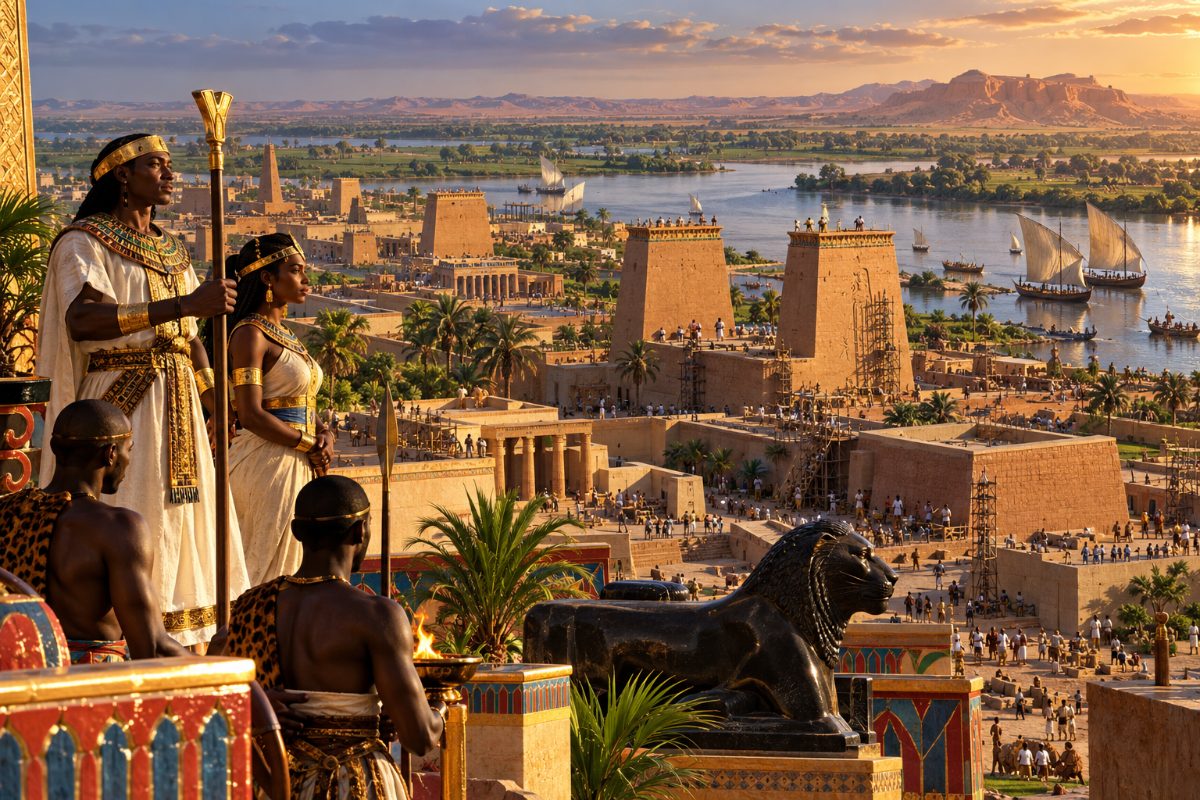 The spread of Islam into the Mali Empire and the ancient Egyptian concept of Maat share a common moral architecture: the king is the guardian of cosmic order, justice is the measure of a legitimate ruler, and the soul faces a reckoning after death, making Islam's arrival in West Africa less a break with the past than a
 new vocabulary for a very old obligation.
spio.comWhat Maat actually is
In ancient Egyptian religion, Maat represents truth, justice, and cosmic order. Its etymology traces from the physical concept of straightness, correctness, levelness and rightness. At its most basic, Maat is "the right" or "rightness," but it also carries the full range: rights, rightful, uprightness, righteousness. Maat was both an abstract concept and a goddess, normally represented as a woman wearing an ostrich feather, placed in opposition to isfet, meaning falsehood, wrongdoing, violence, and disorder.
The king's role had the same structure as the Mali mansa's: Maat embodied the divine order established at creation, which the king was responsible for maintaining by setting Maat in place of isfet. This principle extended to the judgment of the dead, where the deceased's heart was weighed against Maat's feather to test their adherence to proper values.
Where the connection to Islam runs
The link is not direct borrowing. It's a deeper current. Ancient Egyptian morality has been argued by scholars to have contributed significantly to what we understand as the Jewish-Christian-Islamic tradition. The Sunni Maliki school of Islam that came to West Africa via the trans-Saharan trade routes carried its own version of the same core structure: God is the source of order, the ruler upholds it, and the individual soul is held to account. When Mansa Musa and the court of the Mali Empire embraced Islam, they weren't discarding a foreign concept of righteous kingship. They were absorbing a new vocabulary for a moral architecture that already existed across the region.
In African thought, the Egyptian concept of Ma'at embodies cosmic and moral order, balance, justice, and truth. Ma'at represents an ordered and balanced moral cosmos that aligns with the fabric of the universe itself, establishing that ethical conduct reflects cosmic principles.
What this means for the conversation we've been having
The griots, the jeliw, preserved exactly this: the memory that power is a moral responsibility, not just a military one. Sundiata Keita was celebrated not only for defeating the Sosso kingdom but for restoring order after tyranny. Mansa Sakura, a freed man who seized the throne, was remembered as a legitimate ruler precisely because he expanded borders and died returning from the hajj, his accountability before God confirmed. Sonni Ali, who built the Songhai Empire into the largest in African history, was judged harshly by Muslim Arab scholars in part because he was seen as insufficiently devout, meaning he had failed the obligation every ruler carried.
The thread running from Maat through the Saharan trade routes to the mosques of Timbuktu Djenn is this: African kingship was never simply about power. It was always about being answerable to something larger than yourself, whether that was called Maat, or din, or the law of God. The form changed. The obligation didn't.
When did Muslim Arab traders first take control of the Swahili Coast? Muslim Arab traders did not simply take control of the Swahili Coast: from the mid-8th century onward they settled, intermarried, and blended with the Bantu African communities already living there, producing a new mixed Swahili culture whose ruling class by the 12th century was of mixed Arab and African ancestry, neve
r a foreign colonial one.
 spio.com
Muslim Arab traders did not simply “take control” of the Swahili Coast: the more accurate picture is that the coast was always African first, and what actually happened from the 8th century onward was a deep, voluntary blending of Bantu African communities with arriving Muslim traders, producing something entirely new.
The original residents
The original residents of the coast were Africans who spoke Marrying Bantu languages. This group had migrated east from inland areas and later spread up and down the coast, trading with each other. This matters because the story is often told as though the coast was empty before the Arabs arrived. It was not.
Archaeological work, linguistic research, and historical study since the 1980s have revealed, unequivocally, that Swahili culture and language are actually African, and that its people adopted Islam and were influenced by Indian Ocean-style architecture over several hundred years. The old colonial-era argument that Swahili civilization must have been Persian Gulf or Arab in origin has been thoroughly disproven by the archaeology.
When Muslim traders arrived, and how
From the 7th century, the number of traders sailing the Indian Ocean greatly expanded and included those from the Red Sea (and so Cairo in Egypt), and then Arabia and the Persian Gulf. From the mid-8th century, Muslim traders from Arabia and Egypt began to permanently settle in towns and trading centres along the Swahili coast, especially on the safer coastal islands.
In the 8th century, Arab Muslim merchants began to settle permanently in the region and often intermarried with the African Bantu peoples who lived in the area. Marrying Bantu women enabled Arab merchants to sink roots in African coastal communities, and their wives’ families helped them both establish commercial contacts and transact trade while they were away.
Yemeni traders, including the Kharijites, dissident Muslims from Arabia, established a powerful presence on the East African coast in the 8th century, forging complex networks of exchange with local merchant families, villages, and towns.
The Shirazi wave
After 1050, a new wave of Muslim immigrants arrived from the Persian Gulf region, claiming heritage from the city of Shiraz in Iran. They settled along the East African coast, particularly in cities like Mombasa, Malindi, Lamu and Sofala. As they integrated with the local Bantu-speaking populations, they retained their Islamic Mediterranean cultural heritage and contributed to the development of the Kiswahili language, which blended Bantu roots with Arabic influences.
The archaeological record firmly refutes any supposition of mass migrations or colonization but evidences extensive trade relations with Persia. Trade links with the Persian Gulf were especially prominent from the 10th to 14th centuries, which prompted the development of local mythologies of Persian or Shirazi origin.
What “control” actually looked like
Swahili cities were independent from each other and usually governed by a single ruler. By the 12th century, the cities were ruled by the affluent Muslim merchant class. The ruling class, governors, merchants, craftworkers and holders of religious office, was composed of those with a mixed Arab and African ancestry. So the answer to “who took control” is: a new mixed class, not a foreign one.
Islam came to the coast with Arab traders in the 7th century, but the earliest known mosques, built of wood, are at Tanga, Kenya and date to the 9th century. Initially, some unorthodox Muslim settlers may have fled persecution in their homeland, but from the 12th century, the form of Islam most practised along the Swahili Coast was Sunni.
The connection back to this thread’s larger story is real. The same Sunni Maliki school that traveled the Sahara trade routes to reach the Mali Empire, shaping the world of Mansa Musa, reached the East African coast by a different road, the Indian Ocean. One faith, two coasts, two separate trade networks, same direction of travel.
What is the Catalan Atlas?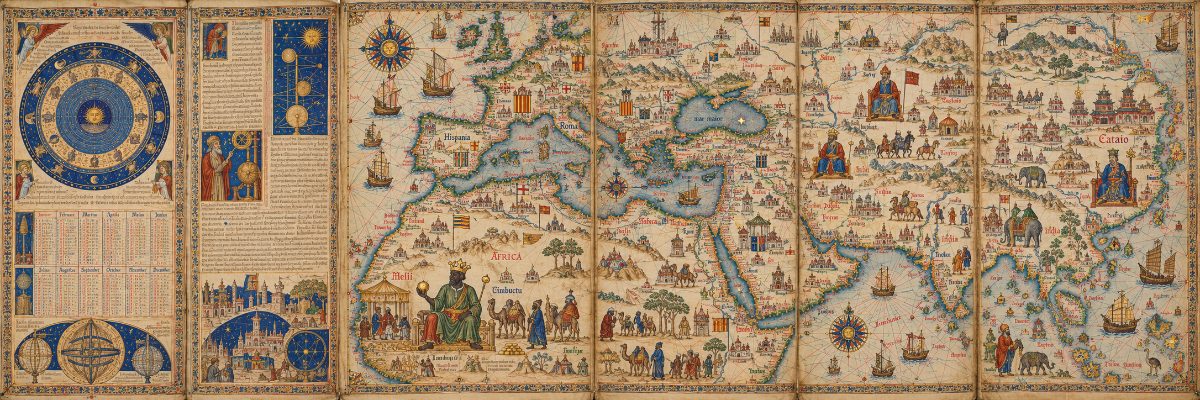 The Catalan Atlas is a medieval world map produced around 1375, widely considered the most important map of the Middle Ages, and the reason it matters to this conversation is that it carries one of the most striking images of the Mali Empire ever made: a portrait of Mansa Musa, ninth mansa of Mali, seated on a throne,
 holding a ball of gold, drawn by a Jewish cartographer on an island off Spain.
spio.comWhat it is
The Catalan Atlas is a medieval world map, or mappa mundi, probably created in the late 1370s or early 1380s, often conventionally dated 1375, and has been described as "the zenith of medieval map-work." It was prepared in Palma de Mallorca by Abraham Cresques and his son Jafuda Cresques. Abraham was a Jewish cartographer working within the Majorcan cartographic school, the leading center of map-making in the medieval Mediterranean world. Given as a gift to the French king, it has long been kept in Paris, now held at the National Library of France.
The atlas originally consisted of six sheets of parchment. The first sheets deal with cosmography, astronomy and astrology, and practical advice for sailors is also provided. The Catalan Atlas is a world map built up around a portolan chart, combining the nautical chart's coastal detail with the medieval tradition of illustrated world maps, representing a transitionary step toward the world maps developed later during the Renaissance.
A portolan chart, to explain the term, was a navigational tool sailors actually used at sea. It showed coastlines in precise detail and used lines called rhumblines to plot compass bearings. What makes the Catalan Atlas extraordinary is that it combines that working sailor's tool with a mappa mundi, the grand illustrated picture of the whole known world, from West Africa to the Pacific coast of East Asia.
Mansa Musa and the gold
This is where it connects directly to our conversation. The Catalan Atlas has received increased attention in recent years for its powerful depiction of Mansa Musa of Mali, crowned and enthroned, gazing at a golden ball held in his fingertips. Enthroned with a golden crown, scepter, and orb, he is described in the accompanying text as "the richest and the noblest sovereign of all this region because of the abundance of gold that comes out of the land."
The caption in the atlas reads:
"This black Lord is called Musse Melly and is the sovereign of the land of the black people of Gineva. This king is the richest and noblest of all these lands due to the abundance of gold that is extracted from his lands."
The atlas is richly illustrated with figures depicting the famous monarchs of the world, their kingdoms, and their enemies at war. The written sections identify well-known cities, biblical places, exotic animals, and coveted commodities such as gold from Africa, pearls from the Persian Gulf, and spices from Asia.
Why it matters for this thread
This map was drawn roughly 50 years after Mansa Musa's famous hajj to Mecca, and his wealth was still so legendary it had worked its way into European consciousness all the way to a cartographer's workshop on a Mediterranean island. The 1375 Catalan Atlas also portrayed a "city of Melly" in West Africa. The Mali Empire was not some vague rumor to 14th-century Europeans: it was on the map, its king was named and illustrated, and the gold was the point.
The atlas also sits at the intersection of several threads we have been following. It was made by Jewish scholars working in the Crown of Aragon, drawing on Arab geographic sources and traders' accounts, including the kind of trans-Saharan trade networks that carried Islam into Mali alongside the gold routes. The world these maps described was already deeply connected, and the people at the center of it were African.
Did Geneva stem from Gineva? The Catalan Atlas refers to "Musse Melly, senyor dels negres de Gineva."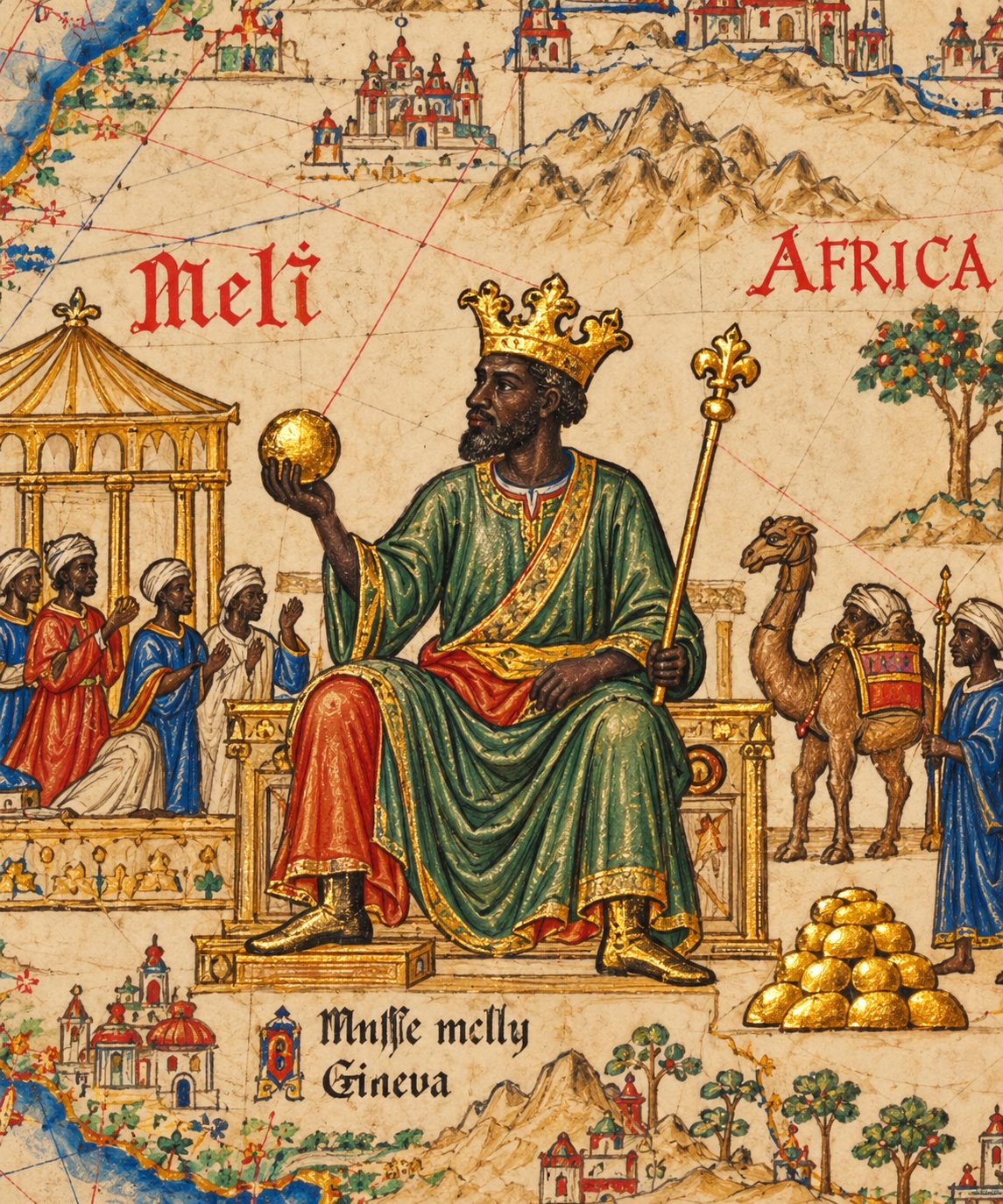 The two words share an ancient root but point to completely different places: "Gineva" in the Catalan Atlas is not the Swiss city of Geneva but a medieval Catalan rendering of Guinea, the West African region that Mansa Musa ruled, while the Swiss city Geneva traces its name to the Celtic-Latin "Genava," meaning estuary
 or bend in a river, making the resemblance a phonetic coincidence from two separate etymological lines.
spio.comWhat the Atlas actually says
The Catalan Atlas, the medieval world map produced around 1375 by Abraham Cresques on the island of Majorca, carries two inscriptions about Mansa Musa, ninth mansa of the Mali Empire. One reads: "Through here pass the merchants who travel to the land of the negroes of Guinea," referring to the Valley of the Draa. The other reads: "aquest senyor negre es appellat musse melly, senyor dels negres de Gineva," translated as "This black gentleman is called Mansa Musa and is the ruler of the negroes of Guinea. This king is the richest and noblest gentleman in all the region on account of the abundance of gold that is obtained from his land."
So "Gineva" in the Atlas is simply the 14th-century Catalan spelling of Guinea, the broad West African region that Musa commanded. The Cresques Project, which catalogues the Atlas's original legends, translates "Gineva" in one inscription as Ghana and in another as Guinea. Modern editors use both words interchangeably for the same territory because in medieval European cartography the distinction between the Ghana Empire and the broader region called Guinea was blurred, and Catalan scribes were writing the sounds they heard from Arab and North African traders, not from any standardized geography.
Where "Geneva" actually comes from
It was mentioned in Latin texts by Julius Caesar with the spelling Genava, probably from a Celtic toponym genawa from the stem genu, meaning "bend" or "knee," in the sense of a bending river or estuary. From Latin Genava, the meaning was likely either "estuary" or "bend," in either case a reference to the city's physical situation where the Rhône exits Lake Geneva. The city in origin shares its name, genawa meaning "estuary," with the Italian port city of Genoa, known in Italian as Genova.
So the chain for Geneva is: Celtic genawa → Latin Genava → Old French Genève → English Geneva. The chain for Gineva is entirely different: it is Catalan ears transcribing an Arabic or Berber name for a West African land, most likely connected to the great trading city of Djenné on the upper Niger River. Leo Africanus, writing in 1526, argued that the word "Guinea" itself derives from Djenné, which he referred to as Gheneo, Genni and Ghinea.
When Each Name First Appears
- 58 BCE, Julius Caesar, Roman general and statesman: in Commentarii de Bello Gallico (The Gallic War), Book 1, Chapters 6 and 7, Caesar describes a town called Genava by the Rhône River. He names it the farthest town of the Allobroges, nearest the territory of the Helvetii, and describes ordering its bridge destroyed. This is the earliest widely cited written record of Geneva. The events took place in 58 BCE, and Caesar wrote his account later, during his campaigns in Gaul.
- 1375 CE, Abraham Cresques, Jewish cartographer of Majorca: more than 1,400 years after Caesar's account, the Catalan Atlas names Mansa Musa as "Musse Melly," ruler of the Black people of Gineva.
Caesar wrote:
“The furthest town of the Allobroges, and the nearest to the territories of the Helvetii, is Geneva. From this town a bridge extends to the Helvetii.”
Source: Perseus Digital Library, The Gallic War, Book 1, Chapter 6
Why the sounds converge
This is the same pattern at the heart of this whole conversation. A hard "G," a front vowel and a nasal consonant produce a cluster of sounds that appears independently across unrelated language families: Celtic, Catalan, Mandé, Arabic. When medieval European cartographers heard West African place names through Arabic intermediaries, they wrote them in the Catalan spelling conventions they already knew, which happened to produce a word that looks exactly like their own name for a Swiss city. The overlap is phonetic, not historical.
The deeper point is one I keep returning to: medieval Europeans knew far more about the wealth and geography of West Africa than the standard telling admits. Abraham Cresques drew the richest man on earth sitting on his throne in the middle of his map, named his territory, described his gold, and marked the trade routes merchants used to reach him. That knowledge came through Arab scholars, North African traders, and the Majorcan Jewish community's remarkable network of contacts. "Gineva" is a phonetic artifact of that network, not a borrowing from Switzerland.
Why do cultures around the world show black gods? From Krishna to Buddha and Hắc Hổ. Where did this tradition start? The pattern of dark or black divinity runs across nearly every ancient civilization on earth, from Egypt's Osiris and India's Krishna to Vietnam's Hắc Hổ, and the most honest answer to where it started is: Africa, because that is where human beings themselves started, and the first people who conceived of gods conceive
d them in their own image.
spio.comThis conversation has been following the thread of Africa's influence across world civilization, from Mansa Musa and the Mali Empire to Maat and the Catalan Atlas. This question may be the deepest one in the thread.
The name itself carries the answer
The name "Krishna" originates from the Sanskrit word kṛṣṇa, which means "black", "dark" or "dark blue." That is not a secondary detail buried in a footnote. It is the first word of the god's name. In accordance with the meaning of the name, Krishna murtis are often depicted with black or blue skin. The question then is: why did the dominant culture of ancient India preserve a black god as its central deity? If Vedic Hinduism was brought by light-skinned Aryans who had come to dominate India, why did they choose so many dark-skinned gods as their principal deities? Two of the most popular deities of Hinduism, Ram and Krishna, both incarnations of Vishnu, are described as dark-skinned. The answer scholars offer is that the dark-skinned deities came to Hinduism from the indigenous people of India, as the two groups assimilated and intermixed their deities.
And it goes deeper. The goddess Kali, the dark-skinned deity of Hinduism, is venerated among the Shakta traditionists and widely venerated across all of India. Darkness, in the oldest Indian religious imagination, was not evil. It was power.
Hắc Hổ, Vietnam's Black Tiger of the North
Hắc Hổ literally means Black Tiger in Vietnamese. It is not a demon or a villain. In Vietnamese folk belief linked to the Mother Goddess worship, the Hắc Hổ, the Black Tiger Goddess, governs the north. In Vietnamese folk paintings, the "Five Tigers" are depicted in five colors symbolizing the five directions: the Yellow Tiger guards the center, the Black Tiger guards the North and the water element, the White Tiger guards the West, the Red Tiger guards the South, and the Green Tiger guards the East. So the Black Tiger is not marginal. It holds a cardinal direction and a primary element. The tiger gradually became a guardian deity in Vietnamese folk beliefs, and its transformation reflects centuries of interaction between indigenous traditions and Taoism.
The Buddha
The earliest depictions of the Buddha in the most ancient temples of Asia show him differently from the Chinese, Japanese and Korean images most people recognize today. It is only centuries later, when Buddhism was introduced outside of India, that the Buddha took on Chinese, Japanese, Korean and other Asian features. The first and original Buddha was a dark-skinned man. The hair is the detail historians keep returning to: the tight curls, rendered in peppercorn style or cornrows in early sculpture, point back toward a specific physical type that carries its own geographic story.
The Black Buddha and Sambo
Some believe Sambo was once a name tied to the Black Buddha. In Japanese, sambō means the Three Jewels of Buddhism: the Buddha, his teachings and the community that keeps them.
It's interesting that when people hear Sambo today, they think of a Black caricature, not a Black Buddha. It shows you the level of erasure, and how these sacred images have been replaced with a caricature.
The caricature spread with The Story of Little Black Sambo, published in 1899 by Helen Bannerman, about a boy in southern India.
 A Black Buddha: stone head with tight curls
 The caricature: Little Black Sambo
Egypt's Osiris and the title "Lord of the Perfect Black"
Back in this conversation's home territory: Osiris, the greatest of the Egyptian gods, was sun-rayed and Black with woolly hair. His chief title means "Lord of the Perfect Black." Osiris was not incidentally depicted this way. The blackness was the point: it signified fertility, the rich dark soil of the Nile flood, the underworld from which life regenerates, and divinity itself. This is continuous with everything this thread has covered about Maat: the oldest formal architecture of cosmic order, justice and divine judgment comes from the same civilization.
Why the pattern is global
The simplest explanation is also the one that fits the evidence. Every human being on earth descends from ancestors in Africa. The people who first developed religion, who first gave form to the idea of a creator, a judge, a protector, were African people, and they made those figures in their own image. As those populations migrated across Asia, the Middle East and the Americas over tens of thousands of years, they carried their cosmologies with them. Later arrivals did what every conquering or assimilating culture does: they absorbed the gods of the people already there, renamed them, recolored them in some places, and kept them in others. Many of the world's first deities and divinities, both male and female, were originally depicted as Black.
The whitening came later, and it was rarely complete. An unnaturally blue Krishna was preferred over a naturally dark Krishna, because the color could be shifted without erasing the god entirely. The name, the myth, the power: those survived. They survive in the very word Krishna. They survive in Hắc Hổ guarding the northern direction. They survive in every Black Madonna found across Catholic Europe and Latin America, seated at the center of a tradition that needed her too much to replace her.
The thread that runs from Maat's feather to the Catalan Atlas portrait of Mansa Musa runs through here too. Civilization did not begin in Europe and spread outward. It moved the other direction first, and the gods went with it.
Black Gods and Sacred Figures Around the World
From Krishna in India to the Black Buddha traditions of Asia, and on to Africa, Europe and the Americas, Black and dark-skinned divine figures appear in religious traditions across the world. They are in Hinduism, Buddhism, African traditional religions, Christianity and indigenous spiritual systems.
1. India: Hindu Gods and Goddesses
India has some of the clearest and oldest traditions of dark-skinned divinity.
| Divine figure | Tradition | Significance |
|---|---|---|
| Krishna | Hinduism | His name is commonly interpreted as "dark" or "black." He is depicted as dark-skinned or blue-black |
| Kali | Hinduism | Powerful goddess frequently represented with black or deep-blue skin |
| Shiva | Hinduism | Appears in different colors and forms, including dark manifestations |
| Vishnu | Hinduism | Often represented with dark-blue skin |
| Rama | Hinduism | Traditionally described as dark-complexioned and often depicted blue |
| Draupadi Amman | Tamil Hindu traditions | A deified heroine sometimes represented with dark skin |
| Karuppasamy | Tamil folk Hinduism | A protective deity whose name and images emphasize blackness |
| Mariamman | South Indian Hinduism | Goddess of rain, protection and healing; some regional images show her with dark skin |
| Mahakala | Hindu and Buddhist traditions | A dark or black protector whose name means "Great Black One" or "Great Time" |
 VishnuVishnu on Garuda, Metropolitan Museum of ArtSource: Wikimedia Commons
 RamaSouth India, about 1820, British MuseumSource: Wikimedia Commons
Krishna stands out: dark coloring is central to his name and identity, not just an artistic choice.
2. Vietnam: Black Guardian Deities and Buddhist Figures
Vietnam has traditions of black divine protectors.
| Figure | Tradition | Significance |
|---|---|---|
| Hắc Hổ (Black Tiger) | Vietnamese Mother Goddess worship | Sacred black tiger guarding the north |
| Đại Hắc Thiên (Mahakala) | Vietnamese Buddhism | A dark protector inherited from Indian Buddhist traditions |
| Dark guardian figures | Vietnamese Buddhist and folk temples | Some guardians have black or dark faces symbolizing protective power |
The Five Tigers tradition is well documented: yellow, green, white, red and black tigers stand for different directions and cosmic forces.
3. China, Tibet, Nepal and Japan
| Culture | Figure | Description |
|---|---|---|
| Tibet | Mahakala | Black or dark-blue protector of the Buddhist teachings |
| Tibet | Palden Lhamo | Fierce protective goddess often depicted dark blue |
| Tibet and Nepal | Black Tara | Dark form of Tara in some tantric traditions |
| Nepal | Bhairava | Fierce form of Shiva, sometimes represented in black |
| China | Heitian / Daheitian | Chinese forms of Mahakala, the Great Black Deity |
| China | Xuanwu | Deity of the north, associated with black and water |
| Japan | Daikokuten | Deity derived from Mahakala, later associated with prosperity |
| Japan | Fudō Myōō | Buddhist protector sometimes depicted with dark-blue or black skin |
 Mahakala (Tibet)Thangka, Central Tibet, 1400sSource: Wikimedia Commons
 Black TaraHimalayan Buddhist imageSource: Wikimedia Commons
Mahakala traveled from India into Chinese, Tibetan and Japanese traditions, a documented example of a dark deity crossing cultures.
4. Africa: Egypt, Nubia and West Africa
| Culture | Figure | Description |
|---|---|---|
| Ancient Egypt | Osiris | Sometimes depicted with black skin; fertility, regeneration and the afterlife |
| Ancient Egypt | Anubis | Black jackal-headed god of embalming and the dead |
| Ancient Egypt | Isis (Auset) | Major goddess depicted in different skin tones, some of them dark |
| Ancient Egypt | Min | Fertility god frequently depicted with black skin |
| Ancient Egypt | Amun | Major god of Egypt and Nubia, sometimes represented with dark-blue skin |
| Yoruba | Eshu | Orisha of crossroads, communication and transformation |
| Yoruba | Ogun | Orisha of iron, technology, warfare and craftsmanship |
| Yoruba | Shango | Orisha of thunder, lightning and royal authority |
| Yoruba | Yemoja | Divine mother of the waters and motherhood |
| Akan | Asase Yaa | Earth goddess of fertility and the land |
| Fon and Ewe | Mawu-Lisa | Divine creative principle with feminine and masculine sides |
 OsirisCopy of a tomb painting, Thebes, about 1386–1330 BCE, MetSource: Wikimedia Commons
 Isis (Auset)Isis leading Queen Nefertari, copy of her tomb painting, MetSource: Wikimedia Commons
Ogun, Shango and the other orishas are shown in human forms that look like the communities who honor them. Their identity is not defined by black skin the way Kali's or Mahakala's is.
5. Europe: Black Madonnas and Sacred Images
Europe has a long tradition of honoring dark-skinned images of Mary and Jesus, some dating to the medieval period.
| Country | Sacred figure | Location |
|---|---|---|
| Poland | Black Madonna of Częstochowa | Jasna Góra Monastery |
| Spain | Our Lady of Montserrat | Catalonia |
| France | Black Madonna of Le Puy | Le Puy-en-Velay |
| France | Black Madonna of Rocamadour | Rocamadour |
| France | Notre-Dame de la Daurade | Toulouse |
| Italy | Madonna of Loreto | Loreto |
| Italy | Madonna of Tindari | Sicily |
| Italy | Madonna of Oropa | Piedmont |
| Switzerland | Black Madonna of Einsiedeln | Einsiedeln Abbey |
| Germany | Black Madonna of Altötting | Bavaria |
| Czech Republic | Black Madonna of Brno | Brno |
| Austria | Black Madonna of Loretto | Basilica Maria Loretto, Burgenland |
 CzęstochowaJasna Góra Monastery, PolandSource: Wikimedia Commons
 Montserrat (La Moreneta)Basilica of Montserrat, CataloniaSource: Wikimedia Commons
 Le PuyLe Puy-en-Velay Cathedral, FranceSource: Wikimedia Commons
 RocamadourChapelle Notre-Dame, Rocamadour, FranceSource: Wikimedia Commons
 La DauradeBasilica of La Daurade, ToulouseSource: Wikimedia Commons
 TindariTindari sanctuary, SicilySource: Wikimedia Commons
 OropaOropa sanctuary, PiedmontSource: Wikimedia Commons
 AltöttingChapel of Grace, Altötting, BavariaSource: Wikimedia Commons
 BrnoChurch of St. Thomas, BrnoSource: Wikimedia Commons
These are Christian sacred figures, not separate goddesses.
6. The Americas: Black Sacred Figures
| Country | Figure | Tradition |
|---|---|---|
| Guatemala | Black Christ of Esquipulas | Catholic devotion, honored across Central America and Mexico |
| Brazil | Nossa Senhora Aparecida | Black Madonna; patroness of Brazil |
| Brazil | Iemanjá | Afro-Brazilian orisha |
| Brazil | Oxum | Afro-Brazilian orisha |
| Cuba | Changó | Afro-Cuban Santería |
| Cuba | Yemayá | Afro-Cuban Santería |
| Haiti | Ezili Dantò | Haitian Vodou lwa, often depicted as a dark-skinned mother |
| Haiti | Ogou | Haitian Vodou lwa of iron, power and warfare |
 Black Christ of EsquipulasBasilica of Esquipulas, GuatemalaSource: Wikimedia Commons
 IemanjáStatue in Vitória, BrazilSource: Wikimedia Commons
 ChangóYoruba figure of Shango on horseback, Brooklyn MuseumSource: Wikimedia Commons
 Ezili DantòHer vevé, the sacred symbol drawn for her in Haitian VodouSource: Wikimedia Commons
 OgouHis vevé, the sacred symbol drawn for him in Haitian VodouSource: Wikimedia Commons
Some are African divinities carried across the Atlantic by enslaved Africans. Others are Christian images that grew within local traditions.
7. The Philippines, India and Sri Lanka
| Country | Sacred figure | Significance |
|---|---|---|
| Philippines | Black Nazarene | Dark-skinned image of Jesus carrying the cross, honored in Manila |
| India | Dhori Mata | Black Madonna honored at Bokaro, Jharkhand |
| Sri Lanka | Kataragama Deviyo | Regional deity sometimes shown with dark skin; linked to Skanda/Murugan |
 Black NazareneQuiapo Church, ManilaSource: Wikimedia Commons
Dhori Mata is a black wooden statue of Mary and child found in a coal mine in 1956. The miners first thought it was the Black Goddess Kali.
What stands out across these cultures? At least 4 patterns stand out: darkness as a divine attribute, darkness as sacred symbolism, African religious continuity and dark-skinned Christian images.
spio.comThere are at least 4 distinct patterns:
- Darkness as a divine attribute. Figures such as Krishna, Kali and Mahakala are tied to blackness or darkness in their names, descriptions or images.
- Darkness as sacred symbolism. In some Egyptian and Asian traditions, black stands for fertility, regeneration, cosmic forces, protection or a direction.
- African religious continuity. Yoruba and other African divine traditions survived and grew in Brazil, Cuba, Haiti and beyond.
- Dark-skinned Christian images. The Black Madonnas and Black Christ images have been honored across Europe, Asia and the Americas for centuries.

The ancient Greeks were voracious borrowers. Their debt to Africa was enormous and openly acknowledged by the Greeks themselves. Thales of Miletus, credited as the first Greek philosopher, studied geometry in Egypt. Pythagoras spent years there. Plato visited.
Read that one firstThe wealthiest empire in history was African. Build yours.
CEEK is where creators and builders share what they know daily, in a community of people putting that knowledge to work.
Join me on CEEK
Comments
Comments are public. Links are removed.