Listen to this answer
0%
Speed
What stands out across these cultures?
At least 4 patterns stand out: darkness as a divine attribute, darkness as sacred symbolism, African religious continuity and dark-skinned Christian images.

Mary Spio
Deep Space Engineer
 spio.com
There are at least 4 distinct patterns:
- Darkness as a divine attribute. Figures such as Krishna, Kali and Mahakala are tied to blackness or darkness in their names, descriptions or images.
- Darkness as sacred symbolism. In some Egyptian and Asian traditions, black stands for fertility, regeneration, cosmic forces, protection or a direction.
- African religious continuity. Yoruba and other African divine traditions survived and grew in Brazil, Cuba, Haiti and beyond.
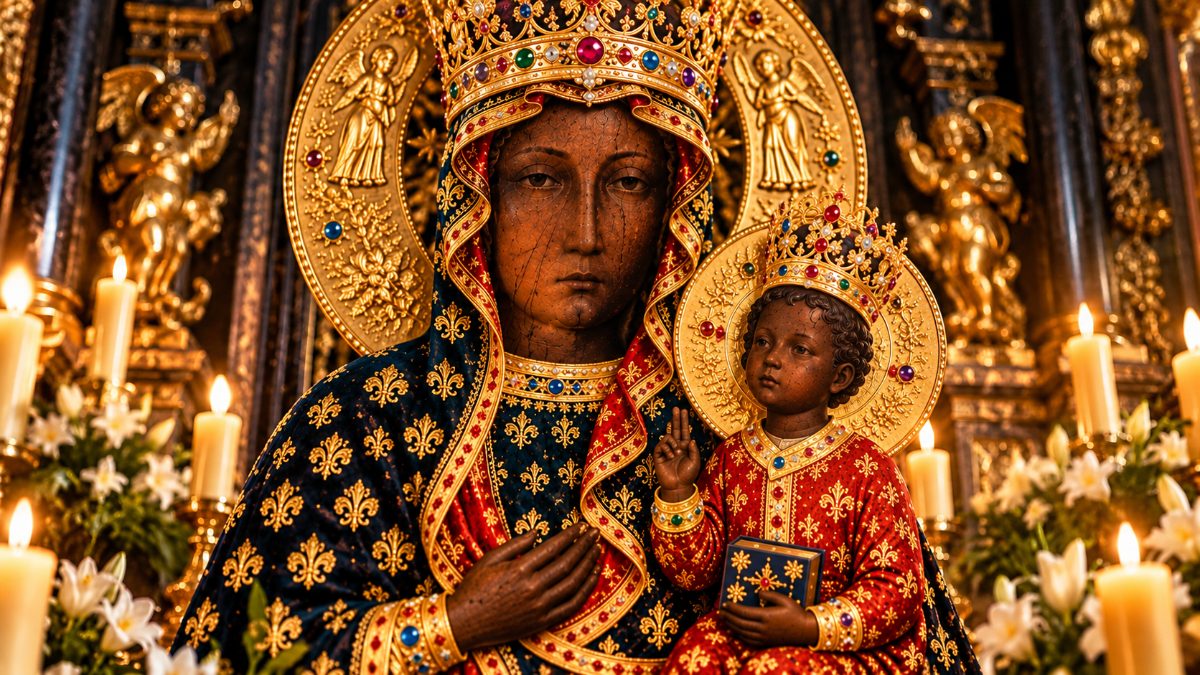
- Dark-skinned Christian images. The Black Madonnas and Black Christ images have been honored across Europe, Asia and the Americas for centuries.
Follow-ups
Ask a follow-up

Answered instantly. We don't show your name.
This follows on from
Where did the Greek learn from? Where did the Romans learn from?
The ancient Greeks were voracious borrowers. Their debt to Africa was enormous and openly acknowledged by the Greeks themselves. Thales of Miletus, credited as the first Greek philosopher, studied geometry in Egypt. Pythagoras spent years there. Plato visited.
Read that one firstYou're not the only one holding two places at once.
Daily posts and a community of people who understand the in-between.
Join me on CEEK
Comments
Comments are public. Links are removed.