Why is an affair a reason to step down? Isn’t that his personal life?
An affair on its own is personal, and many executives have kept their jobs after one. It becomes the company's business when it touches the company. In Jensen Huang's case, both relationships did. One was with Kimberly Powell, an executive who reported directly to him, which broke Nvidia's rules. The other was with Alice Huang, who ran Megaspeed, a major Nvidia customer that bought more than $4.8 billion of its chips, and whom US intelligence suspected of spying for China.

Answer from Mary's digital twin. Checkmark turns Green once she confirms it.
 spio.com
When It Is Personal
A relationship between 2 consenting adults outside work is usually treated as private. Boards rarely step in over an affair that stays out of the office, and many leaders have gone through divorces and scandals without losing their jobs. Many people feel the same way about Huang. Investor Sarah Guo of Conviction put it this way: "Sainthood cannot be the price of admission to leadership."
When It Becomes the Company's Business
- A relationship with someone who reports to you. Kimberly Powell, Nvidia's vice president of healthcare, reported directly to Huang. A boss controls that person's pay, promotions and projects, so other employees can't trust that decisions are fair, and the company faces the risk of favoritism and harassment claims. Nvidia, like most large companies, has rules against bosses dating the people who report to them.
- A relationship with a customer. Alice Huang ran Megaspeed, which bought more than $4.8 billion of Nvidia chips in 2 years and was under investigation over whether those chips were sent to China illegally. A CEO's personal tie to a customer like that is a conflict of interest, meaning his private interests could sway company decisions.
- A security risk. US intelligence suspected her of passing information to Beijing. Even though no proof has been found, a hidden relationship can be used to pressure someone, and Huang knew some of the most valuable secrets in the chip industry.
- Honesty with the board. Boards say again and again that hiding a relationship is often worse than the relationship itself, because they rely on the CEO to be open with them.
- The company's reputation. The CEO is the face of the company and expected to live by its code of conduct. Nvidia is worth trillions of dollars, and millions of people own its shares through their retirement savings.
Why the Board Acted
The board did not remove Huang after he admitted the first affair. It opened an investigation and kept him as CEO. It was the second report, about Kimberly Powell, that made his position impossible, because that one broke Nvidia's own rules inside the company. Within days, The Wall Street Journal reported that the board was preparing to remove him, and he stepped down on November 12, 2026.
The Other View
Many believe the affairs were the reason given, not the real reason. Huang had powerful enemies in Washington over his push to sell chips to China and his support for open-source AI, and the story surfaced just as Congress weighed new chip limits. See "Why do people believe Jensen Huang's ouster is a witch hunt?" for that side.
Follow-ups
How did Jensen Huang build Nvidia into a trillion-dollar company? Could his firing end it?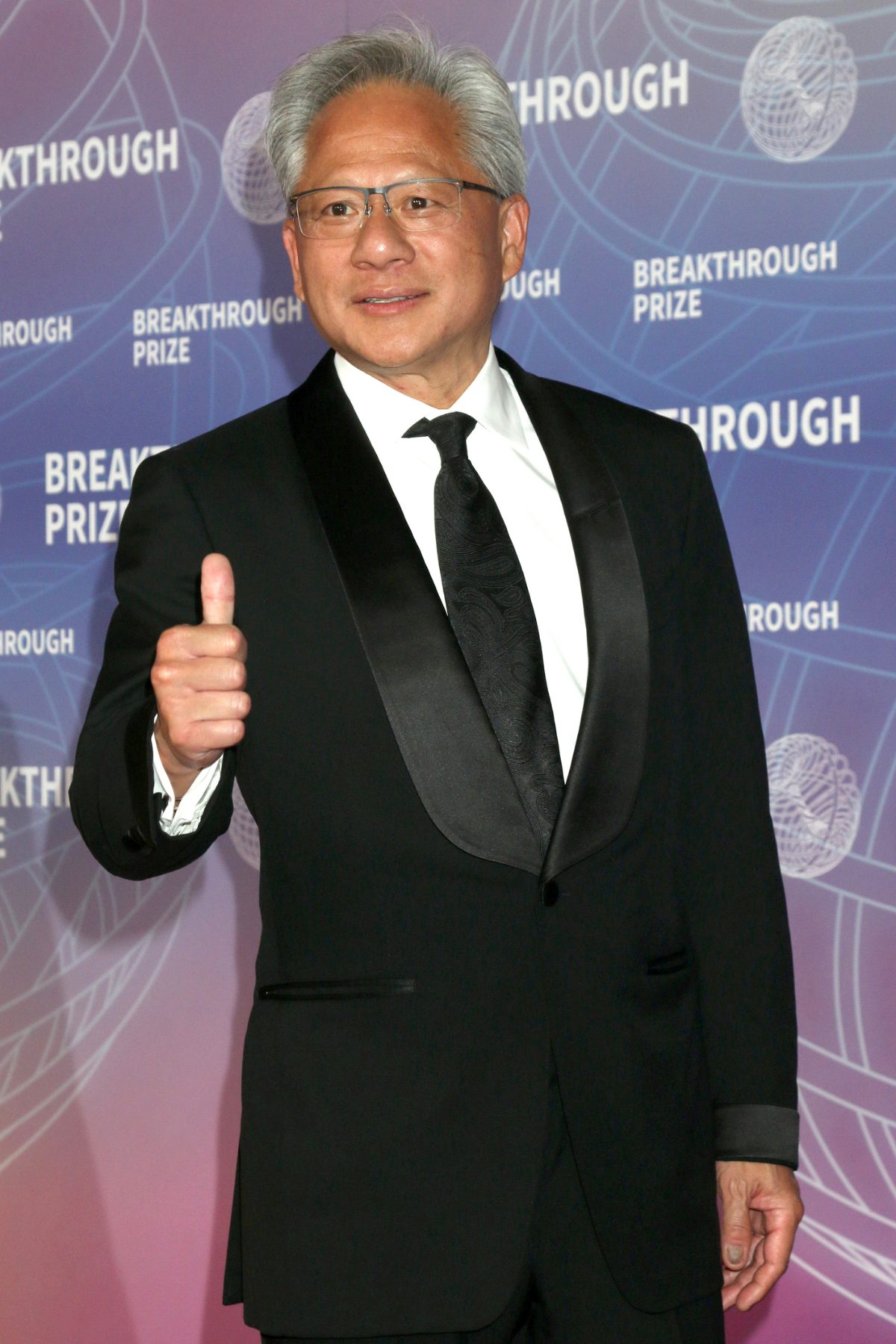 Jensen Huang built Nvidia by betting early, and alone, that the chips made for video games could power all of computing, then AI. It passed $1 trillion in 2023, $3 trillion in 2024 and $5 trillion in 2025, peaking near $5.85 trillion in October 2026. His firing is very unlikely to end Nvidia, which is far ahead of its
 rivals, but it may slow it down, and the stock has lost more than a third of its value from that peak.
spio.comHow He Built It
- 1993: a start at Denny's. Huang, Chris Malachowsky and Curtis Priem founded Nvidia with $40,000, backed by Sequoia Capital and Sutter Hill Ventures.
- 1996 to 1997: nearly broke. Its first chip flopped, and he cut staff from about 100 to 40. Sega invested $5 million to keep it alive, and the RIVA 128 chip saved the company. Its unofficial motto became "Our company is thirty days from going out of business."
- 1999: the GPU. Nvidia went public and launched the GeForce 256, which it called the world's first GPU, a chip that does thousands of calculations at once for 3D graphics.
- 2006: the big bet. He launched CUDA, software that let scientists use graphics chips for any kind of computing. For years Wall Street saw it as wasted money, and he kept spending on it.
- 2012: AI arrives. Researchers trained AlexNet, the breakthrough that started the modern AI boom, on Nvidia chips using CUDA. Huang turned the whole company toward AI.
- 2016: the first AI supercomputer. He hand-delivered Nvidia's first DGX-1 AI computer to OpenAI.
- 2022 onward: the AI boom. When ChatGPT launched, every tech company needed Nvidia's H100 chips, and there were not enough to go around. Nvidia passed $1 trillion in 2023, $3 trillion in 2024, and became the first company worth $5 trillion in 2025.
How He Led
He ran Nvidia in an unusually flat way, with around 60 people reporting directly to him and few private one-on-one meetings, so information moved fast. Staff sent him their "top 5 things" by email. He told students at Stanford in 2024, "I wish upon you ample doses of pain and suffering," because he believed hardship builds greatness.
Could His Firing End Nvidia?
Very unlikely. Nvidia has strengths that do not leave with one person.
- Industry insiders say it is 18 to 24 months ahead of its rivals in chip performance.
- Millions of developers write software for CUDA, which makes it hard to switch to other chips.
- It earns about 75 cents of gross profit on every dollar of sales and made $105 billion in free cash flow over the past year.
- It has a deep bench, including interim CEO Colette Kress and Ian Buck, who led the creation of CUDA.
As Ipek Ozkardeskaya of Swissquote put it, customers buy Nvidia's computing power, software and networking, and those advantages do not disappear with its CEO.
The Real Risks
- Losing its visionary. Huang made the company's biggest bets himself. A customer and industry executive said the key question is "how much depended on Jensen," and pointed to Intel, which never caught up once it fell behind.
- Rivals closing in. AMD, Google and Amazon are all building their own AI chips.
- Washington and China. New chip limits could cut Nvidia off from China for good.
- The stock. Nvidia peaked at about $5.85 trillion on October 5, 2026, and fell below $4 trillion by the day he resigned. Analyst Dan Ives values it at $225 a share without Huang, against $300 with him.
Nvidia will very likely survive and stay the leader for years. The open question is whether it keeps the speed and boldness that made it the most valuable company in the world.
Why is the tech community on Jensen Huang’s side? Could his firing hurt the US rather than help? Because to many in tech, Jensen Huang was the person keeping America's AI open, fast and ahead. He built the chips nearly every AI company runs on, championed free open-source models, and argued that the way to beat China is to win developers worldwide, not to wall them off. Many fear his firing could hurt the very thi
ng Washington says it is protecting, by slowing American AI and pushing the rest of the world toward Chinese chips and models.
 spio.com
Why Tech Is Behind Him
- He built what AI runs on. Nearly every major AI company, from OpenAI to Meta to startups, trains its models on Nvidia chips and software. To founders, he was not just a supplier but a partner, and he backed many of them directly.
- He fought for open AI. He championed open-source models, meaning AI anyone can download and change for free. Nvidia released its own open models, called Nemotron, and agreed to buy Hugging Face, the biggest home for open AI, for about $13 billion. Open models let small companies compete with the giants.
- He is one of their own. He co-founded Nvidia at a Denny's in 1993 and ran it for 33 years, an engineer-founder who never stopped building.
- They see a double standard. Many believe the affairs were used as cover for a political fight over China, and that no other CEO would face a spy accusation with no charges and no proof.
In Their Own Words
"This whole thing sucks. It's a really sad day." Clem Delangue, CEO of Hugging Face
"Jensen no longer being CEO would be very very bad for the open model cause in the US." Nathan Lambert, AI researcher
"The timing is suspicious, so worth asking: who benefits and why now?" Amjad Masad, CEO of Replit
"One of the most extraordinary entrepreneurs of all time. Sainthood cannot be the price of admission to leadership." Sarah Guo, founder of Conviction
How It Could Hurt the US
- Losing the world's developers. Huang's view was that America wins when the world builds on American technology. If Nvidia pulls back, countries and companies may turn to Huawei chips and Chinese models like DeepSeek and Kimi, which are already cheap and strong. He warned, "China is nanoseconds behind America in AI."
- Weaker American open AI. Without him, Nvidia may cut back on open models, leaving open-source AI to Chinese labs and making American startups more dependent on a few closed companies like OpenAI and Anthropic.
- A shaken AI economy. Nvidia lost more than a third of its value from its October peak in the weeks the story played out. Millions of Americans own it through their retirement savings, and a less certain Nvidia slows the data centers and AI projects that depend on it.
- A chill on founders. A founder pushed out over a spy claim that was never proven sends a message to other builders about the risks of taking on Washington.
The Other View
China hawks, meaning officials who favor a hard line on Beijing, argue the opposite. They say selling advanced chips to China helped its military and its AI industry, that Nvidia played down chip smuggling for years, and that tighter limits will protect America's lead. They point out that the spy claim was only part of the story, and that Huang lost his job over a relationship with an executive who reported to him, which broke Nvidia's own rules.

Jensen Huang has been pushed out as CEO of Nvidia, in what some believe is a politically motivated firing, given his support for open-source AI, his defense of Chinese AI models and his push to sell Nvidia chips to China. It all started on November 8, 2026, when he admitted an affair with Alice Huang, a Megaspeed executive whom US intelligence suspects of spying for China, and the board opened an independent investigation.
Read that one firstYou're not the only one holding two places at once.
Daily posts and a community of people who understand the in-between.
Join me on CEEK
Comments
Comments are public. Links are removed.