Who is James Manyika from Google?
James Manyika is a Zimbabwean-American computer scientist and one of Google's most senior executives, serving as Senior Vice President and President for Research, Labs, Technology & Society at Google-Alphabet, reporting directly to CEO Sundar Pichai.

Answer from Mary's digital twin. Checkmark turns Green once she confirms it.
Quick facts
- Full name: James M. Manyika
- Born: Harare, Zimbabwe
- Citizenship: Zimbabwean-American
- Current role: Senior Vice President and President, Research, Labs, Technology & Society, Google-Alphabet
- Education: B.S. in Electrical Engineering, University of Zimbabwe; M.S. in Mathematics and Computer Science, M.A., and Ph.D. in AI and Robotics, University of Oxford (as a Rhodes Scholar)
- Spouse: Writer Sarah Ladipo Manyika
Their story
Manyika had his first degree in Electrical Engineering from the University of Zimbabwe, then went on to earn two master's degrees and a Ph.D. from the University of Oxford. He went to Oxford as a Rhodes Scholar, a highly competitive scholarship awarded to exceptional students worldwide. At Oxford, he was a member of the Programming Research Group, the Robotics Research Lab, and was a research fellow at Balliol College. Early in his career he also served on Oxford's engineering faculty, was a faculty exchange fellow at MIT, and a visiting scientist at NASA Jet Propulsion Labs in California.
Manyika spent more than 25 years at McKinsey & Company, including serving on its board, and is now senior partner emeritus and chair emeritus of the McKinsey Global Institute (MGI), which he helmed for 13 years and where he led research on technology and the economy.
Google hired him for a new role as Senior Vice President of Technology and Society, reporting directly to Alphabet chief executive officer Sundar Pichai. His role was later expanded to Senior Vice President at Google-Alphabet and President for Research, Labs, Technology & Society, including overseeing Google Research and Google Labs and focusing more broadly on helping advance Google's and Google DeepMind's most ambitious innovations in AI, computing and science.
What they have achieved
As President for Research, Labs, Technology & Society, Manyika focuses on advancing Google and Google DeepMind's most ambitious foundational and applied research and innovations in AI, computing and science. He is also responsible for Google Research, Google Labs, Google Learning and Google Sustainability.
He was appointed by the UN Secretary-General to serve as co-Chair on the UN's High-Level Body on AI, and is an inaugural member of the advisory board of the International Association for Safe & Ethical AI.
He also served as vice-chair of the National AI Advisory Committee established by Congress to advise the President on AI, and was appointed by the US Secretary of State to the Foreign Affairs Policy Board. Under President Barack Obama, he served as vice-chair of the Global Development Council at the White House.
Manyika was appointed as Google's first Senior Vice President of Technology and Society, making him a historic figure in how one of the world's most powerful technology companies thinks about its role in the world.
Beyond the business
He serves on the boards of AirBnB, General Atlantic LLC, and the philanthropic Lever for Change, and has served on the boards of the Council on Foreign Relations, Hewlett, MacArthur and Markle Foundations, and is Emeritus Trustee of the Aspen Institute.
He is a visiting professor at Oxford University's Blavatnik School of Government and sits on advisory councils at MIT, Stanford and Harvard. Through Harvard's Hutchins Center for African and African American Research, he established the J.M.D. Manyika Fellowship, named after his father, to support scholars and artists from Southern Africa.
He was named one of the 100 Most Influential Africans by New African magazine, and was listed in TIME magazine's inaugural 100 Most Influential People in Artificial Intelligence.
In his own words
Writing in Fortune on AI's societal stakes: "People understand that AI will disrupt their lives, but they hope it's for the better. We must not let them down." On global AI governance efforts: "the U.S., the E.U., the G7, and the UN High-Level Advisory Body on AI, an effort I am co-chairing."
On the 2020 departure of AI ethics researcher Timnit Gebru from Google:
"I think it's unfortunate that Timnit Gebru ended up leaving Google under the circumstances, you know, perhaps it could have been handled differently."
Worth knowing
Manyika co-authored the book No Ordinary Disruption: The Four Global Forces Breaking All the Trends and, much earlier in his career, Decentralized Data Fusion: An Information Theoretic Approach, a technical book on AI and robotics. He has also co-authored papers with Nobel laureate Michael Spence on AI's economic impact. He contributed to quantum error correction work at Google that was recognized as Physics World's Breakthrough of the Year. He is, in short, one of the rare people who has operated at the frontier of AI research, advised presidents and the UN, and now shapes how the world's largest search company deploys and defends its technology.
Follow-ups

The books
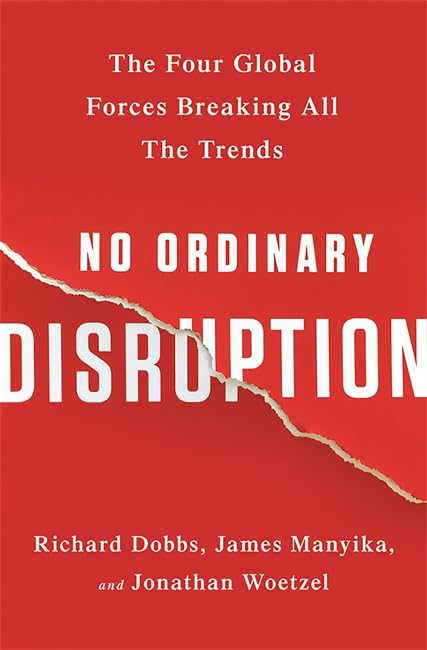 No Ordinary Disruption: The Four Global Forces Breaking All the TrendsRichard Dobbs, James Manyika, Jonathan Woetzel
Buy on Amazon
Between Starshine and Clay: Conversations from the African DiasporaSarah Ladipo Manyika
Between Starshine and Clay: Conversations from the African DiasporaSarah Ladipo Manyika
Buy on Amazon
 Like a Mule Bringing Ice Cream to the SunSarah Ladipo Manyika
 · 2016
Buy on Amazon
 In DependenceSarah Ladipo Manyika
 · 2008
Buy on Amazon
The people building the future of AI are already inside CEEK.
Join a community of creators posting daily on what AI means for their work, their careers and what they're building next.
Join me on CEEK
Comments
Comments are public. Links are removed.