When was the African Humid period?
The African Humid Period ran from roughly 14,800 to 5,500 years ago, turning the Sahara green for nearly 9,000 years before it dried back out.

 spio.com
What it was
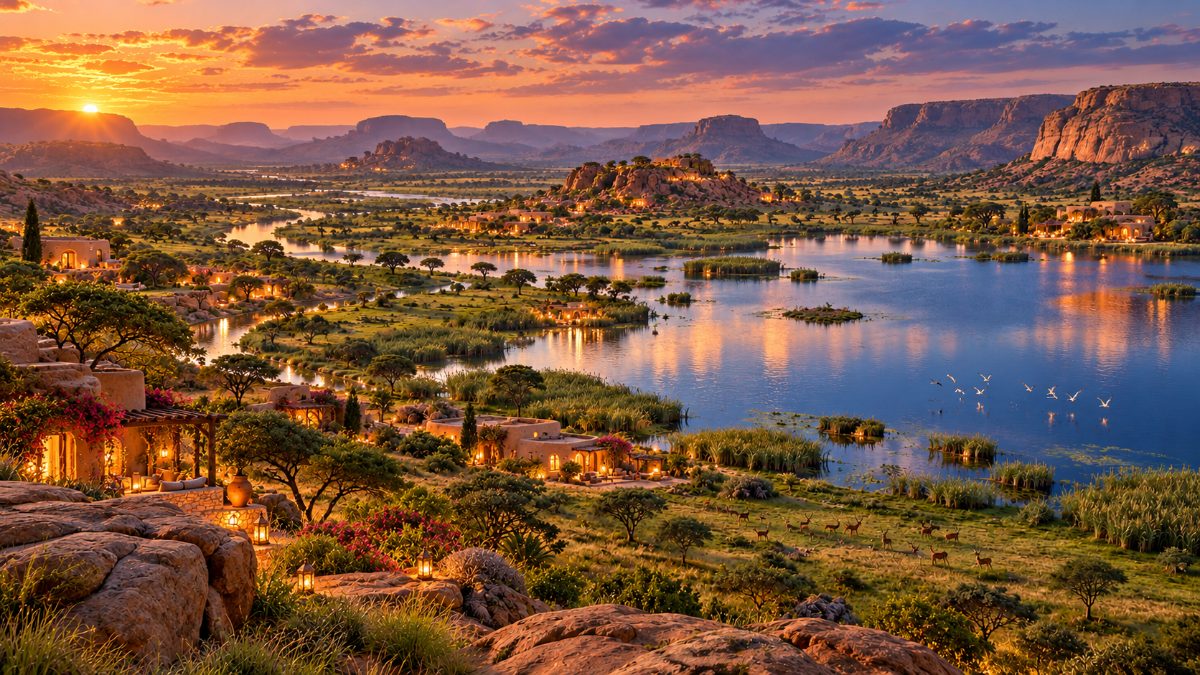
The African Humid Period (AHP), also called the Green Sahara, was a prolonged phase of enhanced moisture across northern and eastern Africa during the late Pleistocene and early to mid-Holocene epochs. In plain terms: the Sahara was not always a desert. For most of this period it was covered in grasslands, dotted with lakes and rivers, and home to hippos, crocodiles and large human settlements.
The dates
During the African Humid Period, roughly 14,800 to 5,500 years ago, changes in incoming solar radiation during Northern Hemisphere summers led to the large-scale expansion and subsequent collapse of the African monsoon. The exact bookends are debated because different records from different parts of the continent tell slightly different stories, and depending on how and where measurements and reconstructions are made, different beginning dates, ending dates and durations have been determined.
What drove it
The African Humid Period in North Africa is mostly related to changes in the Earth's orbital cycle. Due to small wobbles in the Earth's rotation, summer sunlight in the Northern Hemisphere was much stronger during this period than it is today. That stronger summer sun supercharged the monsoon, pushing rainfall far north into what is now the Sahara. This cycle repeats roughly every 20,000 to 23,000 years, driven by a wobble in Earth's tilt called orbital precession.
How it ended
Hydrologic reconstructions from arid North Africa show an abrupt onset and termination of the African Humid Period. Geologic evidence suggests both the onset and termination were abrupt, likely occurring on a timescale of decades to centuries. The ending wasn't uniform everywhere: precipitation reconstructions from across Africa suggest that the termination of humidity was spatially variable, moving towards progressively lower latitudes.
Why it matters for African history
Towards the end of the African Humid Period, the progressive desiccation of the region led to widespread depopulation and abandonment of North African sites, and the large-scale exodus was coincident with the rise of sedentary life and pharaonic culture along the Nile River. In other words, the drying of the Sahara didn't end African civilization. It concentrated it, funneling people toward the Nile and helping to ignite one of the greatest civilizations in human history. The last African Humid Period was not the first of its kind; it is just the most recent of hundreds of humid periods that have occurred over the past 9 million years.
Follow-ups
Which people existed then? What are any civilizations that existed then? The people of the Green Sahara are not a separate story from the great African civilization this thread has already covered — they are its authors.
 spio.com
The peoples of the Green Sahara
Two of the best-documented cultures are the Kiffian and the Tenerian, whose remains were found at Gobero in what is now Niger's Ténéré Desert.
The Kiffian were hunters of wild game who left evidence that they also speared huge perch with harpoons when they colonized the green Sahara during its wettest period, roughly 10,000 to 8,000 years ago. Their tall stature sometimes reached well over 6 feet.
The more recent population was the Tenerian, a more lightly built people who appear to have had a diverse economy of hunting, fishing and cattle herding. They lived during the latter part of the green Sahara, about 7,000 to 4,500 years ago. Their burials often included jewelry or ritual poses, including a stunning triple burial containing a woman and two children in a poignant embrace.
Separating the two peoples was a drought of roughly a millennium. The same lake that fed the Kiffians dried up, then refilled, and the Tenerians moved in. Two distinct cultures, same patch of land, 5,000 years apart.
Nabta Playa: a ceremonial world in the desert
Further north, in what is now the Egyptian Western Desert, the site of Nabta Playa shows that Green Sahara peoples were doing more than surviving. The Nabta Playa stone circle in southern Egypt, dated to approximately 7,000 years ago, is one of the oldest known astronomical alignments. At Nabta Playa, researchers documented a Late Neolithic ceremonial landscape with aligned megaliths and a stone "calendar circle" oriented to the cardinal points and solstice, cattle buried in roofed clay-lined chambers, and tumuli. This was a monument-raising, cattle-cult society with organized religious life.
A distinct North African lineage
Ancient DNA adds another layer. Genomic data from two approximately 7,000-year-old Pastoral Neolithic female individuals buried in the Takarkori rock shelter in southwestern Libya reveals that the majority of their ancestry stems from a previously unknown North African genetic lineage that diverged from sub-Saharan African lineages around the same time as present-day humans outside Africa, and remained isolated throughout most of its existence. These were not migrants passing through: they were a long-established people who had called North Africa home for tens of thousands of years.
Were these "civilizations"?
Honestly, it depends on how strictly you define the word. What archaeology attests in the green Sahara is mobile and semi-mobile cattle pastoralism: herders and fisher-hunters, seasonally on the move, organized enough to raise the Nabta megaliths and bury cattle with ceremony, but without cities, monumental permanent architecture, writing or state institutions. By the narrower definition, no. By a broader one, yes: organized religion, astronomical knowledge, cattle domestication, and elaborate funerary culture are the foundations that full-blown civilizations build on.
The connection to Egypt
The critical bridge is what happened when the Green Sahara ended. When the period ended, populations migrated toward the Nile Valley and Mesopotamia, contributing to the conditions that gave rise to early complex societies including Pharaonic Egypt. The gradual desiccation drove an exodus from the desert that "helped to trigger the emergence of pharaonic civilization along the Nile River" and spread pastoralism across the continent.
They are its authors. The cattle cults of Nabta Playa, the fishing communities of Gobero, the pastoralists of the Tenerian period: these are the people who eventually walked east to the Nile and built Egypt. The green world ended, the desert pushed them together, and civilization as the ancient world knew it began.
Why does the wobble in Earth's tilt called orbital precession happen?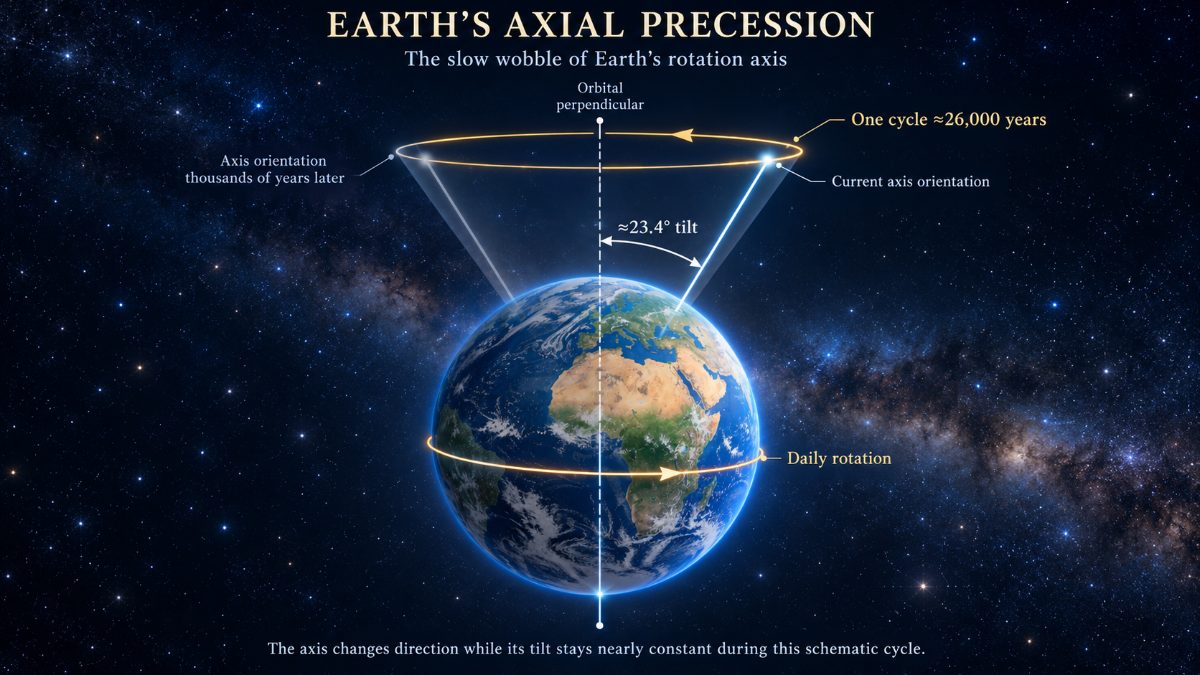 Orbital precession happens because the Sun and Moon pull on Earth's equatorial bulge, and since Earth is spinning, that pull doesn't straighten it out but instead makes the whole axis sweep slowly in a circle, the way a tilted spinning top wobbles rather than falls over.
spio.comThe spinning top you already know
Picture a toy top. When it's perfectly upright it spins fine, but when it leans, gravity pulls on that lean and the top wobbles in a slow circle instead of tipping straight over. Earth does the same thing: as it rotates, it wobbles slightly on its rotational axis, and the cause is tidal forces from the gravitational pull of the Sun and Moon acting on Earth's equatorial bulge.
Here is why the bulge matters. As Earth spins, centrifugal force makes the equator bulge outward, so the planet isn't a perfect sphere but a flattened one, and Earth's axis isn't vertical relative to its orbit but tilted by about 23.5 degrees. The gravitational pull of the Sun and Moon is the "tap" that causes the axis to precess, but gravity alone won't do it: it's specifically the equatorial bulge that gets the gravitational tug, and if Earth were a perfect sphere, there would be no precession at all.
The Sun's gravity pulls on that misaligned bulge, creating a torque by trying to drag it into alignment with the orbital plane; the Moon, orbiting in a plane tipped toward the bulge, yanks on it too; and the combined result is that Earth's axis slowly traces a complete circle once every 26,000 years or so.
The three Milankovitch cycles
Precession is one of three slow orbital rhythms that together are called Milankovitch cycles, named for the Serbian astronomer Milutin Milanković who worked out the mathematics in the early 20th century. The full set includes a 100,000-year cycle in the shape of Earth's orbit (eccentricity), a 41,000-year cycle in the tilt of Earth's axis (obliquity), and a 20,000-year cycle in the wobble of Earth's axis (precession).
- Eccentricity is how oval versus circular Earth's orbit around the Sun gets, driven mostly by Jupiter and Saturn's gravity.
- Obliquity is how much the axis itself tilts, varying between about 22 and 24.5 degrees over 41,000 years.
- Precession is the direction the tilt points, completing its circle in roughly 26,000 years.


Why precession turned the Sahara green
This is the direct connection to the Green Sahara you've been reading about. The precession of the equinoxes is regarded as the most important orbital parameter in the formation of the "green Sahara" and "desert Sahara" cycle.
Here's the chain of cause and effect. Precession controls which season Earth is closest to the Sun. When precession moved the Northern Hemisphere closer to the Sun during the summer months, it caused warmer Northern Hemisphere summers, warmer air capable of holding more moisture, intensifying the West African Monsoon and shifting the African rainbelt northward into what is now the Sahara.
Since precession controls summer insolation over North Africa, it effectively controls the amount and northward penetration of the monsoonal rains. Roughly 11,000 years ago, Earth's axis was pointed such that the Northern Hemisphere summer coincided with perihelion, the closest point to the Sun. The precession cycle varies on a 21,000-year timescale, and the similarity between this cycle and the timing of the African Humid Periods indicates that precession is their dominant driver, because precession influences seasonal contrasts, increasing them in one hemisphere while reducing them in the other.
Today the axis has wobbled far enough that Northern Hemisphere summer happens when Earth is farther from the Sun, the monsoon is weaker, and the Sahara is dry. Give it another 10,000 years and the axis will have swung back around. The Sahara has greened and dried hundreds of times before this last one, all paced by the same slow wobble.
How far into the future will the next green Sahara period occur based on Earth's cycle? The next Green Sahara is projected to arrive roughly 10,000 to 15,000 years from now, when Earth's orbital precession swings Northern Hemisphere summers back into the position that supercharges the African monsoon and pushes rain deep into the Sahara.
 spio.com
The same wobble that ended it will bring it back
The precession cycle is the engine. The wobbles in Earth's axis occur approximately every 21,000 years, and research confirms that the African Humid Periods occurred on exactly that cadence, determined by changes in orbital precession. The last Green Sahara peaked roughly 9,000 to 6,000 years ago and collapsed around 5,500 years ago. Half a precession cycle forward from that collapse lands somewhere between 10,000 and 15,000 years from now.
The next Northern Hemisphere summer insolation maximum, the orbital moment when the Green Sahara could reappear, is projected to happen about 10,000 years from now, around 12000 or 13000 CE. Other estimates put natural greening returning in 12,000 to 15,000 years. The spread between those numbers matters: it is not a perfectly regular timer that turns an entire desert green at fixed intervals.
Why a precise date is impossible
Orbital eccentricity, glacial ice, Atlantic circulation, sea-surface temperatures, atmospheric carbon dioxide, vegetation and dust all influence how far the monsoon moves. Human-driven warming has also changed the background climate against which future orbital forcing will operate. The next favourable alignment will not recreate the early Holocene automatically.
In other words, precession sets the invitation. Whether the Sahara actually RSVP's with grasslands and lakes depends on everything else happening at the same time. Because of the wildcard of human-caused greenhouse gas emissions, it's unclear precisely when the Sahara will turn a new green leaf.
What the past tells us about the future
A study in Nature Communications used a coupled climate model to reproduce 20 North African humid periods over the past 800,000 years. The simulations agreed well with humid phases identified in geological records. Precession set the broad pace, while orbital eccentricity and high-latitude ice sheets strongly affected the amplitude.
The honest answer from the science is a window, not a date: somewhere between 10,000 and 20,000 years from now, Earth's wobble will once again angle Northern summers toward more intense sunlight, the monsoon will push northward, and the Sahara will have its next chance to go green. Whether it does so as dramatically as the Kiffian and Tenerian knew it depends on what greenhouse gases, ice sheets and Atlantic currents look like at that moment.
How did humans spread across Africa during the African Humid Period? The African Humid Period turned the Sahara into a passable landscape of grasslands, rivers and lakes, drawing people northward and outward across the continent.
spio.comThe Green Sahara opened a corridor that drew people northward, westward and outward that created a free-flowing superhighway between sub-Saharan and North Africa.
The gate swings open
The Sahara acts as a kind of gate controlling the dispersal of species between North and sub-Saharan Africa, and in and out of the continent. The gate was open when the Sahara was green, and those North African Humid Periods was crucial in providing vegetated corridors for various species, including early humans, to spread around the world.
During humid phases, the Sahara was a green corridor filled with rivers and lakes that facilitated human expansion into North Africa and beyond. People followed the water, the fish, the game and the pasture, exactly the way the Kiffian and Tenerian cultures this thread already covered did in what is now Niger.
Who moved, and where
Genetic studies of Y-chromosome lineages show that the coalescence age of trans-Saharan haplogroups, the genetic family trees shared across both sides of the desert, dates back to the last Green Sahara, while most northern African or sub-Saharan clades expanded locally in the subsequent arid phase. The findings suggest the Green Sahara promoted human movements and demographic expansions, linked to the adoption of pastoralism.
A signal for population movements from sub-Saharan Africa to North Africa during the Green Sahara has been identified in mitogenome data, providing evidence that the human dispersals associated with this period also involved females.
Groups traversed the green Sahara using the most promising routes, and there is direct linguistic evidence that Nilo-Saharan populations exploited aquatic resources across a wide area, in the form of a widespread shared word for "hippo" stretching from Gumuz in Ethiopia to Songhay in Mali. Language traveling with people is one of the clearest fingerprints of migration.
When the green dried up, people had to move
The termination of the African Humid Period in northeastern Africa was marked by the southward migration of the rain belt and the disappearance of the Green Sahara. This interval of drastic environmental change was also marked by the initiation of food production by North African hunter-gatherer populations. The pressure of the drying Sahara is one of the factors researchers connect to the intensification of agriculture along the Nile River and the rise of what would become Egyptian civilization. The gate that had been open for nearly 9,000 years slammed shut, and the people on the wrong side of it had to adapt fast or follow the retreating water south and east.
Why are historians trying to rewrite history and deny the migration? I believe this is a further erosion of Africa's role in humanity. People moved through the Green Sahara, and the oldest DNA from North Africa points to deep African roots. Yet the old push to pull North Africa away from the rest of the continent, and to Europeanize its origins, keeps coming back.
 spio.com
A Further Erosion of Africa's Role
I believe this is a further erosion of Africa's role in humanity. Each time a study is reported as "limited migration" or "an isolated lineage," the headline can be used to pull North Africa away from the rest of the continent and to Europeanize its origins. The science itself tells a different story.
North Africa Is Where Our Species Shows Up First
The oldest known fossils of our species, Homo sapiens, come from Jebel Irhoud in Morocco. They are about 300,000 years old, published in Nature in 2017 by a team led by Jean-Jacques Hublin and Abdelouahed Ben-Ncer. North Africa is not a side note to the human story. It is one of its first chapters.
What the Ancient DNA Actually Says
- Takarkori, Libya: 2 women buried in a rock shelter about 7,000 years ago, during the Green Sahara. A 2025 study in Nature found they belonged to a deeply rooted North African lineage that split from sub-Saharan lineages around the same time other groups left Africa, about 50,000 years ago. They carried about 10 times less Neanderthal DNA than people outside Africa.
- Taforalt, Morocco: people who lived about 15,000 years ago. A 2018 study in Science found about 2/3 of their ancestry tied to the Near East and about 1/3 to sub-Saharan Africa, most similar to West Africans.
- The Takarkori women shared close genetic ties with the people of Taforalt. Both point to roots that run deep inside Africa.
How Africa's Achievements Were Taken Away Before
This is not new. After Napoleon's 1798 expedition to Egypt, European scholars could not accept that Africans had built such a civilization. They credited Egypt, and later other African achievements, to "Hamites," whom they classified as white.
Charles Seligman wrote in Races of Africa (1930) that "the civilizations of Africa are the civilizations of the Hamites." The historian James Henry Breasted wrote that the people of North Africa were "dark-skinned, but nevertheless physically they belong to the Great White Race." In 1969, Edith Sanders traced how this idea, the Hamitic hypothesis, was used to take Africa's achievements away from Africans, in the Journal of African History.
That is why I read these headlines carefully. North Africa is Africa. Its people, its history and its genes are part of the African story, and of the story of every human on Earth.
The migration itself is well documented in analyses of archaeological occupation of the Nile Valley during the African Humid Period; what researchers argue about is the push and pull factors, not whether people moved.
The evidence for movement is overwhelming
Research on trans-Saharan Y-chromosome lineages found that the Green Sahara promoted human movements and demographic expansions, possibly linked to the adoption of pastoralism. Significant migration of populations from the Nile Valley to the west and northwest of the Sahara occurred during the African Humid Period, an episode of increased monsoons which characterized North Africa in response to increasing insolation. More than 10,000 years ago, when the Sahara was still green, people living near the Nile River migrated hundreds of kilometers from the river's fertile banks.
The frustration is real. The history of African civilizations genuinely has been minimized, doubted and outright suppressed in Western academic traditions.
The honest picture is this: people moved, cultures exchanged, populations mixed to varying degrees in different regions. Comparative analysis of climate-related mobility traces structural continuities from prehistoric periods to the present, and the findings consistently indicate that climatic variability triggered significant population movements. The science on that is not going anywhere.

Explore this further on CEEK
Join the people on CEEK who are digging into African history and the deep science behind it. Daily posts, a community that takes it seriously.
Join me on CEEK
Comments
Comments are public. Links are removed.