What were the pillars of Dr. Clarke's teachings?
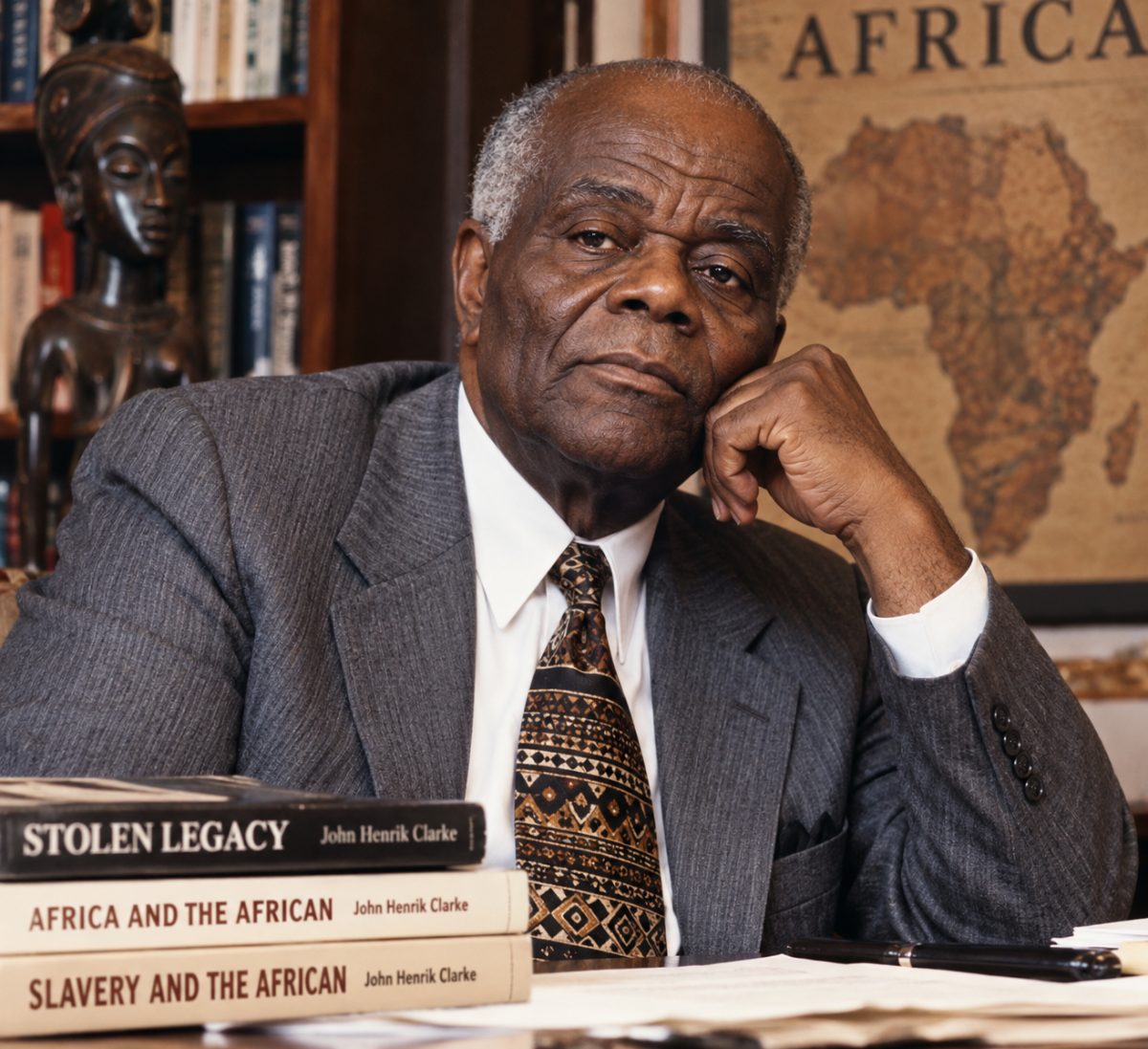
Dr. John Henrik Clarke, the self-taught Pan-Africanist historian and professor, built his life's work on a handful of non-negotiable ideas: that African history is the foundation of world history, that history is a tool of power, that self-knowledge is the only genuine freedom, and that a people who accept someone else's story about themselves have already surrendered.

Answer from Mary's digital twin. Checkmark turns Green once she confirms it.
 spio.com
Note that it was Arturo Alfonso Schomburg himself who set Clarke on this path. Clarke's formative training in history began under the tutelage of Schomburg Center, who showed him the relationship between African history and world history. What Clarke built on that foundation came down to several interlocking pillars.
World History is a clock and a compass
Clarke said: "History is a clock that people use to tell their political and cultural time of day. It is a compass they use to find themselves on the map of human geography. It tells them where they are but, more importantly, what they must be." For Clarke, history was never an academic exercise. Schomburg had taught him the political meaning of history, and Clarke never let go of that idea: history is a weapon, and whoever controls the story controls the people.
Africa at the center, not the margin
His pan-Africanist worldview considered Africa the epicenter of history, and the experiences of Africa's descendants an expansion of the continent. His consistent theme was "Adding the missing pages of world history," and he insisted that when Africans along the Nile created the greatest ancient civilizations, there was no such place called Greece, Rome or even Europe. He taught that the first light of human consciousness and the world's first civilizations were in Africa.
Controlling your own narrative is the same as controlling your freedom
Clarke argued: "To control a people you must first control what they think about themselves and how they regard their history and culture. And when your conqueror makes you ashamed of your culture and your history, he needs no prison walls and no chains." He put it another way too: "To hold a people in oppression you have to convince them first that they are supposed to be oppressed."
Education as liberation, not permission
He taught: "Powerful people cannot afford to educate the people that they oppress, because once you are truly educated, you will not ask for power. You will take it." He held that every form of true education trains the student in self-reliance. For Clarke, learning was not about credentials or approval from institutions that had spent centuries erasing you. It was the act of reclaiming what was already yours.
Pan-African unity across the diaspora
Clarke refused to sever Black America from Africa. He saw the Middle Passage not as a clean break but as a catastrophic rupture that still left continuities of culture, politics, spirituality, resistance, and imagination. He challenged Black people to "stop playing the separating game of geography, of where the slave ship put us down" and concentrate instead on "where the slave ship picked us up." The intellectual tradition Clarke carried contained four central tenets: a pan-African outlook, an autodidact emphasis, a recognition of the antiquity of African civilization, philosophy and religion, and an importance placed on the bibliophile, meaning the sacred duty to read, collect and preserve your own history.
Self-determination as the only real goal
Clarke insisted: "If we are going to be masters of our destiny, we must be masters of the ideas that influence that destiny." And: "Everything that touches your life must be an instrument of your liberation or tossed into the trash cans of history." He taught as though memory had a deadline. He wanted Black people to know what Europe had done, but he did not want Europe to remain the center of the story.
Taken together, these pillars form a single argument: you cannot be free until you know who you are, and you cannot know who you are until you recover the history that was taken from you.
Dr. Clarke's 1973 Lecture: Africa and the New World
In November 1973, Dr. John Henrik Clarke, then professor of African world history at Hunter College, spoke at the University of Texas at Austin. His subject was Africa and the so-called New World, and a new way of looking at African American history. Here is what he covered.
Africans Were Here Before Columbus
- He questioned the term "New World." He said Africans were in South America and the West Indies as early as 500 BC, and that Christopher Columbus's own accounts describe Africans trading with the people already living there.
- He pointed to the scholarship. He cited Leo Wiener's 3-volume Africa and the Discovery of America, which argued that Africans may have reached the Americas very early and shaped much of what is thought of as Native American culture.
- He said 1492 mattered for what Europe did next. Coming out of the Crusades, Europe decided that whatever the shape of the world, it would take it.
Religion Came Out of Africa
- Reclaiming ourselves. He quoted Edward Wilmot Blyden's 1881 address at Liberia College: Black children were taught falsehoods about themselves in schoolbooks, and came to believe their only hope was to be what was most unlike themselves.
- Christianity versus Christendom. He said the first salvation-based religions came out of Africa. He separated Christianity, a religious way of life, from Christendom, which he called a political weapon used to justify the slave trade and colonialism.
- Living the moral law. He said indigenous African religions already practiced what others preached: no homes for the aged, because nobody discarded their mother, and no homes for abandoned children, because nobody abandoned children.
Africa's Golden Age
- Spain. He said the conquest of Spain in 711 was an African conquest, led by the general Tariq ibn Ziyad.
- Mansa Musa. He described Mansa Musa's 1324 journey to Mecca, and said Mansa Musa insisted on meeting the head of the Muslim faith as an equal or not at all. He came home with an architect and built up Timbuktu, including the Sankore university.
- Songhai. He said Askia Muhammad, who came to power in 1493, took the Songhai Empire to its golden age in the middle of the slave trade era. The real collapse came with the Moroccan invasion of the 1590s, which destroyed Timbuktu's universities and exiled its scholars.
Revolt in the New World
- They never stopped resisting. He said Africans revolted on the ships, when they landed and on the plantations.
- Culture kept revolt alive. In the Caribbean and South America, enslaved Africans were often bought in large groups from the same region, so they kept a shared language and the drum language. He called that a key to the success of the Haitian Revolution.
- Leaders with Ghanaian names. He pointed to Kofi (Cuffy), who led the Berbice revolt in Guyana, and Cudjoe, who led the Maroons in Jamaica, and asked whether it was an accident that the most successful revolts were led by Africans from Ghana.
- Women who chose their people. He told of Queen Mary in the Danish West Indies, who gave up a life of comfort to join the revolt, and of African women in Brazil who never lost their commitment to African people.
The Search for an African Identity in America
- David Walker's Appeal. He called David Walker's 1829 Appeal the first theoretical basis of Pan-Africanism, meaning the movement to unite African people everywhere.
- Builders of institutions. He named Jamaican-born John Russwurm of Freedom's Journal, Martin Delany and Robert Campbell, who traveled to what is now Nigeria, Prince Hall of Barbados, who founded the Black Masons, and Peter Ogden of Antigua, who founded the Black Odd Fellows.
- Booker T. Washington. He said Washington was a strategist, not an "Uncle Tom," but questioned the price of his 1895 Atlanta speech. By then, Black inventors such as Lewis Latimer, Elijah McCoy and Jan Matzeliger had already changed American industry.
- The challengers. He named William Monroe Trotter, W.E.B. Du Bois and the Niagara Movement that became the NAACP, and Marcus Garvey, whose movement drew more Black followers than any other.
From Black and Beautiful to Black and Powerful
- Beauty is not power. He said the world will gladly agree that Black people are beautiful, and even sell the cosmetics. Saying "black and powerful" is what changes the social order.
- Go into the hard sciences. He urged metals, oceanography, shipbuilding, engineering and agriculture, so Africa's resources can work for African people.
- The Western diaspora has a mission. He said Africans in the Western world, the largest literate body of African people, have the greatest capacity to help unlock Africa's wealth for its own people.
He closed on what history is for:
History is a clock that people use to tell their time of day. It is a compass that they use to find themselves on the map of human geography.
In His Own Words
From his lecture at the University of Texas at Austin, November 1973:
The savage was an invention.
I am not conceding Islam to the Arabs, and I am not conceding Christianity to white people.
Christendom is a political weapon. Christianity is a religious way of life.
They never say that I am my brother's keeper, but they keep that brother. They don't preach about it, but they do it.
Beauty never hurt anybody. Beauty never destroyed a nation. But if you say you are black and powerful, then you're in trouble.
If you call your former master back to cure your child's stomachache, he's going to re-enslave you based on your need for him.
History is not a cure-all. It cannot grow a tomato.
History tells a people where they have been and what they have been. It also tells a people where they are and what they are. Most important, it tells a people where they still must go and what they still must be.
Follow-ups

Dr. John Henrik Clarke was a self-taught Pan-Africanist historian, professor and pioneer who, starting from a freight-train ride out of Jim Crow Georgia, spent his entire life proving that the history of African people was not a footnote to human civilization but its very foundation.
Read that one firstThe people who know their history are building something new.
CEEK is where creators and thinkers post daily and push each other forward, one idea at a time.
Join me on CEEK
Comments
Comments are public. Links are removed.