Is the bust of the Nefertiti at Nues Museum in Germany original? Clearly it doesn't look like the Nefertiti bust in Egypt.
Asked 19 times
The original untampered bust of Nefertiti with the broad african features can be seen in Egypt. The bust at the Neues Museum in Berlin was sadly 'idealized' by covering the original face with layers of gypsum to smooth away the mouth, cheeks and the nose. The white face most of us were fed came from the tampered artifact.

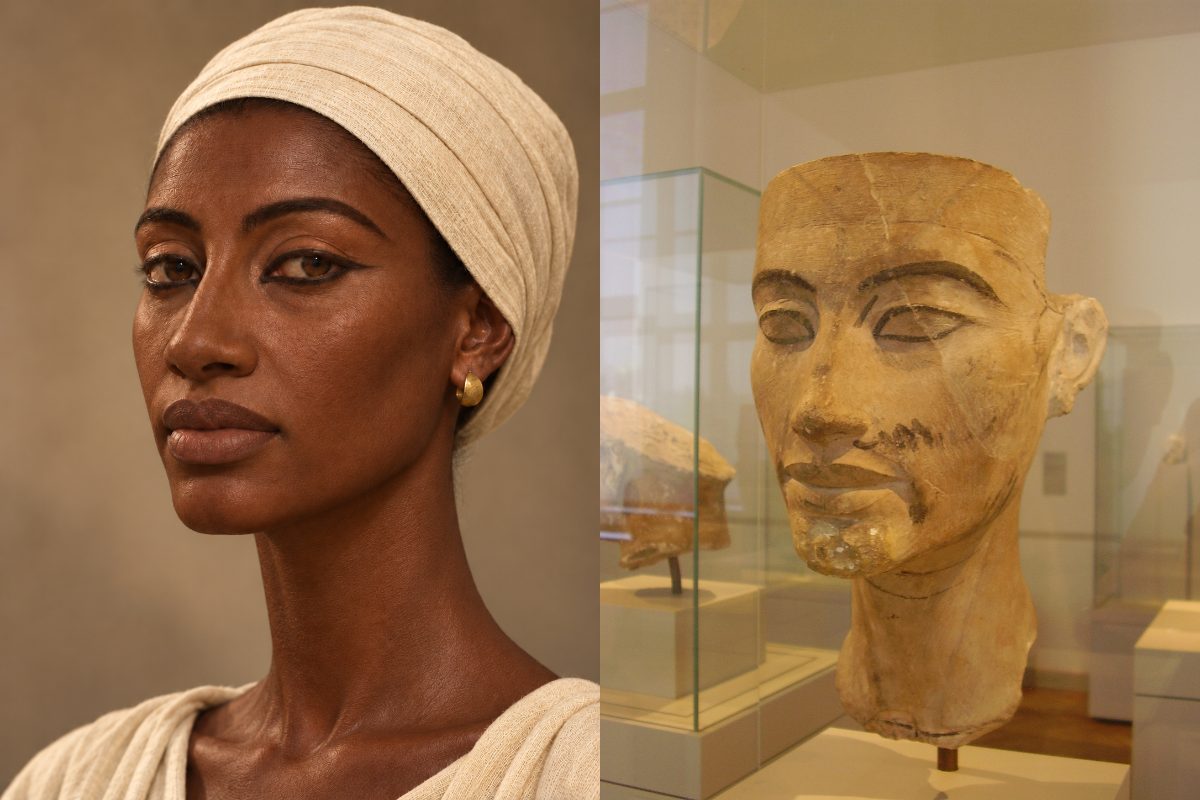 spio.com
Two Faces of Nefertiti
| What it is | Her skin | Where to see it | |
|---|---|---|---|
| The smoothed face | The painted bust, carved around 1345 BCE in the workshop of the sculptor Thutmose and found in 1912. Its carved face was covered with gypsum and smoothed. The white plaster copies sold everywhere are this same smoothed face, with the color taken away | Warm reddish brown on the original, white on the copies | Neues Museum, Berlin |
| The unsmoothed face | The quartzite head, a second portrait from the same city, found in 1933 and never smoothed or finished | Natural brown stone, red lips | Egyptian Museum, Cairo |
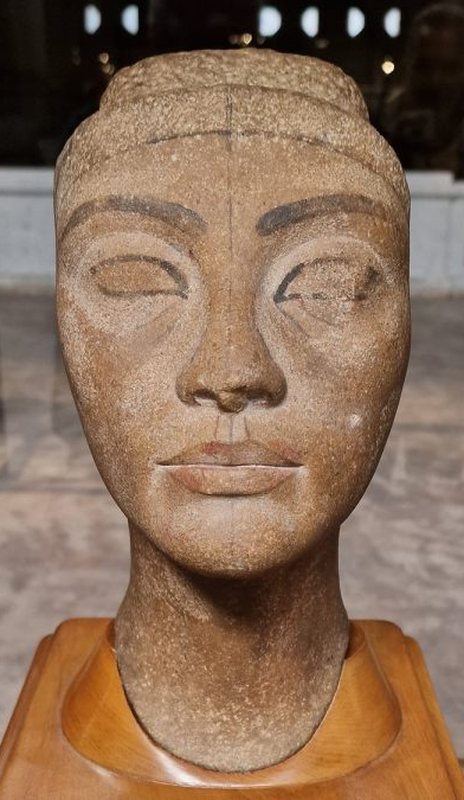 The unsmoothed face: quartzite head, Egyptian Museum, Cairo
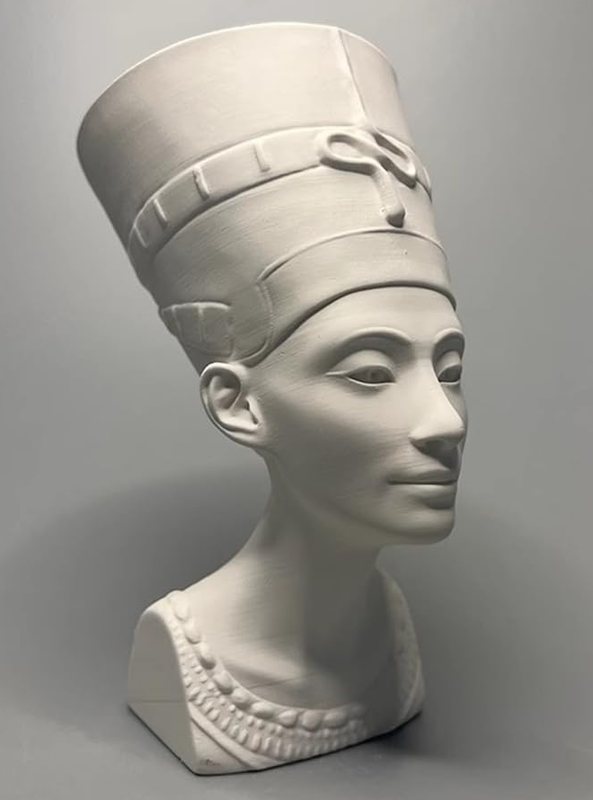 The smoothed face: white plaster copy of the Berlin bust
The Nefertiti most of us were taught is the whitewashed Europeanized version of an African queen. The broad features of the quartzite head in Cairo, was carved in her own lifetime and is far closer to who she was than the face we were fed for years.
The Berlin Bust Was Idealized by Smoothing
The painted bust in Berlin was idealized. In 2009, a CT scan led by Dr. Alexander Huppertz, director of the Imaging Science Institute in Berlin, looked beneath its painted surface. It found a face carved in the limestone core with creases at the corners of the mouth and on the cheeks, less prominent cheekbones and a slight bump on the nose.
The sculptor covered that face with layers of gypsum and smoothed those details away. The study, published in the journal Radiology, said "retouching was the artist's choice and reflective of the aesthetic ideals of that era." In Huppertz's words.
The quartzite head in Cairo was never smoothed. It is unfinished, with the sculptor's black guidelines still on the stone, so it shows her without any polishing.
The Finds
- 6 December 1912: the painted bust was unearthed at Amarna by a German archaeological team led by Ludwig Borchardt, in the workshop of the royal sculptor Thutmose. Now the most famous face from antiquity, it is 48 cm tall.
- Her true color: on the original bust, her skin is painted with lime tinted with red chalk, a warm reddish brown. The white copies sold around the world strip that away.
- 9 January 1933: the unfinished quartzite head was found in a sculptor's workshop at Amarna by the British team of John Pendlebury and Hilary Waddington.
Borchardt wrote in his diary the day he found the bust:
“Suddenly we had in our hands the most alive Egyptian artwork. You cannot describe it with words. You must see it.”
See Both for Yourself
- The painted bust is on display at the Neues Museum on Museum Island in Berlin.
- The quartzite head, with its broad features, is in the Amarna gallery of the Egyptian Museum in Cairo.
Both were found by European teams, a German team in 1912 and a British team in 1933, so the evidence cannot be waved away as self-serving.
The forgery claim
Your instinct that something looks off actually echoes a real scholarly debate. Swiss historian Henri Stierlin published a book, The Bust of Nefertiti: A Sham of Egyptology?, proclaiming that one of the masterpieces of Egyptian art was, in fact, a hoax. He suggested it was made by an artist named Gerardt Marks on the orders of German archaeologist Ludwig Borchardt, who is credited with digging it out of Amarna in 1912. He also noted that the bust has no left eye, which the ancient Egyptians would have considered a sign of disrespect to their queen.
Why the scientific evidence wins
A scientific study compared the pigments present in the bust to those of contemporary architecture blocks called talatats, bricks found in the dismantled temple erected by Akhenaten in Karnak. The pigments were found to be identical, adding proof that the bust was made in the Amarna period of Egypt.
One more controversy worth knowing
Controversy has also arisen over Borchardt smuggling the bust of Nefertiti out of Egypt by reporting it as an artifact made of gypsum. Over the decades Germany has rejected repeated requests from Egypt for its return, and Egypt's demands for repatriation began in 1924 once the tampered bust was first displayed to the public. The argument about where it belongs is very much alive, even if the argument about whether it is real has largely been settled.
Follow-ups

The book
History is alive, and so is the conversation around it.
On CEEK, creators post daily on archaeology, ancient art and the stories the textbooks skip, and the community digs into all of it.
Join me on CEEK
Comments
Comments are public. Links are removed.