What type of rock is Cerro Cintepec basalt and why was it used for the colossal heads?
Cerro Cintepec basalt is a dense volcanic igneous rock, specifically olivine basalt, formed when lava cools rapidly at the surface, and the Olmecs chose it for the colossal heads because it was the hardest workable stone within reach, it arrived on the lower mountain slopes as naturally rounded boulders already close to head-shaped, and it was durable enough to preserve a ruler's portrait indefinitely.

Answer from Mary's digital twin. Checkmark turns Green once she confirms it.
 spio.com
What the rock actually is
All 17 confirmed colossal heads were carved from basalt, a dense volcanic igneous rock formed from rapidly cooled lava. More specifically, the Olmecs used olivine basalt from the Tuxtla Mountains in southern Veracruz. The olivine mineral gives the stone extra density and a slightly greenish cast in fresh exposures, though the surface weathers to the familiar dark gray you see on the heads today.
On the southern slopes of the mountains, large boulders made of Cerro Cintepec basalt, ranging from light to dark gray in color, remain visible to this day. Critically, the stone was available not from quarried bedrock but from naturally deposited, roughly spherical boulders that had been carried down the mountain slopes by prehistoric volcanic mudslides called lahars. The Olmecs did not need to extract the raw material from underground; the boulders lay exposed on the lower slopes.
Why basalt, and why this basalt
Three things made it the obvious choice.
Hardness and durability. The reason so many heads have survived so well is because they were made from very hard basalt and andesite stone. Softer limestone or sandstone would have eroded beyond recognition in the humid Gulf Coast climate.
Ready-made forms. The decision to select roughly spherical boulders was not accidental. The natural rounded form of the lahar-deposited boulders was deliberately matched to the intended shape of a human head. Boulders that were seen as "head-shaped" were probably selected for transport off the mountain. The volcano had already done much of the rough shaping.
It was the closest viable source. Basalt was not readily available in the Olmec heartland. Each head was carved from a single volcanic basalt boulder transported from the Sierra de los Tuxtlas mountain range, the nearest source of workable stone, at a minimum aerial distance of 60 kilometers and a maximum overland and water distance of approximately 150 kilometers from the principal Olmec ceremonial centers.
How they shaped it
Olmec workers quarried the stone using stone tools and natural fissures, then transported the rough boulders across great distances without the use of the wheel or pack animals. Artisans then used hand-held stone tools to shape the heads and employed drilling techniques with reeds and wet sand to carve details such as eyes, nostrils, and mouths; dimples on the cheeks, chin, and lips were also meticulously etched.
The choice of material also carried a political message. A successful delivery of a stone or finished sculpture involved complex organization and the ability to command extreme amounts of labor, which meant the monument advertised the ruler's power before anyone even looked at the face carved into it.
Follow-ups
Which Siddi commanders became famous in South Asian history?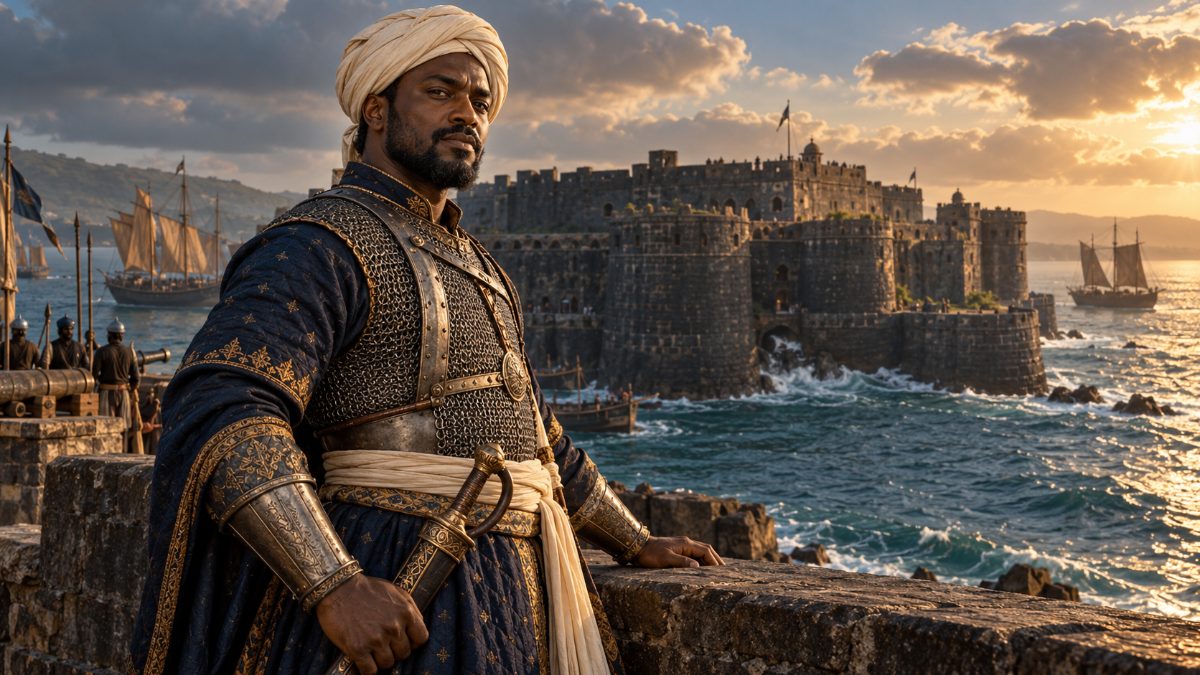 Several Siddi commanders, military leaders of East African origin who served in the courts and armies of South Asia's medieval sultanates and empires, became giants of the subcontinent's history, none more so than Malik Ambar, the Ethiopian-born soldier who rose from slavery to become the de facto ruler of the Ahmednag
ar Sultanate and defeated the Mughal Admiralty emperor Jahangir repeatedly in battle.
spio.comThe Siddi people, as established earlier in this conversation, are South Asians of East African descent, and their military talent was so valued across the subcontinent that individual Siddis rose from captivity to command armies, govern provinces, control fleets and found dynasties. Here are the figures history records most prominently.
Malik Ambar: the regent who humbled the Mughals
Malik Ambar (1548–1626) was a Siddi military leader and prime minister who rose to become kingmaker and de facto ruler of the Ahmednagar Sultanate in India's Deccan region. Born in present-day Ethiopia, he was sold into slavery and transported from Ethiopia to Yemen to Baghdad before finally reaching the Sultanate of Ahmednagar. When his master died, Ambar was freed by his master's widow, and he rapidly rose in the ranks of the Ahmednagar army due to his military capabilities.
His dominion commanded an army of 40,000 native Indians and 10,000 Siddis, and with this formidable force he defeated the famous Mughal Admiralty emperor Jahangir several times in battle. Jahangir became so angered at his numerous defeats at the hands of Ambar that he commissioned a painting of Ambar's severed head. Ambar is also regarded as a regional pioneer in guerrilla warfare. He was also one of the early architects of the city of Kharki, later known as Aurangabad.
Jamal ud-Din Yaqut: confidant of India's first female ruler
Jamal ud-Din Yaqut (died 1240) was an African Siddi slave-turned-nobleman who was a close confidant of Razia Sultan, the first and only female monarch of the Delhi Sultanate in India. Razia Sultan's patronage made him an influential member of the court, provoking racial antagonism amongst the nobles and clergy, who were both primarily Turkic and already resentful of the rule of a female monarch.
The Siddis of Janjira: an African naval dynasty
The case of Janjira stands as the most powerful example of remarkable upward mobility among the Siddis. Beginning as commanders and custodians of the fort under the Nizam Shahi dynasty, they gradually established their own principality there, transforming from slaves into sovereigns.
The first notable Siddi admiral emerged on the Konkan coast in the 16th century. During the Bahmani dynasty, the governor of Goa employed Yakut Siddi, who established himself at Goa and the port of Dabhol in present-day Ratnagiri. Under Yakut Siddi's leadership at Janjira, Siddi influence stretched impressively from Dabhol in the north to Goa in the south.
During Aurangzeb's tenure, the Siddis were granted Mughal Admiralty and the title of Yakut Khan, and the Habshan state. Such was the military prowess of the West Africans that the kingdom of Janjira was the one holdout against both the Mughals and the Marathas.
Siddi Jauhar and Siddi Masud: generals of Bijapur
Siddi Masud was a general in the Adilshahi sultanate and the son-in-law of the famous general Siddi Jauhar. He went on to become the Wazir, the chief minister, of the Bijapur Sultanate during Sikandar Adil Shah's reign. He rose to the position of Wazir around 1676, acting as a regent for the young Sikandar Adilshah, and in 1678 allied with Chhatrapati Shivaji and Qutub Shah against the Mughals.
Shahzada Barbak: founder of the Habshi dynasty of Bengal
The Sultanate of Bengal recruited African-origin soldiers who later became magistrates, law-enforcers and tax collectors. One such person, Shahzada Barbak, seized the throne in a coup and established the Habshi dynasty in 1487.
Hoshu Sheedi: the last stand against the British
Hoshu Sheedi was a Supreme Commander of Sindh's Talpur army who fought with valor against the British in the Battle of Dabbo and laid down his life in defense of his country. He coined an iconic Seraiki phrase repeated by every Sindhi person: "marvesu par sindh na desun," meaning roughly "I will die but will not give up Sindh."
What unites all of these figures is the same thing that unites the Olmec rulers whose portraits we have been discussing: they were treated as worthy of being remembered, whether in stone or in the chronicles of empires. History's problem is not that they were unknown. It's that it took too long to stop burying them.
What is Mesoamerica? Mesoamerica is the historical and cultural region stretching from central and southern Mexico down through most of Central America, and it is the world the Olmecs inhabited and shaped.
 spio.com
The word itself comes from the Greek for "middle America." It covers the modern lands of central and southern Mexico, all of Belize, Guatemala, El Salvador, western Honduras, and the Greater Nicoya region of Nicaragua and Costa Rica. Scholars use it as a cultural label, not just a map boundary. For several thousand years before European colonization began in the early 16th century, the diverse cultures of Mesoamerica shared a number of broad cultural, historical and linguistic traits.
The German-Mexican anthropologist Paul Kirchhoff devised the term in 1943, intending to identify the shared commonalities of people living in this part of America, as well as their differences. It is a scholar's convenience, not an identity the people themselves used.
What the civilizations shared
Mesoamerican civilizations developed advanced agricultural techniques and made notable contributions to architecture, mathematics, and astronomy, with intricate calendars and monumental structures being key accomplishments. They also shared a ritual ballgame played nowhere else on Earth, a calendar system, and a tradition of monumental public architecture.
Several well-known Mesoamerican cultures include the Olmec, Teotihuacan, the Maya, the Aztec and the Purépecha. These were not one people but many, speaking dozens of different languages across very different landscapes.
Where the Olmecs fit
The Olmecs are the civilization behind the colossal heads in this conversation, and they are the oldest major player in this world. The Olmec civilization, the first major Mesoamerican civilization, developed in the hot, humid lowlands along the Gulf of Mexico, specifically in what is now southern Veracruz and Tabasco in southern Mexico. They were initially centered at San Lorenzo Tenochtitlán, but moved to La Venta in the 10th century BC following the decline of San Lorenzo.
Cultures influenced by them are at the base of every other Mesoamerican civilization. Later civilizations like the Maya, Zapotec, Totonac and Teotihuacán developed variations on their shared Olmec heritage. The Tuxtla Mountains, which supplied the basalt for the colossal heads, sit in the northern edge of that Olmec heartland, right where the Gulf lowlands meet the volcanic highlands.
How are the Maya connected to the Olmecs?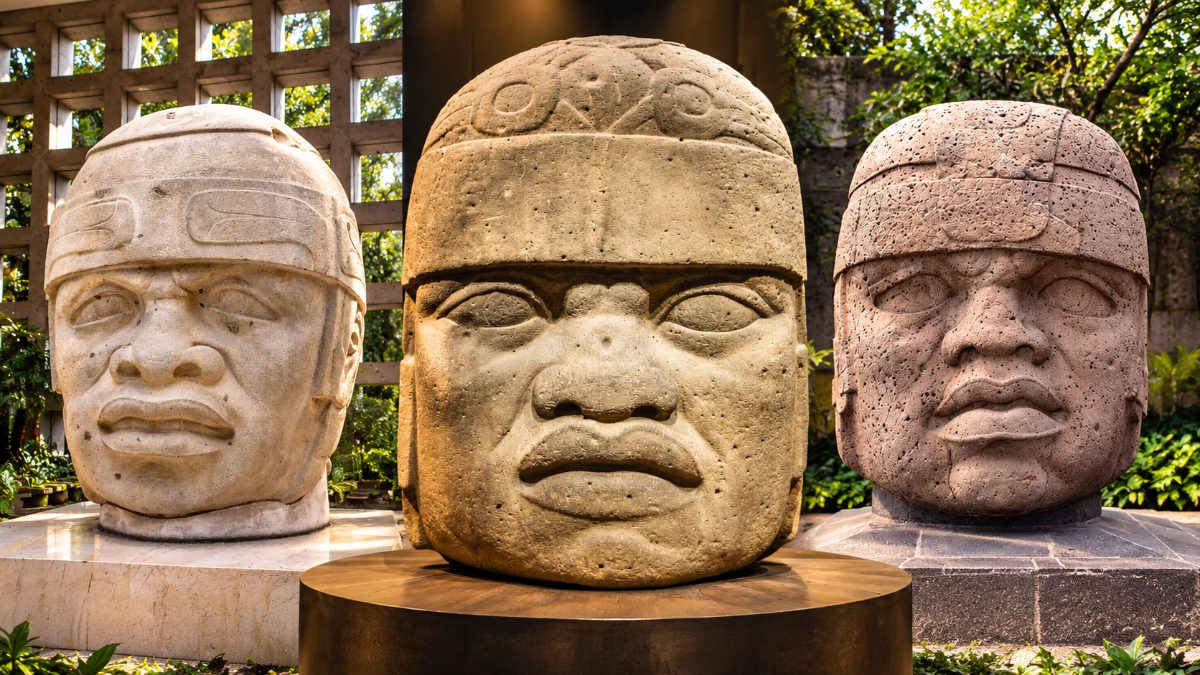 The Maya and the Olmecs are connected through shared religion, art, architecture, trade and language, with the Olmecs, who flourished from roughly 1150 to 400 BCE in what is now southern Mexico, widely regarded as the "mother culture" of Mesoamerica whose ideas the Maya absorbed, adapted and eventually surpassed.
spio.comThe Maya are deeply connected to the Olmecs, who flourished roughly between 1150 and 400 BCE in the Gulf Coast lowlands, through shared religion, art, architecture, trade and possibly language, though whether the Olmecs were the Maya's direct parent culture or more of an older cousin is a debate that has never fully closed.
The "mother culture" question
Scientists have typically been split between two theories: either the Maya developed directly from an older "mother culture" known as the Olmecs, or they sprang into existence independently. Michael D. Coe, an archaeologist at Yale who is an authority on both cultures, sides with the mother-culture school, saying that "much of the complex culture in Mesoamerica has an Olmec origin."
The counter-argument, associated with researcher Takeshi Inomata of the University of Arizona, draws on excavations at the Maya site of Ceibal in Guatemala. That site was built before La Venta, a major Olmec center, by around 200 years, which means La Venta couldn't have been a significant influence on Ceibal. The researchers think that both La Venta and Ceibal represent a general, complex shift in cultures around that time period: one site did not provide the model for the other, even though similarities such as pyramids and evidence of ritual practices unite them.
The honest answer is that both things can be true. The Olmecs were older and more developed first. The Maya were also capable of parallel invention. The influence ran in both directions, and the two civilizations overlapped in time and space long enough for ideas to travel freely.
What the Maya took, transformed and built on
The clearest evidence of connection is in what the Maya kept, adapted and amplified.
Religion and gods. Many scholars regard the Olmec as the "mother culture" of ancient Mesoamerica, a civilization where particular types of monumental architecture, sculpture and gods originated. Among the later Maya, the gods of wind, rain and corn are clearly derived from the earlier Olmec culture. The Olmec created early representations of gods which the Maya adapted, leading to a shared religious iconography. Ceremonial practices such as bloodletting and offerings were mirrored in Maya rituals. Olmec myths surrounding creation and the cosmos informed Maya stories, helping to shape their worldview.
Art and iconography. The widespread incorporation of Olmec motifs, such as the were-jaguar, the maize god and the feathered serpent, in Maya art demonstrates the strong influence of Olmec iconography. The Olmecs were pioneers in the creation of intricate jade artifacts, which the Maya also highly valued. The craftsmanship seen in Olmec jade figurines, masks and other ceremonial items influenced Maya artisanship. For the Maya, jade symbolized wealth and power, and the Olmec style of carving and the significance of jade were absorbed and transformed by the Maya into their own artistic expressions.
Architecture. Many of the religious complexes discovered in Maya territory greatly resemble Aguada Fénix in shape and design, and most significantly, all of these sites seem to mimic a newly discovered rectangular ceremonial complex found at San Lorenzo, the oldest and one of the most important Olmec population centers.
Language. Linguistic studies have identified possible loanwords and grammatical structures shared between Mixe-Zoquean languages, associated with the Olmecs, and Mayan languages, suggesting a period of close contact and cultural exchange.
The trade highway between them
Situated roughly 300 kilometers apart at their closest points, the Olmec heartland and Maya territories facilitated the exchange of ideas, art and technology, with trade routes likely connecting the two regions. Goods traded between the Olmec and Maya included luxury items like jade, obsidian and ceremonial artifacts. That physical exchange was the pipeline through which everything else moved: styles, beliefs, calendar knowledge, writing systems.
The simplest way to think about it is this: the Maya didn't copy the Olmecs. They inherited a world the Olmecs had partly built, ran with it further than anyone, and made it unmistakably their own.

There are several routes by which African ancestry, people or cultural influences could have reached the Americas. Some are established by genetic evidence, others are historically plausible and some remain speculative.
Read that one firstAncient civilizations figured out engineering that still impresses us. Come build something that lasts.
CEEK is a daily stream of posts and a community of people working out how to create, build and make it matter.
Join me on CEEK
Comments
Comments are public. Links are removed.