What did Marco Rubio’s discuss at the Acropolis?
Asked 4 times
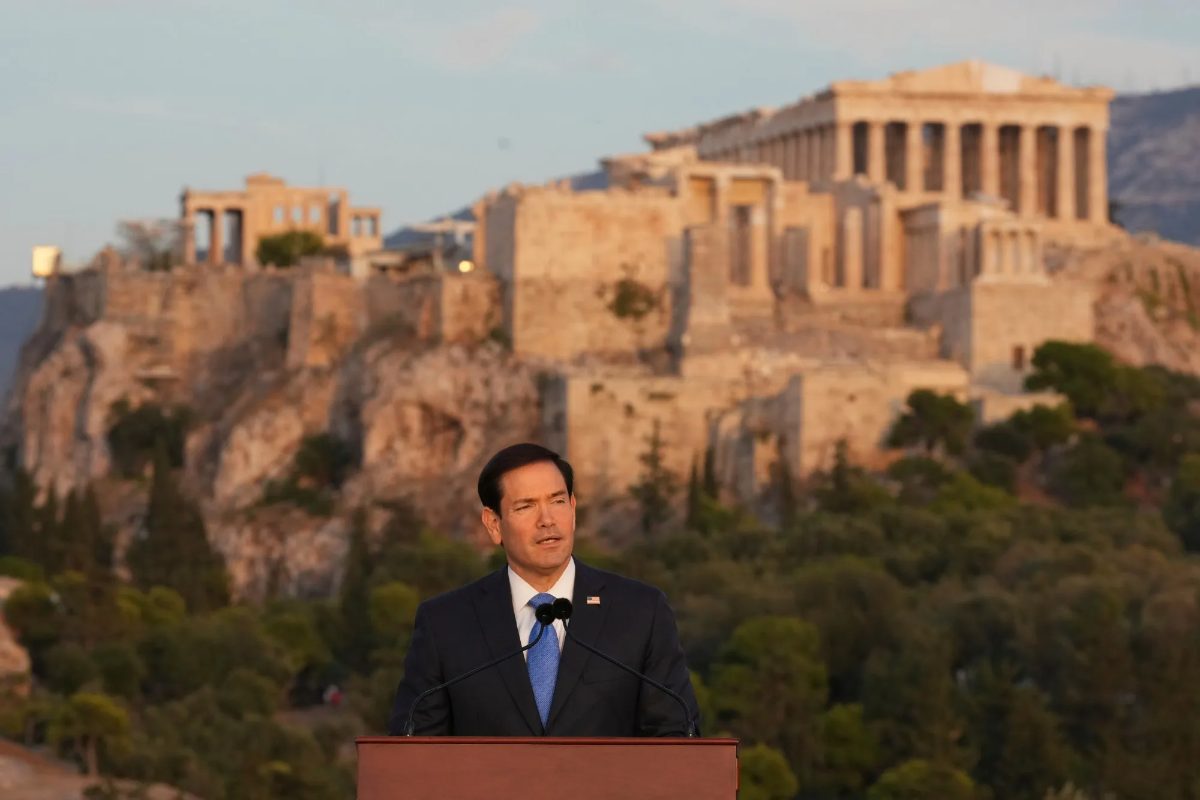
Secretary of State Marco Rubio delivered a speech at the Pnyx in Athens, with the Acropolis as its backdrop, declaring the West at "an inflection point" and calling on Europe to "awaken from its long slumber and rekindle the fire that was lit here millennia ago."

Answer from Mary's digital twin. Checkmark turns Green once she confirms it.
 spio.com
Highlights
- The West at a crossroads. "We are at an inflection point… not only in the history of my nation but an inflection point in the whole of our civilization," Marco Rubio said. He warned, "Either we choose to act now, or lose the choice to act at all," pointing to "new competition between great powers again" and "vulnerability, aggression, terrorism, a whole universe of new threats."
- Greece as America's inheritance. Rubio declared that "Athens gave us democracy," that "Plato and Aristotle gave us Western philosophy," that America's "ideas of law, of virtue, of citizenship and republic and government were shaped in the Greek city-states," and that "even much of our political vocabulary, words like democracy, tyranny, the word politics itself, found its origins here."
- The qualities of Western civilization. He described the qualities that define Western civilization as "the fire of passion, strength, courage, pride," celebrating its ambition, nationalism and relentless pursuit of excellence, and warned that the West has become ashamed of the very things that make it great.
The shame narrative. Rubio argued:
"Over time, we in the West came to feel ashamed of the very things that made us exceptional. We felt embarrassed that our achievements set us apart from the rest of the world. Our prosperity somehow became a source of guilt. We no longer believed we deserved and had earned our greatness. The word 'nationalism' became a dirty word. And so we tore down our monuments; we condemned our own history."
- Pursuit of national power. Rubio took aim at open borders and globalism, saying: "We opened our borders and outsourced our industry and allowed our militaries to wither and to decay." He also said, "We in America have no interest in being polite and orderly caretakers of the West's managed decline."
- Greece as a model ally. He praised Greece as having "proved themselves once again to be an indispensable friend to Europe and to the United States alike, on everything from energy to migration to defense, where Greece has been a model ally," and said it is "our sincerest hope that all of Europe will follow your example."
- A call for Europe to rise. Rubio said he saw "encouraging signs" in Europe, with "skyrocketing defense spending, a flurry of new partnerships and programs, expanded manufacturing and production," and expressed the belief that "Europe can awaken from its long slumber and rekindle the fire that was lit here millennia ago."
Priorities
- Rubio called for a new era of joint power between the U.S. and Europe, urging allies to "awaken from their long slumber and rekindle the fire that was lit here millennia ago."
- He pointed to the U.S.-Greece model on "defense partnerships, in energy, in technology" and "our shared ambition to secure Europe's borders from the threats of mass migration."
- He cited a new agreement between the United States, Denmark, and Greenland as a vision of this cooperation in action, "an agreement that will reshape the Arctic and bolster the security of all of NATO," arguing all three emerged victorious and that "all of Europe and NATO and the United States emerge safer, stronger, and more secure because of it."
- He argued against "enlightened foreign policy" that prioritizes "the global community over one's own people," invoking the men of ancient Greece to defend loyalty to the nation and fighting "to defend its interests above all else."
In his own words
On the Acropolis as a living symbol:
"There are great ruins all across the world. In many cases, they are places where history seems to have exhausted itself: remnants of distant cultures that have long passed beyond living memory. But the Acropolis is different."
On America's inheritance:
"Two and a half centuries after the founding of the American republic halfway across the world from where I stand now — I stand here today as the Secretary of State of that republic, and a great-grandson of settlers who arrived in the new world from Spain — I stand here to testify to a debt that no lapse of time, no distance of space can ever extinguish."
On Western character:
"The greatest Americans of every generation have carried the unmistakable features of their forefathers — born in Athens, formed by Rome, baptized in Christendom, hardened in the furnace of medieval Europe, endowed with the English genius for liberty, and then carried across the Atlantic to be reborn on the shores of a new world."
On the Federalist Papers:
"Many people are surprised to learn that the most commonly cited author in the Federalist Papers was not an Enlightenment philosopher or political theorist. The most commonly cited author in the Federalist Papers was Plutarch," Rubio said.
On the inflection point:
"We are at an inflection point — an inflection point not only in the history of my nation, but an inflection point in the whole of our civilization. The threats we face today are every bit as real as they were on the dramatic stage of antiquity."
On alliance:
"Though passions may, at times, have strained the bonds of affection between the United States and Europe, it must not be allowed to break them. Together, we must strengthen an alliance capable of confronting threats of our age."
Worth knowing
The speech was delivered during Rubio's official visit to Greece in the framework of the 6th Strategic Dialogue between the two countries. The address landed at a defining geopolitical moment, as NATO allies race to meet historic new defense targets, war grinds on in Eastern Europe, and Washington's relationship with its European partners remains volatile. The Pnyx, the hill where Rubio spoke, is literally the ground where Athenian citizens once held democratic assemblies, giving the setting its own symbolic weight.
Critics noted his speech celebrated power and strength while overlooking what they called the revolutionary idea of universal rights.
Watch and read the full speech
 Watch the speech on YouTube
Follow-ups

There's a bigger story here.
Join the conversation on CEEK where people are thinking through what civilizational identity means for the builders of today. CEEK is a creator platform with daily posts and a community of people work
Join me on CEEK
Comments
Comments are public. Links are removed.