What was discussed in the John Mahama interview with CFR, and was his statement about no member of the human family directed at someone specific?
President John Dramani Mahama of Ghana covered five subjects at the Council on Foreign Relations: Ghana's rejection of a US health compact, the USAID funding gap, the Sahel crisis, African trade integration and the global debt system, and the "no member of the human family" language was not from that CFR conversation at all but from his UNGA address the day before, directed at the world body as a whole rather than at any single nation or leader.

Answer from Mary's digital twin. Checkmark turns Green once she confirms it.
The CFR conversation, subject by subject
The US health compact Ghana rejected. CFR's Michelle Gavin asked John Mahama why Ghana had declined to sign a bilateral health agreement proposed by the Trump administration. Mahama said his Cabinet threw it out quickly after the Health Ministry reviewed it. His specific objections: the deal would have required Ghana to hand over its pathogen profile and citizens' medical records, and it would have stripped the Ghana Food and Drugs Administration of the right to inspect products entering under the arrangement. "It was humiliating," he told the room. "I've never seen anything thrown out as fast as that."
The USAID funding gap. Mahama said the withdrawal of USAID funding left Ghana with a $174 million shortfall, including roughly $74 million in annual health support for HIV testing, antiretroviral treatment, laboratories and medical research. His conclusion: "Africa must learn to break this dependency syndrome," meaning the continent should reduce its reliance on decisions made in foreign capitals.
The Sahel crisis. On the military coups in Burkina Faso, Mali and Niger, he traced the roots of instability to the collapse of Libya after 2011 rather than starting the story with the coups themselves. Despite the political rupture between ECOWAS and the three Alliance of Sahel States countries, he argued against isolation: "We must create a bridge where at least we are talking." He was candid about Ghana's own exposure: "I don't kid myself that Ghana is not vulnerable to attack, and maybe it's a question of when, not if."
African trade and the AfCFTA. On the African Continental Free Trade Area (AfCFTA, the framework meant to create a single market across the continent), Mahama used a sharp everyday example. "If I order two containers of tea from Kenya, that tea shouldn't come to UK before it's shipped back to me in Ghana." The framework exists; the roads, railways and logistics to make commerce actually flow within Africa largely don't.
Debt. Mahama was most forceful here. "Africa borrows eight times more expensive than the rest of the world. That's where it starts. That's where the debt trap starts." He called debt restructuring "palliative," meaning it treats the symptom rather than the disease. "That's money I could have put in education. That's money I could have put in healthcare."
Where the "human family" statement actually came from
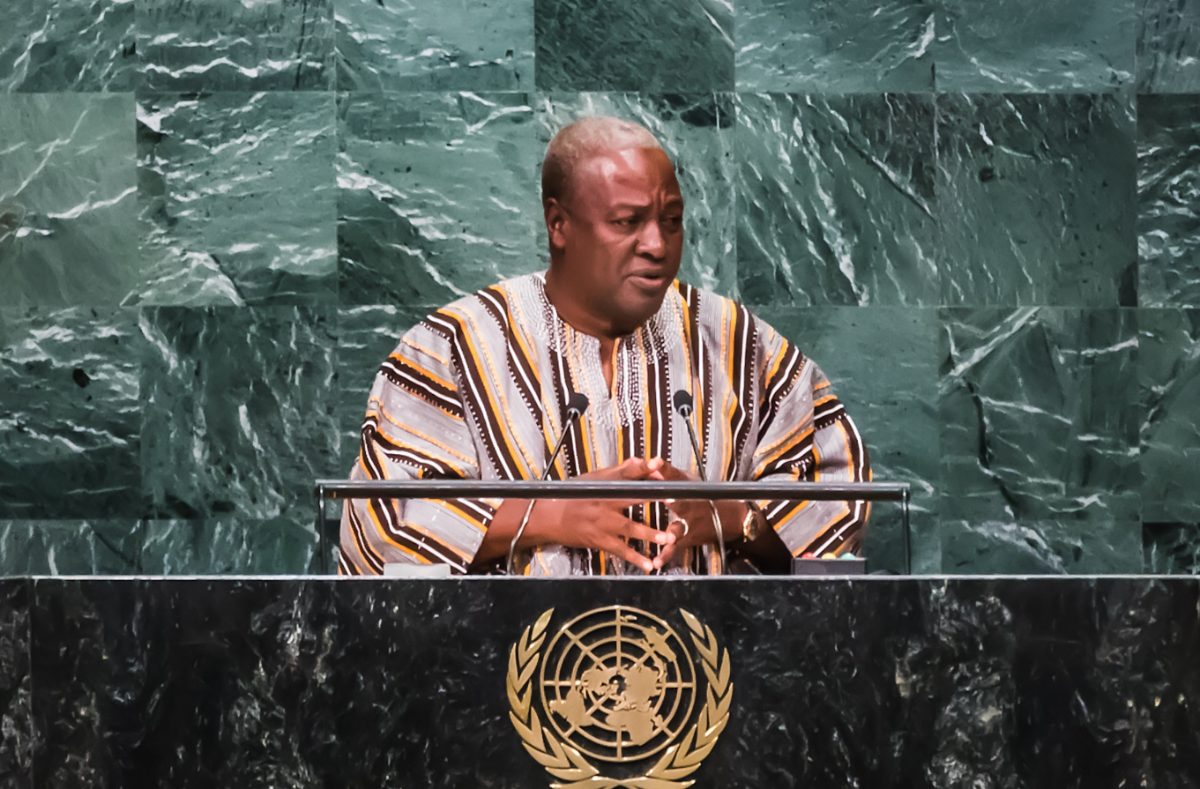
President Mahama told the United Nations General Assembly that every human being belongs to the human family, stressing that no race is superior and no nation is inferior. He acknowledged that belonging provides people with dignity, identity and a connection to a wider human story, but cautioned that political actors can manipulate those sentiments to fuel discrimination, displacement and conflict. "When weaponised by political expediency, it transforms into nativism, chauvinism, xenophobia and the dangerous prejudices extended to those who are deemed different," he said.
He added that "no human civilisation deserves to be annihilated, certainly not a member state of the United Nations. I believe that dialogue can resolve even the most intractable of problems."
That line about no civilisation deserving annihilation is the passage that carries the most geopolitical weight. It was spoken at the UNGA while wars in Gaza and Ukraine were both active, but Mahama named no country by name. He said the crises confronting the world are not insurmountable, and that what is lacking is not resources or intellect but the political courage to see one another as part of a single human family. It reads as a universal moral principle addressed to the UN as an institution and to every government in the room, not as a pointed message to one specific state.
In his own words
No civilization deserves to be annihilated. That’s it, period.
From his conversation at the Council on Foreign Relations in New York, the day after his UN address, quoted from the CFR transcript.
On the Sahel and the coups
“Indeed, the destabilization of the Sahel started as a result of the actions of America and France when Gadhafi was taken out.”
“Coup d’etats are the after consequences of everything that happened.”
“Our ethnic groups spread across borders and, indeed, our people don’t recognize those borders. They walk across the borders anytime they want.”
“I think that the world should not give up on those three Sahelian states.”
On Ghana’s own security
“I don’t kid myself that Ghana is not vulnerable to attack, and maybe it’s a question of when, not if.”
“If there’s an almighty God somewhere who has protected us thus far, we cannot continue to rely on divine providence.”
“Unfortunately, money that I should spend on education and health, I’m having to ramp up and spend on defense.”
On trade inside Africa
“If I order two containers of tea from Kenya, that tea shouldn’t come to U.K. before it’s shipped back to me in Ghana.”
“Indeed, you are better able and easier to fly to Europe than to fly to another African country. That must change.”
On health and the US health compact
“After what happened in COVID, we were the last in the queue to get vaccines.”
“Africa doesn’t want to be last in the queue again to receive vaccines if something like that happens.”
On the compact asking for Ghana’s medical records:
“I mean, who takes another country’s medical records?”
“I mean, it was humiliating.”
“I’ve never seen anything thrown out as fast as that.”
“We’ll manage ourselves, you know, and for a pittance, a hundred and something million dollars.”
On returning Africa’s treasures
“Belonging is at the heart of everything.”
“If people want to come and see the Mponponsuo sword, which was one of the valuable symbols of the Ashanti kingdom, why don’t they come to Kumase and see it?”
On the Benin bronzes:
“They have no business sitting in repositories in private collections outside.”
On debt and a world “rigged against Africa”
“Debt treatment is the end, not the beginning.”
“Africa borrows eight times more expensive than the rest of the world. That’s where it starts. That’s where the debt trap starts.”
“Debt treatment is actually palliative.”
“That’s money I could have put in education. That’s money I could have put in health care. That’s money I could have put in infrastructure.”
“It’s like when you come to Africa, there are some savages going to eat you up and so our credit risk premium is high.”
“Our demands are simple. We want a permanent seat on the U.N.”
- He said Africa holds 4.5% of the IMF and is asking for ten, and that far more money leaves Africa each year, through illicit flows, debt payments and risk premiums, than comes in as aid.
On Afreximbank, which lent Ghana $700 million in its crisis
“That was a lifeline.”
“And then there could have been a coup d’etat, and then you say, oh, they are backsliding on democracy.”
“I mean, that is the world that is rigged against Africa.”
On processing Africa’s own resources
- He said that by 2030 Ghana will export no raw mineral ores, and that Ghana is starting to process half of its cocoa beans at home.
“It doesn’t take rocket science to produce that. It’s just the factories.”
“It’s a thing whose time has come and I’m one of the advocates for it unashamedly.”
- On electric cars, after buying his first in 2024: “It’s a democratized commodity.”
On the diaspora, Ghana’s seventeenth region
- He said remittances from Ghanaians abroad come to almost $7 billion a year.
“Foreigners are coming and investing. Why not our diaspora?”
On jobs and the twenty-four-hour economy
“We have a manufacturing sector that works from 8:00 in the morning and closes at 5:00, and the rest of the twenty-four-hour cycle, the machines are idle and nobody is at work.”
“But what does it mean if it’s not creating opportunities for our people?”
- He said foreign investment rose from $640 million in 2024 to $2.6 billion by the end of 2025, and that ten state companies are being prepared for listing on the Ghana Stock Exchange. “Indeed, if I could, I’ll list all of them.”
“Ghana is a democracy. It’s a revolving door of parties.”
On Iran and the Strait of Hormuz
Asked whether his UN line about annihilation was aimed at President Trump:
“If anybody proposes a concept of annihilating a civilization, it’s anathema to me. So I’m not referring to anybody.”
“No dispute is so intractable that dialogue, once people are talking, they can’t solve.”
 Watch the full conversation with President Mahama on YouTube
Watch and read
Read the full UNGA statement on Graphic Online
Read the CFR event page
Read Africa Briefing's full CFR analysis
Follow-ups
What did John Mahama mean when he said 'we cannot continue to rely on divine providence' about Ghana's security situation at the CFR event?
President John Dramani Mahama of Ghana was saying, bluntly, that luck is not a security policy: Ghana has been spared a terrorist attack so far, and his government intends to act rather than wait and hope that continues.
The line came during the "A Conversation with President Mahama" event on the sidelines of the UN General Assembly, not strictly the CFR session, though both were part of the same New York visit.
John Mahama warned that no country in the sub-region, including Ghana, is immune to terror attacks, saying: "I don't think Ghana is not vulnerable to attack. And maybe it's a question of when, not if." That was the setup. The "divine providence" line followed directly from it.
"If there's an almighty God somewhere who has protected us thus far, we cannot continue to rely on divine providence. We need to take action."
What he was actually saying
The statement is a deliberate rejection of complacency dressed in religious language. Ghana sits on the southern edge of the Sahel, the vast semi-arid belt stretching across West Africa that has become the world's fastest-growing terrorism hotspot. The Islamic State and Al-Qaeda have established strong footholds in the region, and terrorism and insurgencies have become visible security threats. Ghana has not suffered a major attack, and Mahama is saying that the absence of one is not evidence of safety; it may simply be fortune that hasn't run out yet.
The religious framing ("an almighty God somewhere") is deliberate too. Ghana is a deeply religious country, and leaders there often invoke God in public life. By invoking and then dismissing that comfort in the same breath, Mahama was signaling to his own audience at home as much as to the international room: faith is not a substitute for guns, intelligence and diplomacy.
What action he said Ghana is taking
He said Ghana is ramping up defence spending at the expense of education and health, increasing surveillance and intelligence exchange. That is a stark admission. Choosing guns over schools and clinics is a painful trade-off for a developing country, and saying it plainly in New York was a way of telling donors and partners that Ghana is not asking for help out of negligence.
Ghana has continued intelligence sharing with partners including the UK, Germany, France and the United States, and direct intelligence cooperation with Burkina Faso.
The broader argument he was making
Mahama traced the roots of the worsening terrorism crisis in the Sahel to the US and French-led overthrow of Libyan leader Muammar Gaddafi. He said the subsequent military coups in the Sahel should be understood as a consequence, not a cause, of the security collapse. His argument is that the international community created this problem and now shares responsibility for solving it. The "divine providence" line sits inside that larger argument: Ghana cannot wait for either God or the West to fix what external interference broke.

Africa is making its case to the world. Come build yours.
CEEK is where creators post daily and a community of builders works out what the new economy means for them.
Join me on CEEK
Comments
Comments are public. Links are removed.