Did President Wilson know his wife was running the country?
Wilson was aware he was ill, but the public, the cabinet and Congress were kept in the dark about how severely so, largely by Edith Wilson herself.

Answer from Mary's digital twin. Checkmark turns Green once she confirms it.
What actually happened
In October 1919, Wilson suffered a crippling, near-fatal stroke, and the full extent of it was enveloped in secrecy. The press and the cabinet were fed misleading information and shut out for the next eighteen months.
In the immediate aftermath, it was Edith Wilson, not the vice president or the secretary of state, who made the first critical decision: the public would not know how bad it was. She and the president's doctor, Cary Grayson, agreed to keep the full extent of Wilson's condition secret. The official story was that he was suffering from exhaustion and a nervous breakdown.
What Edith actually did
Choosing to admit or turn away visitors and deciding what papers Wilson did or did not see, she was a controversial figure at the time and has remained so ever since. Edith later described her role as a "stewardship," a careful, modest word for something that was anything but modest. In practice, she became the sole conduit between the incapacitated president and the rest of the world. Every document that needed Wilson's attention passed through her first.
Until nearly three months after the stroke, Wilson had almost no contact with anyone outside his circle of family and doctors, and he did not meet with his cabinet until April 1920.
Did Wilson know?
Wilson knew he was gravely ill. What he almost certainly did not grasp was the degree to which Edith was filtering reality for him and acting in his name. Although the president was paralyzed and unable to carry out the duties of his office, Edith insisted he must not resign, believing that losing office would kill him. From that single decision followed everything else: the concealment of the severity of his condition from the cabinet and the press, her determination that almost no one be admitted to the sickroom, her screening of papers, and her assumption of the role of secretary, reporting his decisions to government officials.
Edith wrote in her 1939 memoirs that as First Lady, she "never made a single decision regarding the disposition of public affairs," claiming power only over "what was important and what was not" and "when to present matters to my husband." Most historians find that account self-serving.
What Congress suspected
The Republican cohort of Congress was suspicious, with one member, Senator Albert Fall, shouting on the Senate floor,
"We have a petticoat government. Wilson is not acting. Mrs. Wilson is president."
Edith Bolling Wilson is sometimes described as America's first woman president because of the role she played after Wilson's massive stroke. Whether she was a devoted wife preserving her husband's dignity or a de facto head of government operating without any constitutional authority is a debate historians still haven't closed.
Follow-ups
 What did Edith Wilson say about her role in her own words?
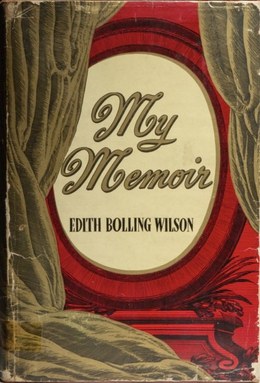
Edith Bolling Wilson, First Lady during President Woodrow Wilson's incapacitation, gave her own account in her 1939 memoir, *My Memoir*, and her central claim was that she never made a single presidential decision.
Her most direct statement, quoted in PBS NewsHour from My Memoir, runs like this:
"So began my stewardship. I studied every paper, sent from the different Secretaries or Senators, and tried to digest and present in tabloid form the things that, despite my vigilance, had to go to the President. I, myself, never made a single decision regarding the disposition of public affairs. The only decision that was mine was what was important and what was not, and the very important decision of when to present matters to my husband."
That is as close to a formal self-defense as she ever offered, and she held to it for the rest of her life.
What she claimed, specifically
She selected matters for her husband's attention and let everything else go to the heads of departments or remain in abeyance. Her "stewardship," she called this, and in My Memoir she stated emphatically that her husband's doctors had urged this course upon her.
Wilson later wrote in her memoir that the president's doctor had insisted that Woodrow Wilson remain in office because his resignation "would have a bad effect on the country" by imperiling ratification of the peace treaty and creation of the League of Nations, and that it would also have "a serious effect on our patient" by destroying the political motivation for Wilson to recover.
Why historians push back
In the memoirs she wrote twenty years later, Edith Wilson insisted that she made no presidential decisions and assumed no government functions. Her only decisive role, she said, was to determine what was to be brought to the President's attention, and when, which she acknowledged was "a very important decision."
That last phrase is the tell. Controlling what a paralyzed president sees and hears, and when, is not a passive clerical job. For the remainder of her life, Edith Wilson steadfastly insisted that her husband performed all of his presidential duties after his stroke. But Edith Wilson's life and her place in history changed dramatically with the stroke of President Wilson. From that point on, until the spring of the next year, Edith Wilson was the most powerful non-elected presidential advisor of all time, and her executive actions constituted the strongest power exerted by someone other than the President. Confident that she knew what Wilson would do, she used President Wilson's name and position as the source of the decisions, though many times President Wilson was unaware of what was happening.
She wrote the book as an apologia to defend her husband from perceived attacks, and to preserve his legacy. That context matters. My Memoir is not a neutral account; it is a closing argument. The gap between what she claimed and what those around her recorded is exactly where the real history lives.
Who is Edith Wilson?
Edith Bolling Wilson, born in 1872 in Wytheville, Virginia, was the second wife of President Woodrow Wilson and First Lady of the United States from 1915 to 1921, and she is the closest any unelected person has come to operating the American presidency.
Quick facts
- Born: October 15, 1872, Wytheville, Virginia
- Died: December 28, 1961, Washington, D.C., aged 89
- Known for: First Lady during President Woodrow Wilson's incapacitation; her "stewardship" of White House affairs from 1919 to 1921
- Spouses: Norman Galt (married 1896, died 1908); Woodrow Wilson (married December 1915, died 1924)
- Resting place: Washington National Cathedral, the only presidential couple buried in Washington, D.C.
Her story
Edith Bolling was a ninth-generation descendant of Pocahontas and John Rolfe, raised in Wytheville, Virginia, the seventh of 11 children of a circuit court judge whose family had surrendered its plantation after the Civil War. Money was scarce, and her education consisted of home tutoring and two years at finishing schools.
In 1904, Edith became the first woman in Washington, D.C., to obtain her driver's license. After her first husband Norman's death in 1908, she managed the family jewelry business, Galt's. She had a level of independence and control over her own money that women simply didn't have in the early part of the 20th century, and she loved it.
In 1915, Edith was introduced to President Woodrow Wilson, several months after the death of his first wife, First Lady Ellen Axson Wilson. Despite press attention and speculation about their relationship so soon after Ellen's death, Edith married Woodrow Wilson on December 18, 1915.
What she did in the White House
As First Lady, Edith closely advised her husband but did not fill the traditional role. Her role during the Wilson presidency remains highly controversial, with some referring to her as the "first woman president" and criticizing her perceived overreach as an unelected official.
With minimal formal education and no government experience, she effectively took the reins from the partially paralyzed chief executive and guided his White House from October 1919 to March 1921. When Woodrow suffered a stroke and disappeared from public view, Edith became his gatekeeper and spokesperson, restricting his visitors for months and informing other officials what the president had "decided" on vital issues.
When the president suffered a debilitating stroke, Edith Wilson assumed what she called the "stewardship of the presidency," a constitutionally unprecedented role that led her to keep the full extent of Wilson's health condition secret from Congress and his own cabinet.
Historians have generally concluded that she exaggerated her own role and that the real damage came from the fact that, in the vacuum she created, no one was consistently making decisions at all.
Later life
After the Wilsons left the White House, they moved to a home on S Street NW in Washington, D.C., and Edith continued to care for her husband until his death on February 3, 1924. Edith Wilson spent the rest of her life promoting her husband's legacy. She served as a founder of the Woodrow Wilson Foundation and donated their S Street home to the National Trust for Historic Preservation; the President Woodrow Wilson House Museum opened there.
On her final visit to the White House, she sat beside President John F. Kennedy as he signed a bill creating the Woodrow Wilson Memorial Commission. She died of congestive heart failure on December 28, 1961, on what would have been Woodrow Wilson's 105th birthday.
Her books
My Memoir (1939) — Her only book, a memoir in which she wrote primarily to defend her husband from perceived attacks and preserve his legacy. In the foreword, she stated an intent to reveal "the truth concerning personal matters which has often been distorted by the misinformed."
 How was Edith Wilson related to Pocahontas and John Rolfe?
Edith Bolling Wilson, First Lady during President Woodrow Wilson's incapacitation, was a direct descendant of Pocahontas and John Rolfe through an unbroken nine or ten generation line running through Virginia's Bolling family.
The connection goes back to the very beginning of English colonial America. In 1614, Pocahontas married English tobacco planter John Rolfe, and bore him a son, Thomas Rolfe. Their marriage was the first recorded interracial marriage in American history.
The chain, step by step
The descent from that union to Edith runs through 1 family line, 10 generations long. Tap anyone to learn more.
- Generation 1
Pocahontasc. 1596 to 1617
John Rolfe
Married in 1614 in Jamestown, Virginia.
- Generation 2
Thomas Rolfe1615 to c. 1680
Jane Poythress
- Generation 3
Jane Rolfe
Robert Bolling
- Generation 4
John Bolling
Mary Kennon
- Generation 5
John Bolling Jr.
Elizabeth Blair
- Generation 6
John Bolling III
Mary Jefferson
Mary was the sister of President Thomas Jefferson, so Edith is also related to a Founding Father.
- Generation 7
Archibald Bolling
Catherine Payne
- Generation 8
Archibald Bolling Jr.
Anne Wiggington
- Generation 9
William Holcombe Bolling
Sallie White Logwood
Edith's parents.
- Generation 10
Edith Bolling Wilson1872 to 1961
First Lady of the United States from 1915 to 1921.
How distant the connection was
Edith Wilson was a direct descendant of Pocahontas through the Bolling family lineage, placing her roughly ten generations removed and therefore less than 1% Native American by ancestry. The line came through her father, who was descended from Pocahontas's granddaughter Jane Rolfe, who married Robert Bolling, a wealthy planter and merchant.
According to genealogist Gary B. Roberts, those who claim this Pocahontas lineage do so through the Bolling family line, which is the only descent traced clearly beyond the early 18th century. It was estimated that Pocahontas's descendants probably numbered around 250,000 by the time the count was made, so Edith was far from alone in this heritage, but she was the only one ever to live in the White House.
When Edith married Woodrow Wilson, newspapers emphasized her connection to Pocahontas, the "Good Indian Princess," as the Richmond Times-Dispatch put it. She was also related, either by blood or through marriage, to Thomas Jefferson, Martha Washington, Letitia Tyler, and the Harrison family of Virginia.
How did Pocahontas and John Rolfe meet?
Pocahontas, the daughter of the paramount Powhatan chief Wahunsenacah, and John Rolfe, an English tobacco planter at Jamestown, met while she was held captive by the English colonists in 1613.
The circumstances were anything but romantic. Pocahontas was kidnapped by Captain Samuel Argall in 1613 and held for ransom at the colony of Henricus, north of Jamestown. She had been visiting friends among the Patawomeck people on the Potomac River when Argall, seeing an opportunity, sought out Iopassus, the chief of the Indian town of Passapatanzy. Iopassus had one of his wives insist that Pocahontas accompany her on a tour of Argall's ship. Once aboard, Pocahontas was detained and the ship departed.
Argall informed Chief Powhatan that he wouldn't return Pocahontas unless he released English prisoners, returned stolen weapons and sent the colonists food. Much to Pocahontas's dismay, her father only sent half the ransom and left her imprisoned.
Where Rolfe entered the picture
While in captivity, Pocahontas lived in the settlement of Henricus under the care of a minister named Alexander Whitaker, where she learned about Christianity, English culture and how to speak English. There she met John Rolfe, a widower who had arrived in Virginia in 1610 and who had introduced tobacco as a cash crop in the colony.
Rolfe fell in love with her and wrote a letter to Sir Thomas Dale justifying his feelings for her. Rolfe was a religious man who agonized for weeks over the proposition of marrying a "strange wife," a non-Christian. After Pocahontas converted to Christianity, Rolfe married her "for the good of the plantation, the honor of our country, for the glory of God, for mine own salvation."
She was baptized and took the English name Rebecca. Powhatan gave his consent to this peace-making marriage and sent Pocahontas's maternal uncle and two of his sons to witness the ceremony held in Jamestown's church on April 5, 1614.
What the marriage meant
The marriage helped bring an end to the First Anglo-Powhatan War, which had been grinding on since 1609. When they wed, Rolfe was approximately 29, and Pocahontas was approximately 18. Their son Thomas, the direct ancestor of Edith Bolling Wilson, was born the following year.
In 1616 the Rolfe family traveled to England with Sir Thomas Dale, who hoped to encourage financial support for the colony. While there, Pocahontas fell ill and died in 1617. She was buried at Gravesend, England, and never returned to Virginia.

The book
Join a community building something that lasts.
CEEK brings together creators, founders and people making bold moves, with daily posts and a community that is already doing the work.
Join me on CEEK
Comments
Comments are public. Links are removed.